Friday, March 4, 2011
Keaton v. Chaplin v. Lloyd
You can guess a lot about a person if you know their favorite silent film star. People who pick Harold Lloyd probably don’t much care for messy emotion. Fans of Charlie Chaplin are all about emotion. And people who love Buster Keaton favor subtlety.
The three longtime rivals compete again at this Saturday’s Silent Clowns series, and for my money Buster still outshines the other two, even though the film being shown is his first and one of his least favorite.
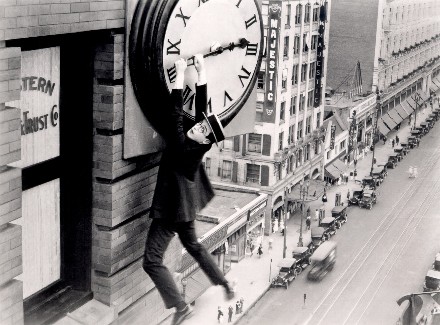
Lloyd is the featured star this month, so two of his two-reelers are showing. Both are from 1920, during the time when he was playing the gangly, glasses-wearing 98-pound weakling you’ve probably seen on that famous clock picture. In High and Dizzy, he’s a newly minted doctor, which gives him an excuse to start off in the first of a series of classic vaudevillian settings (doctor’s office, hotel lobby…) and set-ups (getting chased by a cop; walking on a dizzyingly high ledge …). He’s a likeable loser, but the film feels more like a series of gags than a narrative and some of the gags are overly familiar, though they’re all nicely executed.
A coherent story with a more original set-up, Lloyd’s Number, Please is far more engaging. As Harold vies with a gigantic rival for the girl of his dreams, his frustration takes on real welcome emotional weight, and his protracted battle with that newfangled contraption, the telephone, contains some memorably spiky bits, like the sassy switchboard operator who snaps back when Harold complains about all the calls she misdirected.
Chaplin’s The Pawn Shop sidesteps the maudlin self-pity his duck-walking tramp sometimes displays, but it unfolds at a leisurely pace that slows to a painful crawl. This time, the tramp is a hapless clerk in a pawnshop. Ringing variations on just a handful of bits, Chaplin repeatedly sets up a situation and then plays it out to the nth degree. When the clerk holds his feather duster in front of a fan while it blows off all the feathers, making the room more of a mess than it was when he started to clean it, he seems more clueless than clumsy as he stands with his arm out, waiting – and waiting – for the gag to play out.
The film plays with contrasts, often shifting on a dime from the hectic slapstick of the clerk’s constant battles with his coworker to the calm they feign when the boss checks in on them. Chaplin’s love of contrasts and mining a gag converge in the film’s best bit, where a customer who cons the clerk by spinning a phony sob story is followed by an honest man with a clock to pawn and the newly wised-up clerk checks the clock out so thoroughly he ruins the thing.
Buster’s The High Sign was the first film he conceived and shot on his own, though he held off on releasing it for a while, convinced it was “ordinary,” according to biographer Marion Meade.
To which I can only say: In what universe? True, The High Sign is constructed from a lot of familiar parts – including an oceanside amusement park that looks just like the one in Number, Please – but the familiar bits are tossed off with deadpan understatement and the narrative is tidily constructed.
Buster plays a drifter thrown off a train who looks for a job and finds one—along with plenty of trouble. Each bit builds on the last, and every setup leads to a satisfying payoff – except when it doesn’t because our expectations are being subverted. Nods like that to the audience make his films feel very modern, as does the streamlined editing. Buster never lingers on a setup or underlines a point by mugging. He just shows us something funny and moves on, assuming that we got it.
The film finds some imaginative ways to convey information without resorting to title cards, including an ultimatum letter to the wealthy August Nickelnurser, who Buster’s boss and his gang are trying to blackmail (“Unless you come across today, the first of September will be the last of August,” they warn.) And he sets up a couple of the complicated extended sight gags he was so good at, including the beautifully timed blend of gymnastics and slapstick he uses to fend off the gangsters in Nickelnurser’s house. The cameras sometimes pulls back during that sequence to show all four rooms of the two-story house in dollhouse mode, the façade pulled off so we can watch Buster pour himself in and out of windows, up walls, and through transoms and trapdoors, gracefully knocking off the bad guys as he goes.
Written for The L Magazine
Thursday, March 3, 2011
Rango
Like the kids sitting near me in a crowded all-media screening of Rango, I came in hoping to be transported and left in stunned silence. Gore Verbinski is making much of how his first animated feature is different than anyone else's, but it feels like every other reflexively meta, smugly ironic, pop culture-studded cartoon movie with a cut-and-paste plot and a tediously hawked moral.
Rango is the first full-length feature done by Industrial Light and Magic, which turned out to be ready for its close-up. The landscape and lighting are beautifully rendered, just exaggerated enough to feel almost real (while registering as a pungent distillation of nearly every Western scene you've ever seen onscreen), and its dramatic simulated camerawork, like the "crane shot" that whooshes us skyward with a hawk, does its part to amp up the excitement. That hawk is good for some just-scary-enough yet slapstick chase scenes, and a gigantic rattlesnake pushes the scary up a notch or two, coiling itself into a scene almost as ominously as the basilisk in the latest Harry Potter movie. There are some nicely playful little touches, too, like when Rango—a chameleon who's just another frustrated actor/director until his terrarium falls out of the family car in the middle of the Mojave Desert and he finds himself starring in a real-life Western—comes right up to the screen and his breath fogs the lens of the imaginary camera we're looking through.
But Verbinski's penchant for piecing together movies from shards of pop culture clichés overshadows everything else. Rango gets its main theme ("Control the water and you control everything") and villain from Chinatown, its Greek-chorus musicians from Cat Ballou, and its subtlety from Three Amigos. Also in the mash-up are undigested lumps of classic Westerns-Sergio Leone's Man with No Name movies, Lawrence of Arabia, The Road Warrior, and High Noon, to name just a few—plus a couple of one-offs, like Fear and Loathing in Las Vegas (a nod to Johnny Depp, who does the voice for Rango).
Verbinski says he made the movie for "the child within," but Rango crams in too many homages and grown-up jokes (prostate exams? Really?) to keep the child without wholly entranced, while its toddler-level storyline is too obvious for adults. And a couple of overlong chase scenes are likely to tire people of any age, since they try too hard to mimic live action instead of making use of the blank screen animation offers to creative minds.
As in Verbinski's Pirates of the Caribbean franchise, Depp is the biggest pearl in a rotten oyster. Rango's scaly skin makes him the most realistic-looking of the animals in the film, and Depp's walk-in closetful of voices inspire a wide range of expressions and postures that make the little green guy pretty endearing. The other actors do good voice work too, but the characters they play are more stereotypical: the cute female lizard Rango falls for on sight (Isla Fisher), the slinky bad girl who's literally a fox (Claudia Black), the Walter Huston-like old coot who plays spoons and speaks in homilies (Alex Manugian), etc. They're less expressive physically too, some suffering from that stuffed-animal look of the early Stars Wars characters.
But the worst thing about Rango is its cynicism. It's bad enough to smother our hope of seeing something truly new and imaginative, but do you really have to do it while flakking a generic "Keep hope alive" message?
Written for The L Magazine
Wednesday, March 2, 2011
Our Brand Is Crisis
Just as the news about populist uprisings across the Arab world brings uncomfortable reminders of our government’s ties to the despots involved, a 2005 documentary shows us how American businesses can meddle in other country’s politics, gaming the democratic process in the name of democracy.
Our Brand is Crisis follows a K Street political consulting firm as it engineers Bolivia’s 2002 election, winning a second shot at the presidency for Goni (Gonzalo Sanchez de Lozada), a U.S.-friendly businessman. As the film informs us, Goni privatized state-owned resources and welcomed foreign investors during his first term in office. That was a controversial move, and it became even more of a political lightning rod when his successor sold the rights to the country’s water to foreign companies, which then began charging exorbitant rates. When he ran again in 2002, Goni was part of a field of 11 candidates that included current president Evo Morales, a former coca farmer who was then consolidating power behind his promises to nationalize the country’s resources and redistribute some of the wealth to the poor.
Filmmaker Rachel Boynton opens with harrowing footage of the deadly rioting that broke out soon after Goni began his second term, after he announced plans to export Bolivian gas to the U.S. and Mexico despite a shortage within the country itself. Then she takes us back to the beginning of his campaign, showing how he won.
Goni’s consultants are Greenberg Carville Shrum (the Carville was Clinton war room general James Carville), a group of seasoned DC kingmakers who used expertise they’d gained in this country to run political campaigns abroad. As Jeremy Rosner, the firm’s main representative in Bolivia, puts it, GCS specializes in “progressive politics and foreign policy for profit…. We believe in a particular brand of democracy – market-based democracy.”
The group treats Goni like any other product in need of marketing. They run focus groups, probing for information on how people see the candidates and what they want from their leader. They create messages and taglines (the film’s title comes from the organizing principle they develop for the campaign). They choose a campaign color – pink, which is supposed to make their man seem warmer. And they come up with ways to undermine the competition.
The message from those focus groups is clear: most Bolivians see Goni as arrogant and out of touch, loyal not to them but to his wealthy peers in other countries. But if the candidate is arrogant, his consultants are no better, remaining stubbornly convinced that they know what’s best for Bolivia, regardless of what Bolivians may think.
Boynton shows both candidate and consultants insulated from reality in their swanky environments. She often films from a distance, to emphasize the locked iron gates, the long polished tables, and the uniformed servants silently toiling away in the background, but she can get surprisingly close when she wants to. She’s at the strategy meeting where one of the consultants tells Goni it’s time to go negative on his main opponent – but through an outside group, so they can deny any connection to the attack. She’s in the room when Goni’s campaign manager snipes at the consultants, blaming them for the candidate’s eroding numbers. And she gets a carelessly candid Carville to chortle about how clients think he has “some kind of silver bullet” – and explain how he capitalizes on that myth.
Asking keen questions from behind the camera in her soft, unthreatening voice, Boynton quietly builds a damning case against her subjects. GCS’s campaign can’t hide Goni’s sense of entitlement or his cavalier dismissal of popular concerns, which turn off so many voters that he just barely wins office in a runoff, then he flees a year later, defeated by death threats, strikes, and bloody showdowns in the streets.
In the end, the firm’s self-created mandate to export its favorite brand of democracy to other countries just looks like one more form of arrogant self-interest: imperialism in a “progressive” mask.
Written for TimeOFF
Wednesday, February 23, 2011
Barney's Version
Another in a growing subcategory of films that ask us to empathize with men who behave like sociopathic children, Barney’s Version is about a boorish, alcoholic, secretly self-loathing Jewish-Canadian producer of schlock TV who falls for a cool shiksa goddess the moment he meets her – at his second wedding, yet.
Barney (Paul Giamatti) remains smitten with Miriam throughout their improbable 20-plus-year marriage and for the rest of his life, and though I can believe that (she’s written as a saint and played by the gravely soulful Rosamund Pike), I couldn’t for the life of me figure out what she saw in him. As their own son puts it, after Barney finally drives Miriam away by breaking the one rule she asked him to honor: “How could you fuck this up? She deserved so much better than you.”
Barney’s Version toggles back and forth in time, from Barney’s descent into the fog of Alzheimer’s as a cranky alte kaker to his youthful stint in Rome, where he knocks around with his glamorous his best friend, Boogie (a nicely slippery Scott Speedman), and picks up the first of his three wives. Giamatti gains and loses years far more effectively here without the use of CGI than any actor I’ve seen with its help, so I was glad to see the makeup in this movie was nominated for an Oscar.
But they didn’t do such a great job on the story and characters. Director Richard J. Lewis has worked for years in TV (most recently at CSI: Crime Scene Investigation). That may explain the airless, soundstage feel of the film, which feels more like a succession of scenes – some of them more like bits – than an organic and emotionally effective story. I get that Barney has misspent his life, but this movie makes it feel more like he barely lived at all.
Cutting briskly from one set piece to the next, including far too many conversations in restaurants or dining rooms, Barney’s Version plays like a mediocre TV dramedy. There are the cheap shots at caricatured characters, like Barney’s second wife, a nameless Jewish-American princess bravely brayed by Minnie Driver, who calls her mother from her honeymoon in Rome to dismiss the Vatican (too old) and kvell over the hotel soaps. There are the tepid running jokes, like the one about the aging star of the soap opera Barney produces who clings to the Bulgarian press clips that prove her “international appeal.” And there’s the badly written shtick straining too hard for the punchline. At yet another dinner-table conversation, Barney’s snooty second father-in-law asks Barney's warmhearted, blue-collar father (Dustin Hoffman at his most elfin) if he abused the people he arrested when he was working as a cop. “Are you saying you were gratuitously violent with suspected felons?” the father-in-law harrumphs. “Oh, no,” says dad. “I always got paid."
Pike is dignified and sympathetic, as always, though she seems almost sedated (maybe that explains why Miriam puts up with Barney?), but Hoffmann and Giamatti crank up the charm to a manic degree, lasering folksy-father and gruff-but-loveable-cuss rays at us like drunks taking aim at a dartboard.
Every now and then, usually in an exchange with his father or Boogie, we glimpse a smart, sardonic, loyal and ultimately loving Barney you can imagine people being drawn to. The rest of the time, you just wonder why anyone should waste their time on him.
Written for TimeOFF
Monday, February 21, 2011
Film Comment Selects 2011: The Karski Report
When people ask whether the Allies could have done more to save Europe's Jews from Hitler during WWII, the conversation usually turns to who knew what when, or why some military maneuver would not have been possible. The Karski Report casts that question in a whole new light.
The problem, says Polish resistance hero Jan Karski, is that the Allied leaders were incapable of grasping the nature and extent of the horror of the Holocaust when it was unfolding, since nothing remotely like it had ever happened. "Healthy humanity, rational humanity who did not see it with their own eyes, they could not handle it," he says. In fact, adds Karski, in a 1978 interview Claude Lanzmann conducted for his nine-and-a-half-hour masterwork Shoah, even he can no longer "handle" the thought of what he saw, after 35 years in the U.S.
Karski was a courier between the exiled Polish government in London and the resistance in Poland during the war, repeatedly risking his life to get into places like the Warsaw Ghetto and a feeder camp to the Belzec concentration camp, then returning to England to tell the exiled Polish leaders what he had seen. On one of those trips, he was asked to go to Washington, D.C. and tell his story to President Franklin D. Roosevelt. FDR then sent him on to Supreme Court Justice Felix Frankfurter, a close advisor to the president. What Karski told these two powerful men and how they reacted to his news is the hinge around which this story revolves.
Lanzmann's original interview lasted two days, but he included only a small part of it—Karski's description of the Warsaw ghetto—in Shoah. He released this 49-minute film last year to counter what he called the "falsified history" in a novel about Karski that had been published the year before. One of three films Lanzmann has made from the scraps on Shoah's cutting-room floor (the others are Sobibor, October 14, 1943, 4 P.M. and Un Vivant Qui Passe), The Karski Report has no distributor, but it's playing as part of Lincoln Center's 2011 Film Comment Selects series.
The title refers to the recitation Karski made so often to Allied leaders, reeling off horrendous facts in a rote recitation. "At that time, I was a machine. I was a report," he says, and the powers of observation and memory that suited him for that task are evident. Speaking precisely and deliberately for the "archive" he says Lanzmann is creating, he mimics speech patterns ("The Allied nations are going to win this waaaaar. No more WAAAARS!" he quotes FDR as saying) and body language. He even stands up at one point, gesturing broadly to show how Frankfurter rejected the news.
Karski's job was to report facts, not to question them, and he doesn't claim to know what was in the minds of FDR, who he describes as a great leader and whose presence clearly awed him, or of Frankfurter, who also "emanate[d] some brilliance." But he speculates that FDR sent him on to a long list of Jewish leaders after their long audience, though he had not asked a single question about the Jews, because he cared about what was being done to the Jews but thought it was "outside his jurisdiction" and wanted to refer Karski to people who could help.
Whatever the reason, Karski soon found himself downloading his report to Frankfurter, a small but proud man who, he says, seemed to shrink as he listened, then said he didn't believe what he'd heard. The Polish ambassador who was serving as Karski's intermediary leapt in to defend him, insisting that he was telling the truth. "I did not say that he's lying. I said that I don't believe him," Frankfurter replied. "My mind, my heart, they are made in such a way that I cannot accept it: No! No! No!"
Shot in what looks like a living room with no-frills lighting on black-and-white stock, The Karski Report is filmmaking stripped down to one of its most basic roles: historical record. Lanzmann mostly sits silently and off-camera as Karski speaks, though he asks a trenchant question now and then and reads a brief introduction at the start, providing context for what follows. But for anyone who cares about the Holocaust—and God knows we all should—there's plenty of drama in watching Karski become a report, gravely and carefully delivering his testimony as the camera records him, sometimes from a respectful distance and sometimes moving in for a close-up that reveals the pain in his guarded eyes.
Written for The House Next Door
Friday, February 18, 2011
The Story of Temple Drake
As part of its ongoing spotlight on rare pre-Production Code films, the Spectacle Theater screens The Story of Temple Drake tomorrow afternoon.
William Faulkner dismissed Sanctuary, the novel this movie was based on, as a mere potboiler. But even Faulkner’s trash is pretty high-class, so there’s compassion as well as passion in his portrait of a bored Southern belle in the age of prohibition who plays with fire and gets charred to a crisp.
The screenplay sands off a lot of Faulkner’s rough edges—impotence, voyeurism, world-weary ending—while adding a romance between Temple and the idealistic lawyer who represents her. Southern types Faulkner knew better than to condescend to, like a simple-minded farmhand and the black servants who comment on their white employers from the sidelines, edge into stereotype in the film, and the courtroom scenes that start and end it are pretty hokey.
But there’s still plenty of grit in this salty little oyster, like the moll who puts her baby to bed in a box “so the rats don’t get it” and the bootlegger who makes Temple his sex slave, turning her out with a rape in the barn where she’s huddled for a night, far from home with her society date passed out inside. And there’s Miriam Hopkins’a fierce starring performance, which cuts right through the smoke thrown up by Hollywood’s fog machine. Hopkins, a Georgia peach with a steel-magnolia spine who always seemed to know a thing or two about flirtation and frustration, gives a nuanced, almost naturalistic performance while others around her—most notably the greasily handsome Jack LaRue, who plays her rapist, who is often photographed in lingering, leering closeups—tend to favor the exaggerated, near-pantomime style that was popular in silent movies and early talkies.
The subtly but clearly conveyed moods Hopkins cycles through, from coquettish confidence to panicky fear to near-catatonic withdrawal the morning after her rape and then a ballsy bravado that can’t quite conceal a deep reservoir of shame, make Temple a highly sympathetic bad girl. That—and the happy ending that saw her rewarded for her guts rather than punished for her fall—may explain why the Hays Code, which was just hitting its stride when The Story of Temple Drake was released, came down on it so hard.
As MoMA’s Katie Trainor explains, the Hays office gave the film its most restrictive ruling, which meant it was withdrawn after just a few screenings with no chance for re-release. Not until 2010, when MoMA screened a vintage print obtained from TCM, did it get the kind of showing Karl Struss’s creamily gorgeous noir cinematography deserves, and it still doesn’t show up much outside of the somewhat smudged and streaky version on YouTube.
The contrast between the harshness of the world Temple falls into and Struss’s elegantly framed and lit shots, Hopkins’ flawless hair and makeup and satiny gowns, and the rest of the film’s glossy surface creates a delicious tension in scenes like that one in the barn. As Temple cowers photogenically in a corner, her unseen rapist silently climbs toward her, ascending a ladder whose rungs echo the slats of noir light angling through gaps in the walls.
They don’t make ‘em like that any more.
Written for The L Magazine
Thursday, February 17, 2011
Skater with a Paintbrush: Matthew Porterfield on Blue-Collar Baltimore
Like Matthew Porterfield’s minimalistic-to-the-max first film, Hamilton, Putty Hill is a highly sophisticated yet rawly realistic portrait of mostly adolescent life in northeast Baltimore. Porterfield called in for this talk about his work from Baltimore, where he teaches film at Johns Hopkins.
Your films are about working-class people in a way that very few American movies are. Your characters are smart and self-aware, and they take care of each other in a way that working-class people do in life but not so much in the movies. Tough stuff happens – the narrative thread that ties Putty Hill together is a death by overdose – but this isn’t poverty porn; it doesn’t sensationalize or condescend. So how much were you thinking about class when you made this movie?
That’s a priority for me, sharing a picture of white working class America with great accuracy. So is portraying adolescence. Too often when we see adolescents or the working class onscreen, in working-class, second-tier industrial cities like Baltimore, it either comes across as cultural tourism or pornography, as you say. It’s, like, romantic, too lyrical. It doesn’t feel connected. Maybe that has to do with the relationship between the filmmaker and the subject. I have the privilege of making films in Baltimore in a neighborhood that I know really well. I’ve grown up there.
Class is still the big divider in the U.S. – it’s the thing we can’t get ourselves to talk about. We all think we’re divided along the lines of race, and we are: Baltimore is a very racially divided city. But I think as a nation, class is the big divider. Everybody thinks they’re middle class, but there’s such a big bracket there, and not everybody’s making the same or can afford the same amenities within this so-called middle class.
Your work, especially in Putty Hill, reminds me of directors like Jia Zhangke and Rahmin Bahrani and Laurent Cantet, who also work with nonprofessionals and collaborate with them to create an interesting mix of documentary and fiction. Another thing you all seem to have in common is being less interested in story per se than in conveying a very concrete sense of character and place and class. Do you identify with those guys?
Yeah, definitely. I do. Of the three filmmakers mentioned, Jia Zhangke inspires me the most in terms of form. I like the way he works with non-professionals, but in an aesthetically formal way. Still life is the example that jumps to mind, because it really does walk a line between documentary and fiction.
The characters in Putty Hill are all versions of the people who appear on the screen, and they were all created collaboratively. I had a very loose scenario going in, but all of the dialogue in the film was improvised. All the good stuff – all the funny stuff – the actors came up with themselves.
There’s a narrative tradition practiced by Hollywood and by the studios, the big independents, the Oscar nominees and the Spirit Award winners. There’s also – and I find it more internationally than I do in the U.S. right now – a divergent path of filmmakers who are still working in a narrative tradition. I’m not an experimental filmmaker, or a filmmaker working in the tradition of the avant-garde. At the same time, story is not at the forefront of what I do. There are other things: character, mood, environment, location, whatever.
Raul Ruiz wrote this really great essay in his first book about conflict theory. When I first read it a few years ago, I identified with it immediately and realized it was something that I’d always felt, which is that we put, as storytellers, so much emphasis on conflict that it leaves out all these other kinds of stories. As a filmmaker, I’m less interested in conflict than many. I think there are stories to tell that don’t necessarily include a strong protagonist and a strong antagonist.
And there does seem to be, all over the world, a real interest in what Robert Koehler has tagged the cinema of in-between-ness, this gray area between documentary and fiction. I feel like there are a number of filmmakers – Pedro Costa, Apichatpong, Jia Zhangke – who are making films that are trying to blend a number of elements, that are true to life, that are real, but that are also blending myths or narratives with nonfiction.
The way you sometimes break into a scene to interview one of the characters in Putty Hill felt new to me, though of course it gets done a lot in mockumentaries. Had you seen it before in a feature like this, or did you just invent that technique on the set?
I hadn’t seen it before, but now I’ve gone back and watched a couple things that did it before I did. So I didn’t invent it, but I found it for myself. My most direct point of reference was a straight documentary called Streetwise, by Martin Bell and Mary Ellen Mark. The narrative is pieced together in the editing room but anchored by these interviews that were added as voiceover. Another film I watched recently that I really liked is Apichatpong Weerasethakul’s Mysterious Object at Noon. It’s his first feature and it’s just an amazing hybrid doc. He starts interviewing a woman and she’s telling a personal story. And we hear his voice off-camera tell her to stop and tell a different story.
It sounds as if you often just feel your own way as a filmmaker and then find other people who’ve done the same thing.
Yeah. I don’t watch a lot of movies – probably not as many as I should. I guess I watch enough to draw influences off of and still stay free enough to discover stuff for myself.
Hamilton and Putty Hill were both shot right around where you grew up in, and you skated at the park where we see some of the kids in the cast. Yet you’ve got a very intellectual approach to film that is not shared by your cast, and your dad was part of an experimental theater when you were growing up, so I’m wondering how autobiographical your work is. Did you grow up in kind of an arty family? What kind of kid were you? Were you just one of the skaters or were you kind of skating and watching and making movies in your head about it all at the same time?
Both of my parents were teachers, so they put a lot of value on education. They’d both received secondary degrees themselves. We lived in this pretty blue-collar neighborhood, but they sent me to a private school that was totally on the other side of town, with kids who were really, really wealthy, so I had a really good education that did place a priority on the arts. My dad is a playwright and poet, and he’s written novels. I learned from him – not only from his creative energy and aesthetic but also his dedication and commitment to his craft. I grew up skating but also painting.
Let’s talk a little about the look of your two films, which both favor a combination of long establishing shots where you see characters in context and tighter shots where you establish character by watching people do things. You also seem to like framing scenes so you’re watching several layers of action at once. How do you work with Jeremy Saulnier, the cinematographer who shot both of your films?
First and foremost. I try to tell stories visually. I’m not really interested in telling stories through dialogue, so trying to figure out creative ways to establish space and allow motion and color and light to convey mood and emotion and character is a priority for me. Jeremy really appreciates naturalistic photography, and he has a great ability to combine light, both artificial and natural sources.
I favor wide masters or establishing shots to establish the characters in a frame that contains as much information as you can fill it with. That’s why there are often multiple planes, with things happening in the foreground and background. That’s what I like aesthetically, but it also comes out of an economic concern, in that I know that due to limited time and resources and to the ability of my actors, it’s best to cover things as best as I can in each shot. And then come in close for emotional shots.
Jeremy is so easy to communicate with now. We always spend a lot of time in advance scouting location. He feels like his job as cinematographer is to let the people and places speak for themselves. That’s really what I want, too. Both of us like nice compositions. We like evocative lighting. But we just want to figure out the combination of elements that allows the real world we’re trying to depict to speak.
Casting was important, since the characters in the film are so closely based on the people who play them. What drew you to the people you picked?
Casting is one of my favorite parts of the process. It was pretty extensive leading up to Putty Hill, because I was casting another film called Metal Gods and I needed a big cast with some strong performances from nonprofessionals. [When Metal Gods got sidelined, Porterfield quickly arranged to make Putty Hill instead, writing his treatment for some of the locals he’d auditioned for Metal Gods.] We held formal auditions, which we advertised thorough social media, people on the street – anything. I found Cody [Ray, who plays a skater with a soul patch] on MySpace – at the time it was relevant. Actually I found Cody’s brother, but he’s a twin. His brother didn’t come to the audition, but Cody came with his friend Dustin, who plays the guy who talked in his room about doing jail time. I liked the way they spoke and how they interpreted the dialogue I’d written and made it their own. They auditioned really strong for never having done it before.
Sky [Ferreira, who plays the dead boy’s cousin, Jenny] I found by reading an alternative teen magazine. I thought she was just really interesting. She had a real sense of herself on camera, of her own presence.
Spike [Charles Sauers, a tattoo artist who plays Jenny’s father] I met in a bar around the corner from where I lived. He was shooting pool. I was in the habit of asking people who looked interesting if they wanted to be in a movie, so he asked about the movie and started telling me about himself. He lived right across the street from the bar, so he was, like, a block away from where I used to live.
I loved how Spike talked about the fictional character’s drug use, about how it’s just a shame the drugs are so easy to get because of course kids that age are going to try them.
Yeah. For Spike, it’s a big part of his life since he’s a recovering addict. He’s known people who died and he came close to death on several occasions. I think the remarkable part is that he speaks about it so readily and candidly.
And intelligently. Getting back to what we were saying earlier, you don’t often enough hear in the movies a voice I often hear in life from people who have lived a hard life, learned a lot from it, and achieved a certain kind of wisdom. If people like that get portrayed as characters in a film, they usually get turned into sleazy criminals or pitiable losers or victims – it’s like the wisdom gets sucked right out of them. But Spike was very compassionate and wise. He wasn’t blaming anyone, and he knew Cory was a good kid. He understood that his death wasn’t pathological; it was just sad.
Spike’s been through a lot in 30-odd years, and he speaks about it with authority, but also with a kind of openness. He doesn’t condemn anyone. Too often in the mainstream media there’s this emphasis on what’s good, what’s bad, who’s good, who’s bad – there’s no gray areas, as there are in life. I want to remain open to these characters, who are dealing with things that are unhealthy or dangerous but have a lot of hope and positivity in their lives too.
A lot of people look at this film as a sort of hopeless vision of this community, but I don’t think of it like that. I think there’s a lot of hope built in. Because the characters, all of them, are very open to the world.
Yeah. And to each other. Definitely. I’m actually surprised that people think of it as hopeless. Do you get that a lot?
Yeah, we do. We do get it a lot. Maybe – I hesitate to say this – more international, from people who are interested in portrayals of America that are outside the mainstream. Maybe there’s less of a connection with the culture, so it seems like this bleak indictment of the situation of the working class in America. But in Latin America, man, audiences really get it. They really dig Putty Hill.
I thought the performances in Putty Hill were very strong – much stronger than the ones in Hamilton. Did you work with your actors differently in this one? How much of getting good performances from amateurs comes from casting the right people and how much from creating a safe space for them to work in and giving them helpful direction?
I feel like it’s both of those things. I think the cast in Hamilton was capable, but it was a very young cast, and I didn’t give them the attention that they needed to take risks and bring their performances to an emotional place. The other difference is that Hamilton was completely scripted, and I asked these nonprofessionals to memorize and recite lines that I’d written. Putty Hill was completely improvised. I spent more time with the cast on Putty Hill, even though we had less time to shoot. I had worked with Jeremy before and we knew how to communicate with each other better. I had a lot of confidence in my whole team, so I could direct more energy toward my actors.
I read that you made this movie for just $20,000. How does that kind of budget free you and how does it limit you as a filmmaker?
We shot it for about $18,000, but we had to double that to get through post and make it to Berlin, and then we had to get some equity to get to some other festivals and pay some deferred wages and music rights and so on. Altogether we spent under $100,000, which is still microbudget.
The thing I don’t like about working with a budget of that size is that I can’t really pay people. Some people aren’t getting paid at all, including me, and then other people are making far less than they would command on a regular shoot. So it’s really hard to continue to work with the caliber of collaborators I’d like to work with. As my friends get older, they have families, mortgages. I can’t expect them to keep working for no pay, deferred pay, or less pay than they normally make. And I’d like to pay myself.
But with a smaller budget, you don’t have as much oversight. You can go in and try something kind of wacky -- in this case, shoot a feature film with no script and work with non-professionals. As soon as you get a bigger budget, there are contingencies. Even with a budget of $250,000, you need an actor who has a name, and the more ambitious and bigger budget you’re trying to command, the bigger name you need.
And with a bigger budget there are more crew positions, so there’s more division of labor. In a film like Hamilton or Putty Hill, where you’re working with a small crew, everyone’s wearing multiple hats and willing to do anything. It feels more collaborative.
I saw John Waters’ name go by on the credits. What was his connection to the film?
He saw Hamilton when it was released in the theater and really liked it, told a lot of people about it, put it on his top 10 list for Artforum that year. He introduced me to Pat Moran, who does all the casting for him, and a number of other people in Baltimore. He’s an advocate and a friend.
You've said you want to do a Baltimore “trilogy.” What would the third film be and how would the three fit together?
Yeah, I’ve thought about it a lot. I did finish a screenplay, but I ditched it and I’m about to start another with my partner and my girlfriend, Amy Belk. It’s a scenario about a man on house arrest in Hamilton.
Would it be a trilogy just because they were all set in the same neighborhood?
Yeah. Originally, I thought it would be cool to tell a story in another part of Baltimore. The house arrest film, the one I’m thinking about now, was originally going to be set on the west side, in one of Baltimore’s predominantly African American communities.
The potential of that story told in that community seemed really promising and powerful, but then I decided that’s not a story I can tell, you know? I wish I could, but I can’t.
Interviewed for The L Magazine
Monday, February 14, 2011
Oscar-nominated Shorts
This may be the year when the long-lived boom in high-quality documentary film makes the transition from trend to entrenched institution. At least, that’s what the Academy of Motion Picture Arts and Sciences seemed to think when it opened up a new space for documentaries in the Academy Awards this year.
The Best Documentary (Short Subject) category joins Best Short Film (Animated) and Best Short Film (Live Action), offering Oscar completists and fans of short films a total of 15 nominees to catch before the Oscars air and short films vanish from theater marquees for another year.
The first crop of documentaries are all from the USA, except for one USA/Papua New Guinea coproduction. They’re all pretty somber, looking at the human costs of manmade horrors like catastrophic pollution, war, or the non-state-sponsored killings targeting a particular religious or ethnic group that seem to be the curse of the 21st century. But they manage to work in that trademark American optimism too, mostly by examining their problems through the lens of a person or group that is working to give peace, or people, a chance.
The teachers and administrators in Strangers No More run a thriving secular humanist school in Tel Aviv that welcomes traumatized teens from all over the world. They offer the kids not only a good education but a nurturing community, from which they can rebuild a broken sense of trust and hope, even find surrogate parents to replace those they have lost. They’re clearly doing the work of the angels, but the real heroes are the students themselves, who deal with the often unspeakable traumas they have suffered with dignity and grace, while shifting their focus – with the help of their teachers – from the past to the present and future.
There’s a little too much self-congratulation on the part of the teachers, and things are too often said rather than shown – generally by school staff rather than the children themselves – in this talking heads-heavy film. That diminishes its impact, though what we learn about the children’s backgrounds and what we see of their characters is so strong that it’s still very moving. But if Strangers No More doesn’t dive deep into the lives it shows, it does raise pointed questions about the millions of children who aren’t lucky enough to find a sanctuary like this. As a bittersweet exchange between one father and the school administrator points out, the basics offered here – a high school education, freedom from persecution, social acceptance – are out of reach for so many international refugees that they make even Israel look like a safe haven.
Poster Girl has the opposite problem. It homes in close on its subject, former cheerleader and National Merit Scholar Robynn Murray, as she copes with PTSD, fits of rage, and a deep sense of shame and betrayal after a tour of duty in Iraq. Director Sara Nesson makes us mourn the blighting of such a promising young life, but she doesn’t quite make the connection to the tens of thousands of other young vets coping with similar problems. The movie’s title refers to a poster of a cocky-looking Murray and a couple of her fellow soldiers in full combat gear, which the Army used to recruit other young women – but it also represents a missed opportunity. This is one movie that could have used a couple more talking heads, maybe including a psychologist or someone from one of the anti-war vet groups, to provide a wider context for the damage that was done to Murray and talk about what could be done to protect others from the same fate. As it is, Murray comes off more as a pitiable victim than the powerful voice she is trying to be for her fellow wounded warriors and the Iraqi civilians they terrorized.
Sun Come Up, the Papua New Guinea coproduction, is a competent account of the plight of one of the first groups of a whole new kind of refugee. Calm, reasonable, and saddened by the prospect of abandoning the idyllic island where their people have lived for hundreds of years, the peaceful citizens of the Carteret Islands (the islands are right next to PNG) are poster people for global warming refugees. The film follows them as they look for another home before the rising ocean, which is already flooding their fields with salt water and ruining their crops, engulfs the island altogether.
Killing in the Name highlights a Jordanian Muslim named Ashraf whose wedding party was blown up by a suicide bomber. Despite the dangers of speaking out against this form of self-proclaimed jihad, Ashraf is waging a campaign to get Muslims to speak up against suicide bombings, which he condemns as defying the teachings of the Koran. And in Warriors of Quigang, a self-taught lawyer named Zhang leads the other citizens of his tiny farming community in a campaign against the factories that are poisoning their air, land, and water. They’re fighting for their own home, but what they do could affect the whole world’s health. If, that is, they manage to stand up to the goons who beat, jail, and terrorize people who protest the poisoning of China’s environment. Zhang and the handful of other environmental activists shown in the film don’t look like firebrands, but what they’re calling for is truly revolutionary – nothing less than a political system in which the will of the people supersedes that of the corporations that rule more of the world every year.
One of the nominees for best animated film, Let’s Pollute (USA), is also about protecting the environment, but the preachiness and the hamfisted “humor” of this spoof how-to, which parodies those didactic voice-of-God educational filmstrips nobody’s making or watching any more, neuter its message.
The other animated shorts include The Gruffalo, a sweet but too slow and predictable (though I suppose very young kids might like those qualities) UK/German coproduction. It’s about a squirrel mother (voiced by Helena Bonham Carter) who teaches her babies about the dangers of the forest by narrating a sunny story-within-a-story about a mouse that outsmarts a monster. The Lost Thing, a UK/Australian coproduction, is a melancholy meditation on technology and waste with a retro-modern steam punk look. Day & Night, a sometimes appealing, sometimes opaque imagining of the rivalry between daytime and nighttime, comes from the USA courtesy of Pixar, which bundled it with Toy Story 3 last year.
My favorite of this batch is Madagascar, A Journey Diary (pictured at top), an impressionistic hand-drawn account of French writer/director Bastien Dubois’ time in that country that shimmers with life, drawing us into a landscape and culture that he appears to have seen with more sensitivity and depth than most tourists achieve.
My pick of the live-action shorts is Na Wewe, a suspenseful, nicely detailed account of a vanful of Africans in 1994 Burundi who refuse to yield to intimidation when a contingent of soldiers commands them to separate into two groups, the Hutu on one side of the road and the Tutsi “snakes” on the other. The director – like a man picked up by the van just before the soldiers stop it, who witnesses the event – is from Belgium.
The other four live-action shorts are all about the angst of a pre-teen or adolescent boy. The Confession, a beautifully photographed and expertly edited British film, starts out sweet and then goes surprisingly dark as a little boy tries to do something bad so he’ll have something to tell the priest at his first confession and wreaks unintended havoc. Wish 143 (UK) also changes tone partway through, but with less success. It starts out with promise, as a young man with terminal cancer tells someone from a make-a-wish foundation that his only wish is to have sex before he dies, but it becomes disappointingly maudlin. Ireland’s The Crush is a wryly funny revenge story about a boy who saves his beloved teacher from a man who, as he rightly insists, doesn’t deserve her. And in the slight but entertaining God of Love (USA), a dorky young adult suffering from a bad case of unrequited love finds his prayers answered in an unexpected way.
I’m sure there were a lot of short films made last year that I’d like as much as these or more. I liked Bill Plympton’s The Cow Who Wanted to be a Hamburger, which made it to the Academy’s short list but didn’t get a nomination, better than most of the animated shorts that were picked, and other shorts I saw at last year’s South by Southwest film festival didn’t even get on the short list. But then my favorite features don’t usually get nominated for Oscars either, so why should shorts be any different?
Even so, it’s good to see short films get a little play once a year, and there’s plenty to like – maybe even love – in this batch.
Written for TimeOFF
Tuesday, February 8, 2011
Biutiful
Watching Alejandro González Iñárritu’s emotion-drenched Biutiful soon after Clint Eastwood’s stillborn Hereafter, I kept noting surface similarities between the two – and thinking about what made Biutiful succeed where Hereafter failed.
Eastwood's film earns its few moving moments by playing out the sadness of premature death – a heartstring that’s easily plucked. Biutiful strums that same note, but only as part of a plaintive refrain about the beauty and pain in everyday life and the sadness of having to leave it. Hereafter is packed with painfully expository speeches, while Biutiful shows us what’s happening rather than trying to tell us what to think about it. (A good example is the drawing that gives the movie its name, a bright painting by the daughter of the main character, Uxbal, on which she wrote, apparently practicing her English: “The picnic was biutiful.” We see this poignant artifact of a rare happy family outing in passing, as we would if we were standing in Uxbal’s kitchen and scanning the walls. In Eastwood’s movie, in contrast, the camera zooms in on a photo in George’s apartment so the woman he has invited in can ask him about it, leading to a clunky speech.)
Perhaps most importantly, both Matt Damon’s George in Hereafter and Biutiful’s Uxbal (Javier Bardem) talk to the dead, and both are reluctantly convinced to practice their psychic skills by desperate mourners – and by their need for cash. But Hereafter makes that one simple notion the core of its story, flogging it nearly to death, while Uxbal’s communion with the dead is just one small part of a much more compelling narrative.
The thread that connects a string of crystalline moments in Biutiful is Uxbal’s headlong race to come to terms with his own imminent death while providing some measure of security for the children he must leave behind. Uxbal, who lives and works in hardscrabble, majority-immigrant parts of Barcelona that Bardem’s character never showed those glossy young tourists in Vicky Cristina Barcelona,
is a realistically complex man: a sad-eyed hustler, a strict but loving father, and a loyal friend and former husband.
As the story begins, he learns that he has metastasized prostate cancer. As he wastes away physically over the course of the movie, the sadness of the body’s inevitable decline registers all the more intensely, as it did in Before Night Falls and The Sea Inside, because of the vitality and intensity Bardem brings to the role – not to mention the soulful power of those deep-dish dark eyes and that Easter Island profile.
Cinematographer Rodrigo Prieto (Amores Perros, 25th Hour, Brokeback Mountain) finds the beauty in impoverished settings and Uxbal’s increasingly gaunt face without romanticizing too much, though the harshness may be softened a bit too much in Uxbal’s Camille-like death scene. And right up to the end, Uxbal makes the most of the life he has left, getting chemo and seeing a curandera, trying to square things with his unstable but loveable ex (Maricel Alvarez, an unconventional beauty with a nose to match her costar’s), and doing whatever he can to add to the wad of cash he stashes in his bedroom.
Thankfully, González Iñárritu doesn’t fall back on the overlapping stories and fragmented timelines that felt revelatory when he and writer Guillermo Arriaga used them in Amores Perros, but tiresome by their third collaboration, Babel (though, to be fair, they might not have if so many other filmmakers hadn’t jumped on the idea.) This time around, the director and his co-screenwriters, Armando Bo and Nicolás Giacobone, simply follow Uxbal around enough to give us a sense of what’s happening on some of the side streets he’s rushing through. Besides Uxbal’s own physically deteriorating but psychologically stable home, we glimpse the family lives of a Senegalese street vendor and his wife, a group of undocumented Chinese pieceworkers, and the Chinese manager of the factory where the undocumented pieceworkers labor and live, camped out on the floor of an unheated basement room.
Not all of this movie’s many tangents work – the Chinese workers, in particular, feel more like symbolic victims than actual people. But Biutiful serves up enough pungent little slices of life to make up for its misfires.
Written for TimeOFF
Tuesday, February 1, 2011
Carancho
Specializing in gritty city stories about everyday people hurtling toward a dead end in his native Buenos Aires, director Pablo Trapero carries the torch lit by Warner Brothers in the 1930s. In Crane World, a middle-aged man loses his job and can’t find another. In Lion’s Den, a mother struggles to raise her baby in prison. In El Bonaerense, a young man from a small town in the big city gets falsely accused of a crime, then strong-armed into joining the police force.
Carancho, Trapero’s latest, is set in a literally shady underworld where gangsters exploit uneducated people who are injured or killed in traffic accidents, roping in washed-up lawyers to sign them on and then taking almost every peso their insurance companies award. Those bloodsuckers really exist, but after establishing the basics with a few documentary-style title cards at the start, Trapero couches his facts in neo-noir fiction. Flecked with bits of black humor, anchored by a poignant romance, and dressed down with studiously realistic lighting, sound design, sets, and makeup, Carancho is a darkly entertaining urban legend. (It was Argentina’s pick for a Best Foreign Picture Oscar nomination this year, though the Academy decided to take a pass.)
Ricardo Darín of The Secret in their Eyes and Nine Queens plays Sosa, the lapsed lawyer at the center of the story – and the ambulance-chasing carancho (vulture) of the title. As Trapero told Michael Guillén, caranchos are no ordinary vultures: They’re striking-looking, even impressive birds, but “Still, they eat roadkill.” And sure enough, Darín’s soulful machismo gives him a Pete Hamill vibe even as the naturalistic, often sickly lighting emphasizes his pouchy eyelids and doughy complexion.
A similar tension animates Darín’s performance. Sosa looks convincingly seedy while absorbing yet another beating, and he acts deceptively trustworthy while sweet-talking another grieving widow into signing over her case to him, but when he commits to true love, his sad, searching eyes and confident body language win us over as surely as they do the drug-addicted emergency room doctor, Luján (Martina Gusman) he falls for.
Cinematographer Julián Apezteguia’s handheld camera hugs the actors close, underlining both characters’ unglamorized air of vulnerability by focusing on details like Sosa’s thinning gray hair, the little rolls of fat on the back of his neck, and Luján’s unexplained burn scar and track marks. The two live in a dispiriting world of cramped, closed-in spaces, overcrowded offices, and underfurnished hospital rooms where violence is one of the few constants. (In one of the darkly funny set pieces, Luján even has to duck gunfire in her hospital, after a couple of rival gangbangers wind up next to each other in a waiting room.)
In classic noir fashion, they’re both waiting for something or someone to come lift them out of this life, and for a little while Sosa thinks their relationship may be the change they were waiting for. But in the end, of course, there’s no way out of their marathon of misery.
And yet, despite the underlying despair, there’s an understated, fatalistic feel to the story and its inevitable end that left me shaken but not stirred. It’s as if Luján is speaking for the director when repeats her favorite piece of advice, telling traumatized victims, grieving survivors, or hyped-up gangbangers to take it down a notch or two. “Tranquila,” she coos. “Tranquila.”
Written for The L Magazine
Monday, January 31, 2011
Second Chance Cinema 2011
“For once, it’s not predominantly American independent films. It’s more international, and there are more films from France than anywhere else,” says McCarter Special Programming Director William W. Lockwood Jr. of the lineup he assembled for the 16th annual Second Chance Cinema series. Of the 11 films in the series this year, nine never played at all in the Princeton area, while the other two had theatrical runs so brief that most of their audience never had a chance to find them.
The three American movies include a USA/UK coproduction by English graffiti artist and trickster Banksy. “It’s really a hoot, but you never really know what the joke it, though I think ultimately it’s on us,” says Lockwood of Exit Through the Gift Shop, a nominee for this year’s Best Documentary Oscar. “We don’t really know for whom this film was made or who made it. Is it a real documentary or not? I think it’s a gloss on the whole modern art scene, where the artists become their own objects of desire. It’s like one of those boxes in boxes that keep unfolding on each other.”
There aren’t a lot of laughs in the other two American offerings. Winter’s Bone is a powerfully spare mystery set in a secretive Ozarks community with a fierce and merciless code of honor, and The Messenger follows two soldiers from home to home as they notify next of kin who have lost their husbands, sons, mothers and daughters in Iraq or Afghanistan.
The strength of Winter’s Bone lies mainly in its realistic settings and performances, which director Debra Granik achieved partly by casting many locals and using their homes and yards as the setting for most of the action. “They’re real people,” says Lockwood of the film’s characters. “Emotionally, the film has a lot in common with Wendy and Lucy.” In our late January talk, Lockwood anticipated several of the Oscar nominations Winter’s Bone would soon scoop up (it’s a candidate for best picture, actress, supporting actor, and screenplay). “It’s not going to win, of course, but a lot of people recognized it for the fine piece of work it is,” he says. “I’m surprised it never played here.
“It just goes to show you how inundated we are by films these days. Not from the major studios, who only released 110 films last year, but there are hundreds of others. Ten or 20 movies opened every week in New York last year.”
Another film that never made it to Central Jersey is The Messenger, which Lockwood admires for “the fine acting, by Woody Harrelson and Ben Foster in particular,” and for “reminding us that the war is still going on. Usually the war films we see are things like The Hurt Locker and Restropo, which are about the fighting and the interfacing between the soldiers and the people in the occupied country. What we haven’t seen as much is this side of the war, which is the effect on the families that have lost someone.”
The French entries in this year’s series include features by some of that country’s – and the world’s – best living filmmakers: Claire Denis (35 Shots of Rum), Alain Resnais (Wild Grass), Jean-Pierre and Luc Dardenne (Lorna’s Silence -- pictured above), and Jacques Audiard (A Prophet).
The story of a father and daughter, 35 Shots of Rum is “a lovely poem, really,” says Lockwood. “It’s just delightful in how it captures the mood of loving people and the difficulty and the cost of breaking bonds. It reminds us of how complicated families are and how painful it is when they break up. The essence of it, I think, is what isn’t said – it’s the spaces between the dialogue.”
Silence is also of pivotal importance in Lorna’s Silence, whose heroine must decide whether to endanger herself by speaking up to save someone else. “The Dardenne brothers are old favorites of our series,” says Lockwood. “There’s a very moral approach to everything they do. People in their films are always having to address their ability to compromise in this world.”
Lockwood describes A Prophet as “a story about prison life and what it can do for you, in the end. This illiterate kid enters jail and comes out a man, outgrowing his reliance on the Mafia man who controls the prison and becoming a self-reliant criminal. This is not a film for the squeamish,” he adds, “because it’s pretty grisly, especially when he has to kill somebody with a razor blade he hides in his mouth.”
Wild Grass, the story of an awkward, sometimes comic mid-life romance, feels much lighter. “If Renais is still making films at 87, everybody should see them,” says Lockwood. “How many masters are still going at that age?” (Actually, quite a few. Last year’s New York Film Festival included new works by Portugal’s Manoel de Oliveira, who’s still prolific at age 102, and by Jean-Luc Godard, Frederick Wiseman, and Clint Eastwood, who were all born in 1930 – apparently a good year for filmmakers.)
Last Train Home is a documentary about the greatest annual human migration on earth, in which 130 million laborers leave cities all over China to spend a few days at home over the new year. It is the only trip home for most, including the couple the film focuses on, whose son and daughter are being raised by the man’s mother. “It shows us a side of China we don’t know about,” says Lockwood. “To see your parents just once a year….”
Japan’s contribution to the troubled-family theme that runs through this year’s series is Tokyo Sonata, the story of a family’s slow disintegration as secrets drive people apart. “It is, very apropos, I think, in terms of the problem we have with continuing unemployment and its effect on people in the United States,” says Lockwood. “A guy loses his job and he can’t bear to tell his family. It tears them apart. I think the resolution is somewhat suspect, but nevertheless [director Kiyoshi] Kurosawa is going to be a major filmmaker. I love the kid who sneaks out for piano lessons and turns out to be really pretty good.”
Set in a working-class English housing project, Fish Tank is another story of a fractured family, this one focused on the teenage daughter. “Talk about breakthrough performances,” says Lockwood. “There are two this year, both by young women. One is Jennifer Lawrence in Winter’s Bone, and the other is Katie Jarvis, who played this role. They discovered her on a subway platform in London.” Jarvis’ Mia, says Lockwood, is “almost a contemporary cousin to the Truffaut character, Antoine, in The 400 Blows, because she’s very angry and she destroys everything. She’s thrown off balance by her relationship with her mother’s boyfriend, played by Michael Fassbender, who you may remember from Hunger. He take a little too close an interest in her and she responds. But you never know what she’s going to do, because Jarvis is an untrained actress. Mia’s foolish and she’s fearless – she’s almost feral. It’s another in the youth-in-trouble school, but I thought this one really stood out.”
Lockwood had to pull two of the films he had planned to show – Police, Adjective and Life During Wartime – when he learned they might not be released on DVD in time to be shown. In their place, he is showing Exit to the Gift Shop and I Am Love, a lushly melodramatic love story that was a critical favorite last year. “This one is really out of the [director Luchino] Visconti playbook, and Tilda Swinton steals the show,” says Lockwood. “It almost couldn’t have been made without her. There’s a lot of eating in it, and the sexy guy is a chef, of course. You have to have one movie in every series on cooking and love. Sex and food go together, especially in the movies.”
Written for TimeOFF
Saturday, January 22, 2011
Sundance 2011: Septien
An appealing little oddball of a movie, Septien is ironic and yet genuinely sweet.
Writer/director Michael Tully’s hipster Southern Gothic starts slow, its long takes giving us plenty of time to adjust to the laconic rhythms of a family farm that’s home to two brothers who get paid by the government not to work the land. Amos spends most of his time in the barn, making cartoonish paintings that serve up an American goulash of football, sex and violent death. Wilbur, the brothers’ sweet but slow former farmhand, lives outside in a tractor tire and spends his days like Of Mice and Men’s Lennie, stroking his kitty or digging up buried treasures. Ezra plays mom, cooking, cleaning, and clucking over the others.
The first hint of trouble in paradise arrives with the third brother, Cornelius, who appears after an unexplained 18-year absence with Joaquin Phoenix’s stiff posture and I’m Still Here beard, but the real drama starts when a creepy local plumber drives up to unclog the old house’s pipes. The psychological shitstorm the plumber unleashes, like the missing puzzle piece Ezra finds at the end of the movie, is just one of many comic bones tossed our way by this deadpan drama, which breaks into a riot of quick cuts and hysterical action in a climax as overheated and quintessentially American as Amos’ paintings.
Part spoof and part homage, Septien plays with psychological-horror tropes while creating a pungent little universe all his own, peopled by characters you find yourself actually caring about.
Written for Slant Magazine
Wednesday, January 19, 2011
Johnny Mad Dog
Straddling the line between education and exploitation, Johnny Mad Dog is a visually sumptuous, sometimes stagy story about beautiful children doing horrible things.
Based on a novel about child soldiers by Congolese writer Emmanuel Dongala, it’s set in an unnamed African country engulfed by civil war. Johnny Mad Dog (Christopher Minie), a gorgeous 15-year-old who was conscripted into the rebel army when he was 10, takes his orders from the only adult we ever see on his side of the conflict. Johnny is in charge of a ferocious contingent of soldiers who are mostly even younger than he is. Like the marauders of some post-apocalyptic road movie come to life, they trudge past burned-out cars and smoldering trash or pile onto carjacked trucks to spread terror in the name of freedom. Amped up by their general’s constant yelling, the drugs he feeds them, and the chants he leads (“You don’t wanna die? Don’t be born!”) and costumed in things they loot along the way, like the wire-frame wings that earn one boy the nickname Butterfly, they play at being “death dealers” until the role becomes real.
At its best, Johnny Mad Dog bears witness to the horrific abuse perpetrated against and by child soldiers. I’ve read about most of the atrocities it depicts, but even so it was wrenching to watch child actors, some of them former child soldiers themselves, act out the killing, rape, and terrorizing of civilians. It’s also a stark reminder that the rules of war are made to be broken, and that even “legitimate” armies are made up mostly of soldiers not much older or less impressionable than Johnny. These feral kids’ earnest imitations of Hollywood hard guys are also a reminder of how Western weapons and war imagery have spread, a cancer that has infected the whole world.
But at its worst, like when a stiffly self-conscious Butterfly sings a bawdy GI death dirge over a dead comrade’s body, flicking glances at the camera, Johnny Mad Dog feels awkwardly staged or didactic. The story of a stoic young civilian trying to escape the rebel troops with her little brother and her legless father, which is intercut and periodically intersects with Johnny’s, is so underdeveloped that she feels like a symbol clumsily inserted in a realistic movie, more ghost than girl as she wheels her father through city streets. And a simpleminded attempt to assign the blame for the war falls flat in a scene where the kids file past a cemetery while a long passage from Martin Luther King Jr.’s speech from the Mall booms forth.
Worse yet, director Jean-Stéphane Sauvaire sometimes seems to be getting off on the brutality he’s depicting. When he exoticizes an ecstatic nighttime dance around a bonfire or uses slo-mo, stutter cuts, and a curtain of sound to dramatize the kids’ point of view as they open fire on a town, he completes the circle, turning the dreams of these Hollywood-worshipping kids back into cinematic glamour.
The scourge of child soldiers is a 21st century scandal, and closing our eyes to the facts won’t make them go away. But I’m not sure how it helps to bathe in images like these, either. Is Johnny Mad Dog part of the problem or part of the solution?
Written for The L Magazine
Tuesday, January 18, 2011
The Dilemma
The Dilemma stumbles along like an amiable drunk that can’t quite find his footing. The worst he’s likely to do is annoy you, but your best bet is to stay out of his way if you can.
Vince Vaughn plays – well, you know what he plays. Ronny Valentine is a paunchy party boy on the verge of a panic attack, his motor-mouthed patter designed to draw attention away from the vulnerability in his eyes. Ronny’s pudgy best friend and partner (they co-own a small auto development business) is Nick, the Barney to Ronny’s Fred Flintstone. A nerve-shot little nerd, Nick (Kevin James) relies on his big pal for practically everything.
Their bromance is (very conspicuously) set in Chicago, but it really takes place in that arid Hollywood no-man’s land where every scene is a brief setup followed by a lame bit of schtick, and where you can see just about every plot twist a mile off. As soon as Ronny declares that Nick and his improbably pretty wife, Geneva (Winona Ryder) are his “hero couple,” for instance, you figure something bad is about to happen to them. And sure enough, Ronny soon spots Geneva making out with a hot boy (Channing Tatum) – and he’s off. As he agonizes over when and how to tell Nick, Ronny wades deeper and deeper into the morass of his friend’s dysfunctional marriage, learning things he never wanted to know while making things worse with his bumbling interference.
In a four-way dinner conversation that opens the movie, Ronny riffs on whether we can ever really know another person. It’s an interesting question, which the script explores in other ways too – mainly through Geneva, an intriguingly unpredictable character brought to brooding life by Ryder. Jennifer Connelly unearths some layers in a less well-rounded character as Ronny’s adoring girlfriend, who stays loyal to the big lug as he bangs around the joint, bruising her delicate sensibilities. But not even the almost always charming Queen Latifah can redeem the maniacally upbeat Susan (“I got lady wood!”).
Susan is a consultant hired by Chrysler to shepherd Ronny and Nick through the process as they rush to create an electric muscle car prototype they can sell to Detroit. That project is an origami tiger, just one more temporary roadblock to keep Ronny from telling Nick about his marital problems, since Ronny doesn’t want to distract his engineer friend from his work until he’s finished the car.
Director Ron Howard presumably could have made a pretty good drama about all that – not to mention the questions of loyalty and honesty that the script periodically raises -- or turned it into a sweet little comedy of misunderstanding, along the lines of his early hit Splash. Instead, he mashed together a lumpy mix of comedy and drama in which the comic bits are often awkward and the emotions realistically raw. When Ronny calls his sister, fishing for her advice on whether he should tell Nick about Geneva’s affair, his coded questions convince her that her own husband is cheating, but when she rages at him for choosing such a cowardly way to deliver the news he just raises his eyebrows and hangs up the phone. The scene is mean to be funny but it plays out all wrong, the intensity of her agony making his cluelessness seem less comic than cruel.
But no sooner has he done something obnoxious than Ronny does something sweet or goes off on another of Vaughn’s patented run-on riffs. You get the feeling the actor is doing for his movie what his character is doing for himself: tap dancing as fast as he can in an effort to salvage a desperately uncomfortable situation.
Written for TimeOFF
Tuesday, January 11, 2011
Getting Ready for Oscar
There are less than 50 days left to catch the nominated films before the Oscars air on the last Sunday in February, so here's a rundown of movies I expect to see nominated in a couple of weeks. Even if they don’t get any love from Oscar, most are all well worth watching.
The Social Network's combination of first-class filmmaking and social significance is catnip to the Oscars, as it has been to just about every other awards program this year, so I’m betting it’ll be nominated for best picture, director, and screenplay and for at least one acting award. All three of its leads (Jesse Eisenberg, Andrew Garfield, and Justin Timberlake) deserve the statue, but Garfield has gotten most of the awards so far, maybe because his character was the only one of the three you can actually relate to.
The King’s Speech is another kind of Oscar candy, a beautifully acted historical drama with snob appeal (we Yanks just can’t get enough of those royals) and a strong populist streak (the king’s quirky self-taught therapist treats his crippling stutter by daring to treat him as a friend). The movie is likely to be nominated for an Oscar, and Colin Firth is almost sure to get a best actor nod for his buttoned-down yet emotionally flayed portrayal of King George VI, a very private man forced to assume a very public role.
Black Swan is all but certain to be nominated for best picture, best director (Darren Aronofsky), and/or best actress (Natalie Portman as prima ballerina Nina Sayers in the title role that slowly drives her mad – and, of course, as her choreographer incessantly reminds us, in the white swan role Nina inhabits so effortlessly).
Inception, 127 Hours, and The Town are all likely contenders for best picture and/or director too, and James Franco should get a best actor nod for his impressive physical and emotional work in 127 Hours. True Grit, The Fighter, The Kids Are All Right, Winter’s Bone, and Blue Valentine are also likely to get best picture or screenplay nominations and almost sure to nab some in acting. I thought Mark Wahlberg’s unshowy but rock-solid performance in The Fighter was the best work he’s done since Boogie Nights, but he’ll probably be passed over by the Academy as his character was in real life, overshadowed by his crack-addicted brother Dicky (Christian Bale), whose motor mouth alpha-dog antics are just the sort of thing that wins trophies. That said, Bale has earned whatever accolades he gets for his Dicky, a volatile antihero with electric eyes, a hungry stride, and a comically outsized ego that might actually be almost justified.
Jeff Bridges will probably earn another richly deserved nomination for his laconic Rooster Cogburn, an outlaw disguised as a lawman in True Grit, the Coen brothers’ pitch-perfect adaptation of Charles Portis’ martini-dry Western satire. Bridges’ teenage costar Hailee Steinfleld may get some love in the supporting actress category for nailing 14-year-old Mattie’s humorless self-righteousness and unbending backbone. I’d like to see Matt Damon recognized too, since he’s very funny as a preening Texas Ranger who turns out not to be as useless as you’d expect, but I think Oscar prefers Damon as a more conventional hero.
And The Kids are All Right may well earn a supporting actress nomination for the amazingly intelligent, emotionally transparent Annette Bening. Bening turned in a standout performance last year in the tasteful tearjerker Mother and Child, but I liked her even better in the funny and warmhearted Kids, which takes the temperature of family life in a particular place and time in American history as precisely as a John Updike novel.
Melissa Leo in The Fighter, Jacki Weaver in Animal Kingdom, and John Hawkes in Winter’s Bone could all win best supporting actor or actress nominations for their work in much darker family stories (Jennifer Lawrence may also get a best actress nomination for her real-as-dirt work as Winter’s Bone’s Ree Dolly). Hawkes’ Uncle Teardrop is the closest thing Ree can find to an ally while scouring her fist-tight and lethal Ozarks community in search of her missing father. Leo and Weaver both portray toxic moms, though Leo’s is all head-tossing sound and fury while Weaver’s coyly aging “Grandma Smurf” is a piranha disguised as a goldfish.
Other possible nominees worth catching include:
Written for TimeOFF
The Social Network's combination of first-class filmmaking and social significance is catnip to the Oscars, as it has been to just about every other awards program this year, so I’m betting it’ll be nominated for best picture, director, and screenplay and for at least one acting award. All three of its leads (Jesse Eisenberg, Andrew Garfield, and Justin Timberlake) deserve the statue, but Garfield has gotten most of the awards so far, maybe because his character was the only one of the three you can actually relate to.
The King’s Speech is another kind of Oscar candy, a beautifully acted historical drama with snob appeal (we Yanks just can’t get enough of those royals) and a strong populist streak (the king’s quirky self-taught therapist treats his crippling stutter by daring to treat him as a friend). The movie is likely to be nominated for an Oscar, and Colin Firth is almost sure to get a best actor nod for his buttoned-down yet emotionally flayed portrayal of King George VI, a very private man forced to assume a very public role.
Black Swan is all but certain to be nominated for best picture, best director (Darren Aronofsky), and/or best actress (Natalie Portman as prima ballerina Nina Sayers in the title role that slowly drives her mad – and, of course, as her choreographer incessantly reminds us, in the white swan role Nina inhabits so effortlessly).
Inception, 127 Hours, and The Town are all likely contenders for best picture and/or director too, and James Franco should get a best actor nod for his impressive physical and emotional work in 127 Hours. True Grit, The Fighter, The Kids Are All Right, Winter’s Bone, and Blue Valentine are also likely to get best picture or screenplay nominations and almost sure to nab some in acting. I thought Mark Wahlberg’s unshowy but rock-solid performance in The Fighter was the best work he’s done since Boogie Nights, but he’ll probably be passed over by the Academy as his character was in real life, overshadowed by his crack-addicted brother Dicky (Christian Bale), whose motor mouth alpha-dog antics are just the sort of thing that wins trophies. That said, Bale has earned whatever accolades he gets for his Dicky, a volatile antihero with electric eyes, a hungry stride, and a comically outsized ego that might actually be almost justified.
Jeff Bridges will probably earn another richly deserved nomination for his laconic Rooster Cogburn, an outlaw disguised as a lawman in True Grit, the Coen brothers’ pitch-perfect adaptation of Charles Portis’ martini-dry Western satire. Bridges’ teenage costar Hailee Steinfleld may get some love in the supporting actress category for nailing 14-year-old Mattie’s humorless self-righteousness and unbending backbone. I’d like to see Matt Damon recognized too, since he’s very funny as a preening Texas Ranger who turns out not to be as useless as you’d expect, but I think Oscar prefers Damon as a more conventional hero.
And The Kids are All Right may well earn a supporting actress nomination for the amazingly intelligent, emotionally transparent Annette Bening. Bening turned in a standout performance last year in the tasteful tearjerker Mother and Child, but I liked her even better in the funny and warmhearted Kids, which takes the temperature of family life in a particular place and time in American history as precisely as a John Updike novel.
Melissa Leo in The Fighter, Jacki Weaver in Animal Kingdom, and John Hawkes in Winter’s Bone could all win best supporting actor or actress nominations for their work in much darker family stories (Jennifer Lawrence may also get a best actress nomination for her real-as-dirt work as Winter’s Bone’s Ree Dolly). Hawkes’ Uncle Teardrop is the closest thing Ree can find to an ally while scouring her fist-tight and lethal Ozarks community in search of her missing father. Leo and Weaver both portray toxic moms, though Leo’s is all head-tossing sound and fury while Weaver’s coyly aging “Grandma Smurf” is a piranha disguised as a goldfish.
Other possible nominees worth catching include:
- Michelle Williams and Ryan Gosling for their exquisite acting in Blue Valentine, a realistic domestic downer about the birth and death of a love affair;
- Likely best foreign film nominees Mother, A Prophet, Biutiful, and Carlos;
- Best documentary candidates Exit Through the Gift Shop, Inside Job, A Film Unfinished, Marwencol, Last Train Home, The Tillman Story, and Joan Rivers: A Piece of Work;
- Toy Story 3, which is almost sure to win Best Animated Feature, and Despicable Me, The Illusionist, and Megamind, which may also get nominated; and
- The excellent ensemble casts of Mike Leigh’s Another Year (Lesley Manville is a likely supporting actress nominee), Rabbit Hole (Nicole Kidman could nab a best actress spot for this one), Please Give (Catherine Keener is a long shot for best actress) and Greenberg (mumblecore queen Greta Gerwig was widely and deservedly praised for her sort-of-mainstream debut in this one).
Written for TimeOFF
Thursday, January 6, 2011
The L Magazine's Second Annual Film Poll
This was the second year the regular contributors to The L magazine's film page came up with a list of the year's top films -- and the first year I participated, since I started writing for The L this year. I think it's an interesting list since, as film section editor Mark Asch notes in his intro, his reviewers are a pretty varied group.
Last month The L's senior film writers, myself included, unveiled their year-end Top 10 lists; now, in an attempt to define, beyond our (sometimes profoundly) individual tastes, the sensibility of the L's film section—which, despite the somewhat chance-filled way in which our roster of critics has been assembled, seems now to exist—we present our second annual poll of our regular contributors.
Read the rest of Mark's intro and see the list on The L Magazine
Last month The L's senior film writers, myself included, unveiled their year-end Top 10 lists; now, in an attempt to define, beyond our (sometimes profoundly) individual tastes, the sensibility of the L's film section—which, despite the somewhat chance-filled way in which our roster of critics has been assembled, seems now to exist—we present our second annual poll of our regular contributors.
Read the rest of Mark's intro and see the list on The L Magazine
Subscribe to:
Posts (Atom)