Monday, October 17, 2011

The Descendants


The Descendants was the closing film for the New York Film Festival yesterday. It opens in U.S. theaters on November 18.

Part Coen Brothers and part James L. Brooks, Alexander Payne makes comedies about serious stuff like the abortion wars and midlife crises. His characters may verge on caricature and his scripts on contrivance, but nuanced acting and lingering close-ups make their emotions feel vividly, even painfully real.

His best film since Election, aside from the segment he directed in Paris, je t’aime, The Descendants is based on a novel written by a young woman (Kaui Hart Hemmings), which may explain why the two girls in the story feel so well-rounded. But then, Payne has always gravitated toward interestingly prickly female characters, from the glue-sniffing title character of Citizen Ruth to Election’s endlessly ambitious Tracy Flick and the impetuous biker played by Sandra Oh in Sideways.

The main women in this story are Matt King’s wife Elizabeth (Patricia Hastie) and the couple’s two daughters, 10-year-old Scottie (Amara Miller) and 17-year-old Alex (Shailene Woodley), both of whom are acting out like crazy as the story begins.

Elizabeth never speaks a word (we see her first as a gigantic face filling the screen with delight as she rides in a speeding motorboat, then as a comatose husk of a body in a hospital bed), but we get a pretty good sense of her through the things other people say about her—and to her as she lies there, a pale slate for other people to scrawl their emotions on.

Her injury leaves her workaholic husband to care for the daughters to whom he has always been an absent presence. Matt, Alex, and Scottie have to come to terms with Elizabeth’s condition. They also have to learn how to be a family in a whole new way, since Matt has been just the “backup parent” up to now, as he says in a voiceover that dominates the first part of the film but fades away in the second, as he finds people other than himself to talk to.

As if that weren’t enough, everything Matt thought he knew about his marriage is upended when Alex tells him that Elizabeth had been having an affair before the accident that knocked her out.

Hawaiian culture is as strong a presence in this film as Omaha was in Citizen Ruth or California’s wine country was in Sideways. We don’t see much of the state, but what we do see is heavy on aging beach bums (“In Hawaii,” Matt tells us, “some of the most powerful people look like bums and stuntmen.”) and light on picturesque volcanoes and beaches. More than halfway through the film, Matt asks a cousin who’s driving him and his girls from the airport on Kauai to make a detour to the family holdings. (Another subplot has Matt guiding a huge clan of cousins to a decision about how to dispose of 25,000 gorgeous acres of Kauai that belong to the family, since their great-great-grandmother was a Hawaiian princess.) “Let’s see the land,” he says, and he might be talking to us, since the magnificent vista we’re about to be treated to is the first we’ve seen since the movie started.

Matt is supposed to be an ordinary shlub but, as good as Clooney is here, he can’t quite pull off ordinary. He does manage to look tired and unglamorous, his shoulders tensely awkward and his waistband too high. When Matt finds out about the affair, he takes off running with none of Clooney’s natural grace, his elbows flailing and his feet slapping the ground noisily.

But the real power of Clooney’s performance rests in his eyes, which always let us know just what Matt is feeling, whether he’s warily greeting a cousin, confronting his wife’s lover in a near-paralyzing rage, watching his daughters in frustrated silence, or gazing into space, stunned at the news of another betrayal.

Matt is not the only character whose soul is bared. All but the most minor characters have at least one emotional scene where they get to reveal their true face, often triggered by news of Elizabeth’s dire condition. (Grief is always closely linked to anger in The Descendants, and people generally cope with a blow by attacking somebody else.) But the excellent cast—particularly Clooney, Woodley, and Robert Forster as Elizabeth’s fiercely devoted father—keeps the rolling epiphanies from feeling rote.

Written for The House Next Door

Saturday, October 15, 2011

The Artist


The Artist screens tomorrow at the New York Film Festival. It opens in U.S. theaters on November 23.

The Artist is a feather-light gimmick spun into a feature-length film. Writer/director Michel Hazanavicius’s tribute to silent movies starts with a movie buff’s tongue-in-cheek premise: What if we made a silent movie about the silent film era, where the stars all act the same way in their real lives as they do in their film-within-a-film movies?

The film begins at the end of Hollywood’s silent film era, as star George Valentin (Jean Dujardin) and aspiring starlet Peppy Miller (Bérénice Bejo) meet cute and fall for each other. The rest of the movie chronicles their long journey to a happy ending while their careers careen in opposite directions as he laughs off the talkies as a fad, fading into impoverished obscurity, while she embraces the new technology and becomes one of its biggest stars.

The two mug like Gloria Swanson in Sunset Boulevard, exaggerating the already extreme expressions and gestures employed by most of the stars of the teens and early '20s. George flashes his blindingly white grin on the red carpet like Dudley Do-right, and Peppy’s signature move—onscreen and off—is a two-fingered whistle followed by a blown kiss. But then everyone in this world overacts, even the studio head (John Goodman) who bellows things like “the public is never wrong!” and the audience members who radiate oversized emotion at a screening, some clapping their hands to their cheeks in amazement.

The best thing about The Artist is its look. Crisply lit black and white photography, and anti-panoramic 4x3 aspect ratio, periodic iris cuts, and the clearly phony painted backdrops in some of the film-within-a-film scenes evoke early American films nicely. So do the distinctive faces and forms of supporting players like James Cromwell as George’s faithful manservant, Ken Davitian as a pawnshop owner, and Goodman’s blustering studio chief.

Dujardin, whose mustache, piano-key smile, and heroic poses make him look like a cross between Gene Kelly and John Gilbert, also channels Douglas Fairbanks and Fred Astaire, among others. Peppy is the quintessential perky, spunky, beautiful but sexless early American movie heroine, while the icy wife who ditches George on his way down (Penelope Ann Miller) conjures up the grim, lace-collared, straw-man matriarchs played by the likes of Esther Dale when the jazz babies were sending up Victorian values. Even the adoring Jack Russell terrier that sticks like a burr to George is a doppelganger for the dog who played Asta in the Thin Man movies.

The Artist is as much about what we know (or think we know) about how those movies were made as it is about the movies themselves. We laugh knowingly when a series of credits illustrates Peppy’s rise, starting with one that misspells her name at the bottom of a long roll, and the story of George’s John Gilbert-like descent bangs out a comfortingly familiar chord.

But there’s something a little disingenuous about the whole thing, which feels like a spoof masquerading as a tribute. Singin’ in the Rain covers similar ground, looking at how careers rose or fell when Hollywood discovered sound, but it’s upfront about its attitude toward the mugging that was rampant in the silent era, portraying it as loveable but laughable. In The Artist, Peppy voices that sentiment (in title cards) and then apologizes for it, saying she didn’t really mean it, but why not? Watch a truly great actor in one of the truly great films of the silent era – John Barrymore in Don Juan, Buster Keaton in just about anything – and you’ll see no mugging or posturing or winking or two-fingered whistles, just comedy, tragedy, and raw human emotion.

The Artist could have used a few more little bits of business like the one where Peppy fondles George’s jacket, putting her arm through one sleeve and then around her own waist to pretend that he’s holding her. It also could have used a lot fewer scenes that tell us things we already know in not-clever-enough ways, like the recurring bit where George’s wife defaces pictures of him, adding florid mustaches and goofy glasses. Instead, it relies too much on the charm of its leads, making their exaggerated gestures feel a bit desperate at times.

This might have made a lovely 15- or 20-minute short, if anyone out there would fund such a thing. But at 100 minutes, it’s a joke stretched too thin.

Written for The House Next Door

Friday, October 14, 2011

The Ides of March


Toward the end of The Ides of March, Governor Mike Morris (George Clooney), a presidential candidate maneuvering to win the Democratic primary, gains the crucial support of a powerful senator by promising to appoint him secretary of state if elected. It’s an important compromise that Morris earlier vowed not to make, since the senator “wants to cut the top 10 floors off the United Nations.”

Political protests are toppling governments around the world. In our own country, people on both the right (the Tea Party) and the left (Occupy Wall Street) are becoming increasing vocal about their disgust at the corporations and other unfielded players who call so many of the shots in our political system, controlling politicians mainly through financial contributions but also by delivering blocs of special-interest voters. The time seems ripe for a mainstream movie with the guts and the smarts to dramatize the pressures that make candidates speak in slogans and backtrack on important decisions, sometimes even betraying their own core principles. I had hoped that The Ides of March would be that movie—certainly Clooney, his frequent creative partner Grant Heslov, and the excellent case of this film would have been up to the challenge—but it turns out to be something much blander and less interesting.

The Ides of March is not about its leading candidate or the choices he makes. Morris is never even seen or heard from in Farragut North, the book on which Clooney and Heslov based their screenplay. He has a couple of brief but important scenes in the film, but for the most part he’s in the background if at all, a face on a heroic campaign poster, a body in a makeup chair, or an orator briefly glimpsed on a monitor or half-heard from backstage while making another in a series of plainspoken, left-of-center speeches.

In fact, this movie isn’t even about the political process. It’s just another coming-of-age story about an ambitious young man—in this case, media-handler prodigy Stephen Myer (Ryan Gosling, who goes from starry-eyed to dead-eyed without showing us much in between)—who gets a job in a cynical system that he fully intends to reform but gets corrupted by instead.

Stephen’s road to ruin passes through some pretty dirty double dealing, both by him and by his campaign-management colleagues. Rather than finding the fun in their one-upmanship, the way Duplicity did with corporate espionage, or locating an interesting middle ground between outrage and pathos, like Up in the Air or The Informant!, The Ides of March goes for a moralistic gravity that makes the film feel as naïve as crack reporter Ida Horowicz (Marisa Tomei) accuses Stephen of being before his change of heart.

The film’s relatively humorless authorial hand weighs even heavier when a pretty young intern (the always vivid and sympathetic Evan Rachel Wood) winds up in mortal danger after developing clandestine relationships with both Stephen and another key player. There are some good lines (after planting a rumor with the gullible media about Morris’ opponent, Stephen tells an assistant: “I don’t care if it’s true. I just want to see him spend a day denying it”), but at least as many feel scripted and glib. “Mark Morris is a politician…. He will let you down, sooner or later,” says Ida in a speech that might as well come packaged with a blinking neon sign that spells out “foreshadowing.”

Paul Giamatti and Philip Seymour Hoffman turn in rock-solid bookend performances as the former allies turned rivals who head up the competing campaigns. The film kicks into high gear whenever either or both of these grizzled pros is on screen, with Hoffman in particular giving it a much-needed jolt of rumpled realism.

But then Stephen gives the camera another long tragic stare or Morris delivers another liberal-wet-dream speech, making a clear, cogent, uncompromising and unapologetic case for secular humanism or abortion or higher taxes on the rich, and we’re reminded that The Ides of March is nothing more than a comfortingly familiar fable for fans of CNN. After all, no one who talked the way Morris does could remain a serious presidential candidate in this country for long.

Written for TimeOff

Thursday, October 13, 2011

Policeman


Policeman will play at the New York Film Festival on October 15 and 16. It is not scheduled to open in U.S. theaters.

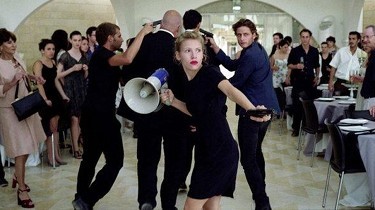
Why does everything always have to be about the Palestinians? Natanel (Michael Aloni) asks Shira (Yaara Pelzig) as she reads the first draft of a manifesto she’s writing for their tiny group of anti-capitalist rebels. Can’t we just make this about what’s happening within our country—the social equities, the wealth gap, the relentless violence?

Natanel gets his wish in Policeman, an Israeli film that was one of NYFF sleeper hits among the press and industry types who saw it last week. Israel’s conflict with the Palestinians is just one small part of the backdrop here. The showdown is between two insular tribes with a shared love of violence: the young protesters and a clique of not much older cops, whose fatal collision has the somber inevitability of a Greek tragedy.

Writer/director Nadav Lapid starts with the cops, all members of an elite counter-terrorism unit. An insular pod of hard-driving, hard-bodied, testosterone junkies, they’re the kind of guys for whom a new arrival at a backyard barbecue sparks a noisy orgy of back-thumping and chest-bumping.

After marinating in their culture long enough to get to know their leader, Yaron (Yiftach Klein), pretty well, we switch to the protesters. Natanel and Shira are humorless, near-expressionless true believers, but their sidekick Oded (Michael Moshonov) is more like a faithful puppy than a comrade. Impressionable and emotionally volatile, he seems to be loyal to the cause mainly because he’s hopelessly in love with Shira.

We linger a while with this group, too. In a Q&A after the press screening, Lapid explained the logic behind his unusual and effective way of showing the two groups consecutively rather than cutting between them from the start. He dispensed with the parallel cuts, he said, because he didn’t want the focus to be on when or how the two groups would meet. “The question for me was, who are these people? Who are these groups? I tried to describe their existential essence.”

Natanel is officially in charge of the protesters, but it soon becomes clear that Shira is the group’s emotional fulcrum, the one who naturally winds up in charge, as Yaron does with his buddies. She and Yaron each get one lingering extreme close-up that underscores the parallels between the two as they stare into the camera, all willpower and seemingly unshakeable self-confidence.

The two groups meet after the “killer babies,” as the bride contemptuously calls the young protesters, take three hostages at a society wedding. They take hostages to attract media attention to their manifesto, but they chose these particular ones for a reason: they see them as guilty of a long string of capitalist crimes that include privatizing the nation’s salt mines and cruelly exploiting their workers.

Lapid grants every character his or her dignity, and he makes most easy to empathize with even if they’re not particularly sympathetic. Touching ties between fathers and children help humanize the people involved, motivating heroic acts from both hostages and hostage-takers in the final showdown. But there are no feel-good happy endings in Policeman. These characters are boxed into rigid roles, and though their actions can make things marginally better or (more often) worse, there may be no way out of the mess they wind up in.

Hmm, maybe this is a metaphor for the Israelis and the Palestinians after all.

Written for The L Magazine

Wednesday, October 12, 2011

Substance Over Style: 2011 Trenton International Film Festival


The 2011 Trenton International Film Festival will run from October 14 through 16 at the Mill Hill Playhouse in Trenton.

"The theme running through this year's selection is the complexity of human relations—in communities, in larger societies, and between individuals and people of differing religious and political beliefs,” says Trenton Film Society Executive Director Cynthia Vandenberg of the 2011 Trenton International Film Festival. “In each of the films we see how people can transcend the normative behaviors that surround them and how, consequently, they challenge others to do the same."

Watching the films in this year’s festival, you get the sense that the programmers were more interested in substance than style. In the opening of Scheherazade: Tell Me a Story, for instance, the camera drifts around the Cairo apartment where the main character, TV journalist Hebba (Mona Zaki), lives with her husband Karim (Hassan El Raddad), a reporter yearning to become editor-in-chief of his state-owned newspaper. The intention is probably to introduce us to the power couple’s über-consumerist lifestyle, but badly lit spaces and painfully slow pans make it hard to see anything much. And in the opening scene of Kinyarwanda, a dark room looks washed-out as the camera shoots toward the light pushing through the windows, the saturation levels briefly and distractingly correcting themselves whenever someone walks between the camera and the window and temporarily blocks the glare.

The storytelling and acting are often a little rough around the edges too. In Scheherazade, Hedda replaces the political programming on her show with personal tales of everyday women to please Karim, who’s been told he won't get the job he’s angling for if he doesn’t put a lid on his outspoken wife. Most of the stories Hedda airs are interesting, if only in a gossipy sort of way, but the movie feels inorganic and schematic, thanks in part to ham-fisted dialogue. “You veil me, take my money, impose your conditions and your mother’s. If marriage just means having sex, I’ll pass on you!” one of Hebba’s guest yells at her fiancè during a flashback, in a speech that would sound graceless and unnecessary even if we hadn’t just heard him do everything she accuses him of.

The festival’s opening film, Kinyarwanda, is fictional, but it’s based on testimonials from Rwandans who found refuge at a mosque and a madrassa during the 1994 genocide of Tutsis by their Hutu countrymen. Its earnest effort to document the bravery of those who resisted the calls to slaughter and to explain the reconciliation process that followed sometimes feels didactic. Some of the actors are also stiff, including Zaninka Hadidja, who plays young Jeanne, a central character who goes on the run after finding her parents murdered in the home she shared with them.

But if Hadidja does not have sophisticated acting chops, she does have an innate sweetness and strength of character that radiate out from the screen, almost as compelling as a commanding performance. And the stories that unfold in the film’s overlapping multipart narrative, in which a scene glimpsed in one segment may be played out in full in another, are so inherently dramatic that they can’t help but capture your interest.

At the same time, Kinyarwanda never lets you forget that life has a way of getting in your face even in the midst of a genocide. More than once, like when Jeanne’s parents fight over the affair her mother has just learned that her father was having, the murderous talk on the radio and the rampaging mobs outdoors are just a dim background accompaniment to a heated exchange about something else altogether.

That’s not to say that the filmmakers soft-pedal or ignore the horrors that were part of that genocide, but they make them clear without rubbing our noses in them. Instead, they focus on acts of heroism by brave people who risked their own lives to save others and on the resilience of the human spirit.

Kyrgyzstan’s The Light Thief stars writer/director Aktan Arym Kubat as the man everyone calls Mr. Light, an electrician who jerry-rigs connections for village elders and others who can’t afford to pay for electricity. Either an antic drama or a comedy with a heavy heart, it’s an unusual, sometimes uneven mixture of light and dark, silly and serious.

At times, the film seems to be lurching from point to point like the boyishly open Mr. Light and his friends after they’ve been on a bender. If it’s not moving from one loosely connected set piece to another–Bekzat the town capitalist, tries to bend other people to his will; Mr. Light gets electrocuted and survives; the village major dies; Bekzat tries to woo a group of Chinese investors–it’s showing us seemingly random shots of village life, the horses and donkeys as well as the people. It’s interesting, in a purely ethnographic sense, to see how these people work, play, and keep house, but it’s not always clear what a given scene has to do with the main story, which is about the enlightenment and eventual disillusionment of the charmingly naïve Mr. Light.

Uruguay’s A Useful Life stars Jorge Jellinek, who is an actual film critic and looks it. His Jorge, a pale and pudgy mole of a man, is a longtime employee of a grant-supported arthouse whose sheltered routines are shattered when his cinema loses its funding, forcing him to rediscover the modest pleasures and unexpected joys of real life. Filmed in black and white with a droll sense of humor that comes out mostly in the visuals (Jorge gets his first heroic close-up as his head is being shampooed, and that shot is followed by an artily askew one of the shampooer’s upside-down face), A Useful Life could have been a clever film student’s response to the challenge: “Make a film about the most uncinematic subject you can think of.” It’s a deliberately small-scale character study, an island of sly subtlety in a sea of films with far grander intentions.

Written for TimeOff

Tuesday, October 11, 2011

This Is Not a Film


This is Not a Film will play at the New York Film Festival on October 13. It is not scheduled for commercial release in the U.S.

Alternately funny, sad, and infuriating, This Is Not a Film is a shiv smuggled out of a prison and slipped into our hearts.

Iranian director Jafar Panahi made his ironically titled movie with the help of a good friend, documentarian Mojtaba Mirtahmasb, after being sentenced to six years in prison for the crime of “preparing an anti-government film.” (Mirtahmasb has since been arrested as well.)

Judging by the digital footage we see here, which was shot while Panahi waited for the results of an ultimately unsuccessful appeal, the prospect of prison was nothing compared to the sense of nerve-shot entrapment brought on by the other half of his sentence. Panahi’s real tragedy is that he has been silenced as an artist in the prime of his creative life, forbidden to make films, write screenplays, leave the country, or give interviews for 20 years.

The pain of that gag order is half of the subject of This is Not a Film. Its conjoined twin is the exhilarating creativity that allowed Panahi to find one last way around his gag rule, creating this remarkable movie and somehow getting it smuggled out of the country on a USB drive baked into a cake.

At first the filmmaker just moves in and out of the frame before a stationary camera while he eats breakfast, cleans up, makes and drinks tea, and talks on the phone. He could be making an updated Jeanne Dielman, with the housewife’s self-imposed imprisonment replaced by the restrictions imposed on a free spirit by an oppressive regime. But Panahi’s soul turns out to be as expansive as Dielman’s is crabbed, so the scope of the film soon swells to include other people and ideas. It even makes room for his daughter’s surprisingly affectionate iguana, Igi, who is often in the foreground or background of Mirtahmasb’s casually elegant compositions, giving us something compelling to look at while Panahi surfs a heavily censored internet or talks to a friend.

Most of This is Not a Film was apparently shot in one day, on the 2010 Muslim New Year. That’s either a happy accident or another example of the filmmakers’ savvy, since the New Year fireworks constantly cracking in the background and the reports of unstable excitement in the streets magnify our sense of the world outside Panahi’s cushy Tehran apartment as a perilous place. Panahi remains under a kind of unofficial house arrest, never once leaving his apartment building, but people keep coming to him. A neighbor tries to drop off her neurotically yappy dog, Micky, with him for a few hours; a delivery boy drops off an order of food; a handsome and personable young man comes by to collect his trash.

And, of course, there’s Mirtahmasb. He arrives after Panahi calls with a cagy invitation, his request worded carefully to avoid getting his friend in trouble with eavesdropping officials, and the two never stop collaborating, discussing lighting, camera angles, and settings and fighting amiably over who gets to call “cut.” They sometimes film each other simultaneously, Panahi with his iPhone and his friend with a semi-professional-looking videocam that belongs to one of Panahi’s children. They don’t always seem to know why they’re filming, but they agree that it is of the essence. “They say when hairdressers get bored they cut each other’s hair,” says Mirtahmasb, after noting that Panahi would have captured some “important moments” if he started filming when he was arrested. “It’s important that the camera stay on.”

Panahi talks a lot on the phone, his seemingly unscripted conversations with friends, family, and his lawyer telling us a lot about his situation, including the fact that his sentence was “100% political and not legal at all,” according to his lawyer. He also keep popping his movies into his DVD player, fast-forwarding to certain scenes and then talking to Mirtahmasb about what he got or failed to get there that he’s looking for now, in their contraband film.

Meanwhile he keeps circling back to the activity he asked Mirtahmasb over to film: his reading aloud of a screenplay he’s been forbidden to film. He busies himself with this project like a kid playing house, outlining the set with colored tape on his floor and unself-consciously acting out the rudiments of his plot. And then he stops, visibly agitated and frustrated by the limitations of his self-imposed exercise. “If we could tell a film, then why make a film?” he asks, a question that lingers in our minds as it no doubt does in his.

In his final encounter of the day, Panahi rides his apartment’s elevator down with the trash collector and we have the pleasure of watching the neorealist director, who has always loved working with nonprofessional actors, ease into action. Under his gently persistent questioning, their brief encounter yields humor (Micky’s owner tries to foist the dog off on the young man), social commentary (his subject talks about how hard it is to find jobs, even with an advanced degree), and human interest to spare.

It also supplies a powerfully poignant ending to the film, whose last lines are spoken gently by the trash collector as he heads out into the chaotic courtyard. “Mr. Panahi,” he says, “please don’t come outside. They’ll see you with a camera.”

Written for The House Next Door

Monday, October 10, 2011

My Week with Marilyn


My Week With Marilyn played on October 9 and 12 at the New York Film Festival. It's scheduled for release in U.S. theaters on November 23.

At the Q&A after the press screening of My Week With Marilyn, director Simon Curtis said he fell in love with the two Colin Clark memoirs the script is based on because of the insights they provided into Marilyn Monroe.

A funny thing must have happened on the way to Film Forum. Either those insights just didn’t make it into the screenplay or else Curtis knows a lot less about Hollywood’s Lady of Perpetual Sorrow-slash-sex appeal than I had thought was possible for any reasonably well-educated citizen of the developed world.

The Skin I Live In


The Skin I Live In is playing this Wednesday and Friday at the 49th New York Film Festival. It opens in the U.S. in limited release this Friday.

Like a Spanish Woody Allen, Pedro Almodóvar has directed a movie every year or two since 1978, and if not every one is great, almost all are worth seeing. And like a latter-day Douglas Sirk, Almodóvar loves stories about gorgeous, creamily photographed people who commit soap-operatic acts in picturesque settings. His subversive sense of humor and convoluted plots, which often circle back through time, keep his films from being merely melodramatic, but at their worst they can seem frenetic, all color-saturated surface and no substance.

The Skin I Live In lacks the fire and emotional depth of his best work, which includes the brilliant four-film streak that started with All About My Mother in 1999 and ended with Volver in 2006. But it digs deep into the aging wunderkind’s bag of tricks to keep us entertained while slipping in a few pointed observations about how our bodies define us and what people—particularly women—will endure to survive.

The sometimes overly complicated plot begins with a mysterious captive, the almost inhumanly beautiful Vera (Elena Anaya) who lives in a large room in the luxurious but sterile home of Dr. Robert Ledgard (Antonio Banderas). Projected on a huge monitor so Dr. Ledgard and his rabidly protective housekeeper (Marisa Paredes) can watch her 24/7, Vera is clearly the subject of some kind of experiment by the doctor, who is developing a genetically engineered form of artificial skin, but his obsession with her seems more than medical, despite the purely clinical way in which he insists on treating her.

To reveal just what the doctor has done to Vera and why, Almodóvar tells us a series of overlapping tales that would feel right at home on a telenovela, with their news of horrific disfigurement, kidnapping and torture, experimental surgery performed without the consent of the patient, unacknowledged children, fraticide, suicide, and rape, both real and imagined.

The eye in the center of this hurricane, Vera remains studiously impassive in the present, but as flashbacks explain how she got that way, her porcelain surface takes on new depth. Whether she’s submitting to a rape in order to stay alive, playing on the doctor’s growing lust/love in order to break free of the prison of her room, or simply submitting to the hungry gaze that always follows her, she becomes the personification of womanhood in a paternalistic world.

Written for The House Next Door

Sunday, October 9, 2011

Sleeping Sickness


Ulrich Köhler's Sleeping Sickness plays this Wednesday evening at the 49th New York Film Festival. It is currently without distribution.

Sleeping Sickness feels more like sketches for a painting than a finished work of art.

In the first half, a German doctor, Ebbo Velten (Pierre Bokma), and his wife (Jenny Shily) are preparing to leave Cameroon, where they were stationed for years while he worked for Doctors Without Borders. They’re going back to Germany, but they’ve been in Africa so long they’re not sure it will still feel like home.

In the second, a French aid worker dispatched by the World Health Organization travels to the village where the doctor is holed up three years later. It seems he stayed behind after all, without his wife or their grown daughter, taking on an African family and launching a program to treat sleeping sickness. The Frenchman, Alex Nzila (Jean-Cristophe Folly), is there to observe and report on that program—an anemic enterprise centered in a scruffy open ward that houses more chickens than patients.

Writer/director Ulrich Köhler spent a chunk of his childhood in Zaire while his parents did aid work, his father as a doctor. His film is dotted with emotionally authentic moments, like the one where Velten’s wife lavishly (and slightly paternalistically) praises a dish made by her African cook, who smiles brightly while the wife is in the room, her expression turning far more complicated the moment the white woman leaves.

But the second half of the movie loses focus, giving us an episodic series of snapshots of Nzila’s Heart of Darkness-lite journey that occasionally becomes borderline surreal without ever quite feeling profound. In once scene, he wakes up in what appears to be a hospital with an IV in his arm. We have no idea where he is or why, and neither does he. It could be a deft metaphor for his trip to Cameroon but it doesn’t seem to go anywhere, so it winds up as a random snippet of experience, vivid enough in its own right but not really meaningful. It’s as if the filmmakers were sliding into African time along with Dr. Velten, inhabiting the moment so thoroughly they’ve half-forgotten what they were doing there.

Written for The L Magazine

Friday, October 7, 2011

Moneyball


After going rigid with rage in this year’s Tree of Life, Brad Pitt is all fluid energy in Moneyball, marshalling his considerable gifts to rampage through the Oakland A’s clubhouse like an alpha dog off its leash. It’s an intense performance—you’re as conscious of the intelligence behind his level, measuring gaze as you are of his sheer size and strength—but its delivered with the looseness and grace of a man who knows who he is and where he wants to go.

It’s a good enough performance to make the movie worth seeing, but even Pitt’s effervescence can’t quite oxygenate Steven Zaillian and Aaron Sorkin’s script, which sputters to life for the subplots but keeps stalling when it returns to the main story.

Beane’s barely-there home life is sketched out nicely in a handful of scenes, including just one resonant snapshot of his California-girl ex (Robin Wright) and her insufferably mellow new husband (Spike Jonze, in a very funny uncredited cameo). Keris Dorsey also makes a strong impression in a short time as his touchingly reserved daughter, and her jauntily wistful rendition of Lenka’s The Show gives the film its emotional resolution.

But the meat of the story is left a little too raw. Moneyball is about Beane’s transformation of an underfunded, struggling baseball team into a near-winner (in 2002, the year in which the film is set, the A’s tied the record for consecutive wins), which he achieved with the help of a Yale-educated numbers wonk who had embraced a new way of evaluating players through computer analysis of statistics. The Michael Lewis book on which the film is based reportedly explains just how they did that, but the movie leaves it frustratingly vague, the camera often panning over columns of numbers that are left unexplained.

We see the team turn around after Beane trades away a few players and starts holding two-on-one sessions with the players and his numbers guru, Peter Brand, helping his athletes recognize and play on the strengths he and Pete see in them. We hear the philosophy behind his and Pete’s use of statistics, which they see as a way to replace the old-school, from-the-gut method of evaluating players that inevitably overvalued some and undervalued others. By cherry-picking undervalued players, they assemble a winning and relatively cheap team Pete calls “an island of misfit toys.” And we get a glimpse of how it worked when Beane recruits players because of how often they get on base, regardless of their batting averages or other statistics. A walk is as good as a hit, he later tells one of them: What counts is that you get to first base, not how it happens.

That’s an intriguing premise, but imagine how much more interesting the film would have been if it had explained more about how the players were being evaluated and then shown how those criteria translated into wins on the field. And where they failed, since, as Beane himself keeps pointing out, the A's didn’t get any farther in the playoffs right after he changed his recruiting strategy than they had in the two years before.

Instead, we just watch our motley collection of underdogs do badly and then do better, in classic sports-underdog fashion, without quite understanding why, though we are saved from choking on formula by the team’s failure to capture the coveted pennant—and by Beane’s decision to turn down a chance to cash in on his (limited) success.

There’s nothing visually inspired about this film, which features way too many scenes of Beane driving around alone in his car, a motif so uncinematic that I bet it came from the book, which presumably clued its readers in on what Beane was thinking behind the wheel. Without the benefit of X-ray vision, though, not even Brad Pitt’s chiseled profile can hold your interest forever.

Even the baseball scenes rely on the game’s inherent drama rather than interesting camera angles or lighting for their interest. When a ball in one key game is shown arcing through the darkness from on high at night, heading toward the camera as it falls, it seems to have arrived from another movie altogether.

But there’s some nice, snappy dialogue, and someone—maybe Sorkin, since that’s one of his signature themes—does an excellent job of portraying the peculiar form of love that can develop between workaholics who bond over work. Jonah Hill plays Pete as the perfect lapdog acolyte to Pitt’s big-dog leader, spitting out numbers and names on demand with a brilliant nerd’s awkward mixture of diffidence and confidence.

In the end, their little team of two is the only one that counts in this sports story. Moneyball makes you feel the excitement of their gamble and the thrill of their victory, even if it never quite explains how they did it.

Written for TimeOFF

Wednesday, October 5, 2011

4:44: Last Day on Earth


Abel Ferrara's 4:44 Last Day on Earth, an IFC Films release, screens tonight and Saturday night at the 49th New York Film Festival.

As 4:44: Last Day on Earth putters to an end, Skye (Shanyn Leigh, director Abel Ferrara’s girlfriend) tells Cisco (Willem Dafoe in patented tragic-hipster mode) not to worry because they’ll be spending eternity together. It’s presumably supposed to be tragic or transcendent or something, but all I could think was: Good luck with that.

Ferrara’s overheated hipster-boy tales work pretty well when his lead actor is memorable and quirky enough to spin the maudlin material into fool’s gold, the way Harvey Keitel did in Bad Lieutenant. Better yet is a star with a sense of humor, who can counterbalance Ferrara’s shallow depth and leaden self-pity with a lightness of spirit, maybe even a little fancy footwork, like the seemingly impromptu little dances Chris Walken tossed into King of New York. And best of all is when the supporting cast, including the obligatory babes, can command our attention even with their clothes on.

But pair Ferrara with an equally self-regarding star like Dafoe and a charisma-free leading lady like Leigh, who alternates between doughy impassivity and hysteria, and you’re in for a long 82 minutes.

As usual in Ferrara’s movies, a fashionably sinewy man sins and a pulchritudinous woman pays the price. And as usual, we learn a little more than we want to know about the director’s penchant for big butts and dirty dancing.

Cisco and Skye are a May-October couple facing the end of the world (“Al Gore was right,” as a newscaster on their big flat-screen TV puts it) in a fashionably artsy downtown loft. She never sets foot outside their door for the whole length of the film, which delineates the last day for planet Earth. He goes out only once, to score some dope she confiscates when he brings it home. And oh my God, when he’s out there he runs into Paz de la Huerta, decked out in a party dress and platform heels and acting out on some picturesquely seedy downtown street. Just what we needed.

Aside from that abortive drug run, Cisco spends his time fretting, watching the news, and Skyping his friends and family in the apartment while Skye paints it black, splattering paint Pollock-style onto a mediocre-looking canvas that gets an awful lot of reverent camera time. She changes her clothes a lot. He goes out on their rooftop terrace and yells some.

Together, they dance, have sex, fight a little, meditate, order takeout, and let the delivery man Skype his family in Vietnam on their computer, an unsubtitled exchange that provides the film’s only genuinely moving moment.

Meanwhile we hear from such cutting-edge luminaries as Charlie Rose, Al Gore, the Dalai Lama, and Joseph Campbell. Okay, now I’m just being snarky. I’m sorry. These people just bring out the worst in me.

Written for The L Magazine

Saturday, October 1, 2011

A Separation


A Separation played at the 49th New York Film Festival on October 1 and 2. It's due to be released in U.S. theaters on December 30.

A Separation seems to invent itself as it goes along. It doesn’t mirror or mock or play minor variations on some timeworn genre or theme. It just pulls you in, instantly and inexorably, to its perfectly life-sized world. If it feels familiar, it’s because it feels as poignant, precarious, and endlessly complicated as life itself.

We first meet Simin (Leila Hatami) and Nader (Peyman Moaadi) in what appears to be a divorce court hearing. The camera assumes the unseen judge’s point of view, so the couple talks directly to it, making their impassioned arguments to each other or to us. Meanwhile, the judge’s disembodied pronouncements provide the first of several male voices of authority, embodying Iran’s paternalistic, often repressive social structure and justice system.

Simin wants to leave Iran with the couple’s 11-year-old daughter, Termeh (writer/director Asghar Farhadi’s daughter Sarina). “As a mother, I’d rather she not grow up under these circumstances,” she says. “What circumstances?” the judge asks, the first of many questions the film pointedly leaves unanswered. Nader won’t join her because his father (Ali-Asghar Shahbazi), who lives with them, has an advanced case of Alzheimer’s and he refuses to abandon him. He doesn’t try to stop Simin from leaving, a decision that clearly hurts her deeply though it seems to be motivated by his principled respect for her autonomy. But he won’t let Termeh go and Simin can’t take her out of the country without his permission. So they’re stuck in a standoff, one convinced she must leave for her daughter’s sake and the other convinced he must stay for his father’s.

The fact that we learn all this in the first five minutes or so of the movie, and that those five minutes play out with such fluid and compelling drama that you never once feel the heavy hand of an author doling out expository information, should give you some idea of how elegantly and intelligently this tale is told. In a somewhat clumsily translated Q&A following the press screening, director Farhadi said it is very important to him that his films be shown in his homeland, so he has developed a few ways of making sure that happens. “One way is, I don’t speak loudly in my films,” he said. “Another way is that I don’t force my judgments on the audience. And there are other ways that, if I tell you about them, I won’t be able to show my films [there] any more.”

I’m sure there are veiled references to conditions in Iran in A Separation that I missed, but there was still plenty to chew on. When Nader hires a very devout woman (Sareh Bayat) to look after his father after Simin moves out, a new dimension of class differences is introduced. And when that arrangement comes to an abrupt and disastrous end, the fault lines created by class, wealth, and gender inequalities crack under the stress, creating chasms deep enough to swallow whole relationships.

Farhadi, who worked in theater for years before becoming a director (the first movie he directed was 2003’s Dancing in the Dust), said he always rehearses with his actors for 6 or 8 weeks before shooting, letting them use that time to discover their characters for themselves. “I want whatever happened in me to cause the creation of that character to happen in the actor,” he said. Whatever he’s doing, it clearly works: The cast is universally excellent, inhabiting their characters so fully that it’s easy to forget they’re acting. All the characters work hard to hide things from each other, but they can’t hide much from us, thanks to the strategically placed camera and the emotional transparency of the actors.

At the same time, Farhadi is playing a cat-and-mouse game with us, often ending a scene just before a key event occurs or keeping us behind closed doors with some of the characters while unseen others do something crucial on the other side. Some of that information is withheld only temporarily, but we’re left to guess at a number of things. “This is a detective story, but the detectives are the audience,” he said, and some of the questions the movie raises are not easily answered.

Nader is constantly schooling his daughter, drilling her on math and Arabic and other academic subjects, but the most important lessons she learns are the ones we absorb along with her. When is a lie the morally correct choice? How much of your own safety and comfort should you risk to stand up for the truth, and how much are you entitled to risk of other people’s? How do you decide whether to stay or to go if either choice will mean abandoning someone you love?

Unpredictable twists, a gathering sense of dread, and the tender humanism that infuse it all make Farhadi’s film absorbing, but it’s fundamental ethical and moral questions like these that make it great.

Written for The House Next Door

The Guard


Considering the deep, generally unslaked thirst so many people I know have for movies that are just plain fun to watch—entertaining and absorbing without being too deep-dish or depressing—I’m surprised this delightful little black comedy hasn’t gotten more buzz. Fortunately, there’s still a little time to catch it before it slips out of the local theater—and if that doesn’t work, you can always look for it on Netflix, or whatever other service you’re using these days.

Writer/director John Michael McDonagh’s brother, Martin McDonagh, wrote and directed the similarly exhilarating In Bruges, which also costarred the magnificent Brendan Gleeson. The Guard isn’t as quirkily splendid as that brilliant little bit of business—this one is just a change nicely played on a well-worn theme—but it’s rooted in the same rich Irish loam.

In classic Dirty Harry style, Gleeson’s rogue cop (Sergeant Gerry Boyle of the Irish guard) breaks every rule in sight, teeters on the edge of suspension, and gets matched with another outsider (Don Cheadle’s Wendell Everett, a straitlaced FBI agent) in an odd-couple pairing that winds up as a true partnership as our flawed hero cracks the big case. But The Guard goes light on chase scenes and explosions and heavy on the wordplay and character development, creating a rich Irish stew that tempers deep sentimentality with smart skepticism and self-mocking wit.

The story is set in Connemara, but this is no tourist-board view of Galway. The action generally takes place at night or inside dark rooms, mostly shot in a strenuously anti-glamorous high-contrast, super-saturated style, with harsh, interrogation-strength lighting emphasizing the crags and crannies in Gleeson’s broad mug. When he’s not sitting in front of a supersized photo of water and swimmers (one of the many ways forms of foreshadowing the filmmakers have knit, mostly seamlessly, into the narrative), he’s often surrounded by some garish color, whether it’s the sickly green of his bedroom wall or the checkerboard floor and cherry-red accents of a faux-American diner.

There’s just one consistent exception: a freckle-faced little boy who keeps popping up on his bicycle, his disheveled dog in tow, always outdoors and filmed in rich colors. The heroic angles from which he is shot and the gorgeous landscapes that often stretch out behind him make him a symbolic, almost mythical figure: the sole witness to Boyle’s hidden heroism and maybe even the soul of the town.

But there’s nothing mythic about Boyle. Reaching inside his baggy briefs to scratch his balls as he stumbles across his bedroom one minute and drawing information out of his partner’s widow with surprising delicacy the next, Gleeson’s sergeant is a walking Rorschach test. Everyone with the sense to see his own carefully cached sensitivity trust and confides in him, while the rest heap him with abuse. He takes it all in with an air of bovine indifference, punctuated every now and then by a goofily mischievous grin.

Cheadle plays off Gleeson’s deceptive passivity beautifully, his sense of humor getting a rare and welcome airing as Everett goes into slow burns at Boyle’s bouts of apparently blissful insensitivity (“I’m Irish, sir,” he protests at one point. “Racism is part of my culture!”) Watching these two play off one another is one of the movie’s great pleasures.

Another is the interplay between the villains, especially Mark Strong’s tightly wound Clive Cornell and David Wilmot’s sociopathic Liam O’Leary, who looks and acts something like an ungroomed terrier. Between bouts of violence, the bad guys kill time Tarantino-style, comparing favorite philosophical quotes, parsing the fine points of each other’s statements, and chafing at the quality of the people they’re forced to put up with. “That’s the payoff, yeah?” Cornell hisses when his contact asks if all the money he promised is there. “That’s the dynamics of this situation. Why the f--- would I cheat you out of the money? … That would defeat the entire freaking purpose of the entire interaction!”

Every so often—including, unfortunately, in an ending that feels more canned than candid—the supple script strikes a false note, pulling you out of the story for a moment. But then someone says or does something so smart or touching or funny or all three that you’re immersed once again in this entertaining fable. After all, that’s the dynamics of this situation, right? And you can trust this crew to respect those dynamics.

Written for TimeOFF

Saturday, September 24, 2011

Contagion


You don’t need to bring any Kleenex to Contagion, but you might want to pack some Purell.

For a story about a brain-liquefying virus that decimates the human race worldwide, Contagion is surprisingly unemotional. As he did in other recent films like The Informant! The Girlfriend Experience, and Che, director Steven Soderbergh films like an alien sent here to create a documentary on the human condition. Even the film’s sickly-beautiful look holds us at arm’s length, its precisely framed, yellow-tinged compositions making most of the environments feel sterile and unwelcoming.

In some ways, the film’s coolness comes as a relief. It’s a pleasure to simply sidestep those persistent disaster movie clichés Airplane! skewered three decades ago: There are no saintly clerics or estranged couples brought together by crisis here, and though there is a pair of young lovers, their separation is played more for dark laughs than for tears. Just a click or two more of empathy might have drawn me in closer to the people in Scott Z. Burns’ script, who are glimpsed in such brief snippets and from such an emotional distance that I never really cared what happened to them.

But it’s impossible not to root for Team Human in movies like this, especially one with such a first-class cast. Soderbergh plays on that instinct with intelligence and bone-dry humor, turning a battle for survival into a morality tale. The pandemic is started by a cheating wife (an alarmingly pallid Gwyneth Paltrow) and cured by a phalanx of noble scientists, including a nurturing and perpetually concerned Kate Winslet; a sly Elliott Gould, his face sagging like a half-melted candle but his wit still sharp; a mostly wasted Marion Cotillard; and a fierce Jennifer Ehle, who steals the stage out from under all the rest as an obsessive-nerd hero.

Paltrow’s Beth may have started the fire, but the real villain is a blogger played by a hammy Jude Law, who’s perpetually photographed by a camera that floats somewhere just under his chin, the better to emphasize a set of jagged prosthetic teeth meant to make him look seedy and unattractive. (Yeah, right.) Profiting off the crisis by peddling misinformation and seeding mistrust of the vaccine our scientist heroes are sweating to produce, Law’s Alan Krumwiede is a proxy for the internet, which is seen here as a 21st-century twist on Newton Minow’s vast wasteland. “Blogging isn’t writing,” Gould tells him, in one of the film’s best lines. “It’s graffiti with punctuation.”

Contagion sometimes seems to be another of the tales our anxious age keeps telling itself about the end of civilization as we know it. It starts in the epitome of pampered civilization, at a bar in a glossy hotel, where the lithe and lovely Beth is rapidly degenerating into a splotchy-skinned, sniveling mess—not to mention, as the probing camera keeps reminding us, a teeming colony of contagion who spreads death every time she picks up a drinking glass or reaches into a bowl of nuts.

From there, we head out into less privileged public places, watching people collapse in planes, on buses, and in hospitals, before retreating into the houses where the panicked survivors hole up, forced to rely on that infernal internet for the human contact they can’t risk getting in person.

Soderbergh and crew do a good job of conveying the claustrophobic comfort of the warrens people create, from the cavernous house where Beth’s widower, Mitch (Matt Damon) retreats with his increasingly resentful teenage daughter to the cramped apartment where Krumwiede hunches in front of his webcam, a great spider weaving its web. But the film’s quick-cutting, episodic approach is less successful at conveying the big picture.

The snapshots we see of panicked crowds making runs on drugstores and grocery stores, two men breaking into the house across the street from Mitch and apparently shooting its owners, and people siphoning gas from cars in a parking lot indicate a total breakdown of civilized society, yet Mitch and his daughter manage to keep going for months in that house. Sure, they’re lonely and antsy, but they seem perfectly comfortable and well fed. Where are they getting food and water, not to mention the money to buy them? Who’s making sure that the electricity and phones are still working?

A more textured sense of that social context, a little more focus on the main characters’ emotions, or both might have turned Contagion into a hauntingly resonant classic. But even without them, it’s an engaging evening’s entertainment—and a creepily effective reminder of why mom was right when she told us to wash our hands.

Written for TimeOFF

Wednesday, September 14, 2011

Granito: How to Nail a Dictator


Granito is director Pamela Yates’ attempt to spread the gospel of collective action she learned while making her debut documentary, 1983’s When the Mountains Tremble.

Both films are about the war waged by Guatemala’s government against its own people in the early ‘80s, a ruthless campaign that resulted in the deaths (often by torture) of an estimated 200,000 indigenous Mayans and political activists. The strength of the first flowed from the impressive access Yates got to both sides of the conflict, and from the charisma of gravely eloquent young Rigoberta Menchú, a Quiché woman whose personal testimony and historical analysis put the killing in context. Yates bivouacked with guerillas, interviewing shy teenage recruits and their not-much-older commander/comrades. She recorded hundreds of their rural supporters as they emerged into a clearing as if from the mountain itself, filling the field for a few minutes before melting back into the woods. And she gained the trust of General Efraín Ríos Montt, the main officer in charge of the campaign, capturing chilling footage and quotes as she interviewed him or rode shotgun in trucks and helicopters with his soldiers.

Granito begins about a quarter century later, as Yates pores over outtakes from When the Mountains Tremble in search of evidence for Almudena Bernabeu, an international human rights lawyer who is trying to convince a judge in Spain to convict Ríos Montt and other former generals of genocide. (Guatemala refuses to put the general on trial.) Yates works hard to organize her material, structuring it like a detective story (Will Yates find the footage Bernabeu needs in her outtakes? What’s that crucial document someone else just stumbled across? Will they be able to find hard evidence, or will the judge dismiss the case?), personalizing it with a voiceover, and dividing it into three chapters.

The third chapter, Grains of Sand, elaborates on the collective philosophy that is the movie’s real subject. Granito de arena is a saying the guerillas adopted to describe the slow accumulation of effort that gradually brings about change as each individual makes a small but crucial contribution to a communal effort. It’s a humble philosophy, Menchú notes, since everyone is equally important and “there are no heroes.”

It’s also an effective way to keep a broad-based movement going for the years, even generations, that are clearly required if the Guatemalan activists are ever to get the delayed justice they want, as they are pushed back a step for every step they take forward. (A new setback too recent to be mentioned in the film is currently making headlines: Mexican drug cartels have made life so dangerous in parts of rural Guatemala that some people want to vote the military back into office.)

Unfortunately, Yates muddies her own message the first two chapters. This time around, the only inside track she has is with the other educated professionals who are helping to gather evidence, so she gives that group most of the screentime. Besides the director herself, who is often shown noodling with a projector or gazing moodily at the camera, we see a lot of Bernabeu, the Spanish judge, a Guatemalan forensic anthropologist who moved to the Bronx as a boy, and two more New Yorkers: a forensic archivist and a former journalist.

Some of them seem off-puttingly self-involved at times, like when the journalist says she left Guatemala after realizing that the country hadn’t changed despite all the work she’d done there. But the real problem is simply the nature of the medium: People we see and hear more of are bound to feel more important than the people we see not at all or in passing.

Yate’s detective-story scaffolding provides some structure and suspense, but the real drama is in the interviews, either conducted or captured by Yates, of Guatemalans who are working for change. When the president of the Association for Justice and Reconciliation matter-of-factly describes the day when 95 people in his small town were massacred, or a young woman whose father was “disappeared” when she was a baby talks about how she dreamed as a child of becoming a butterfly and flying into the dark prisons to find him, tears streaming down her face unheeded, we sense the pain, the strength, and the thirst for justice that motivates them—and, presumably, all their fellow granitos.

Written for The L Magazine

Saturday, September 10, 2011

The Help


The Help wants us to feel bad about the mistreatment of black maids in the Jim Crow South while making the white people in the audience feel good about themselves. These two sometimes competing goals make for a bumpy ride that stops considerably short of confronting the dark heart of white privilege.

I wish it were a more historically accurate portrait of racism—and I wonder whether it would be as effective if it were. The feel-good tone I recoil from may be just what has drawn in so many other people, making them comfortable enough to share their thoughts and feelings about racism online, in long comment threads that have grown up beneath several thoughtful essays over the past month.

The film filters the experiences of African American maids in early-‘60s Jackson, Mississippi, through the pen of Skeeter (Emma Stone), a young white writer who collects their testimonials for a book called The Help. Skeeter is an avatar for Kathryn Stockett, the white Southern woman who wrote the novel the movie is based on, and her mediating presence is a problem for The Association of Black Women Historians, which issued a statement saying that The Help “distorts, ignores, and trivializes the experiences of black domestic workers” and calling it “the coming-of-age story of a white protagonist, who uses myths about the lives of black women to make sense of her own.”

That syndrome of using black people’s stories as fodder for a white protagonist’s journey of enlightenment has bothered me enormously in other films mentioned by Matt Zoller Seitz in an impassioned attack on The Help in Salon, but I don’t agree with his conclusion that The Help belongs in their ranks. Basing the pivotal character of Aibileen (Viola Davis) on the black woman who helped raise her, I think Stockett just built on what she knew, focusing on what the maids experienced at work and on the charged relationships they formed there. During their long days in white women’s homes, performing often intimate tasks, the maids form complex relationships with their employers and their children, relationships—like Stockett’s with her family maid’s—that are sometimes infused with real love. True, the movie sometimes veers away from those relationships to focus on the relatively uninteresting problems of the white women. But the black women are not in this story to solve problems for the whites. On the contrary: The white women are there to cause problems for their maids.

In fact, one of the movie’s main weaknesses is that the white women are one-dimensional to the point of stereotype. Even Skeeter never becomes much more than a tomboyish career girl, and the young women in her social set are even more firmly pigeonholed, from queen bee Hilly Holbrook (Bryce Dallas Howard) to body image-obsessed ice queen Elizabeth Leefolt (Ahna O’Reilly).

Their group dynamics are just as oversimplified, creating the impression that racism in 1960s Mississippi was purely a matter of personal integrity. While Skeeter, the author and audience surrogate, interacts with the maids with an anachronistically respectful humility, the psychopathic Hilly rides herd on Minny (Octavia Spencer), her maid and Aibileen’s best friend, just because she can. Meanwhile, Hilly’s cowed friends all follow her lead, motivated by insecurity and peer pressure.

Sure, there’s talk now and then of the other powerful institutional forces that are keeping Mississippi’s racial divisions in place, including the KKK and the governor himself, but none of that feels as real as the high school clique-like dynamics of the town’s Junior League, or the personal power of the mean girl in charge. And that makes it too easy for white people watching to reassure ourselves that we would have seen the racism that colored everything at the time for what it was as clearly as Skeeter does and resisted it as easily.

What’s more, by setting up a conniving villain as source of the group’s racism, the movie distorts the nature of the insults the maids of the time endured, which no doubt sprang far more often from the thoughtless exercise of white privilege than they did from intentional cruelty.

Misrepresenting the extent to which unquestioned racism underlay every aspect of social relations between blacks and whites in Jackson at the time also undercuts the sense of dread that any maid who dared tell tales out of school about their employers would have felt, which is more spoken of than felt.

But just as you’re starting to slip out of the story, the great Viola Davis reappears and lets us hear the release in the explosive laughter Aibileen lets out with Minny in some white woman’s kitchen. Or she tells Skeeter/us the story of her son’s death, slowly surfacing all the pain she carries with her to present us with a burden that’s almost too much to bear.

Spencer is excellent too, unleashing the ferocious intensity Minny must bury in her interactions with employers in exchanges like her hurried coaching of her oldest daughter as the girl heads to the bus to launch her own soul-bruising career as a maid.

Are moments like these enough to overcome the movie’s many weaknesses? Your answer will depend on how you feel about “the eternal question faced by minority groups who have to fight for space onscreen,” as Dana Stevens put it on Slate: “Do we count ourselves glad to make any inroads we can, or do we demand rich, nuanced, subtle representations right from the start?”

Written for TimeOFF

Wednesday, September 7, 2011

The Pianist


Tonight, MoMA kicks off a comprehensive Roman Polanski series, running through the end of the month, with The Pianist. Oddly for a retrospective of this magnitude, the filmmaker himself won't be on hand for the opening night screening, but star Adrien Brody will be there to introduce.

Much as I hate edicts about what kind of art people should and shouldn’t make, I’m sometimes tempted to go along with Claude Lanzmann’s that no one should make fiction films about the Holocaust. Especially in a world where Holocaust deniers are looking for any excuse to say the whole thing was faked, it seems irresponsible to falsify any facts about it, or to try to make its savage lessons go down easy by breaking them into easily digestible bits. As Alain Resnais argued so ferociously and prophetically in Night and Fog, unless we look squarely at what the Nazis did, acknowledging the human impulses within us all that allowed the German people and the Nazis’ many collaborators in other countries to help perpetuate Hitler’s Final Solution, we’re doomed to repeat that hellish slice of history—or something very much like it, as we already have in Rwanda and the former Yugoslavia, among other places.

But the line separating good and bad Holocaust films is not drawn between fiction films and documentaries. Rather, it separates films that help us understand something about that massive crime against the very concept of humanity from films that cheapen their subject, usually by using it as the backdrop for some photogenic protagonist’s tale of suffering and survival—or, worse yet, spiritual growth.

By that standard, The Pianist is one of the best Holocaust movies ever made. Director Roman Polanski grew up in Poland during WWII, where he was on his own for much of his childhood after his mother was killed by the Nazis and his father was sent to a concentration camp. After becoming a director, he looked for years for a Holocaust story to film. Then he found a memoir published by Wladyslaw (“Wladeck”) Szpilman in 1946, which went out of print soon thereafter. Polanski gravitated toward the book, he says in a DVD commentary, because it was “extremely accurate, and that’s because it was written immediately after the war,” while the author’s memories were still fresh.

This is not only one of the best Holocaust movies ever made but probably the film Polanski was born to make. The closest he’s ever come to making an autobiographical movie, it combines the best of his other best work, including the slowly accumulating sense of menace of Knife in the Water and the breathlessly casual cruelty of Rosemary’s Baby and Chinatown, whose protagonists are also fighting for their lives in opaque power structures presided over by ruthless psychopaths.

If there were an antonym for sentimentality—a word that describes a compassionate but clear-eyed view of the human condition as devoid of mawkishness as it is of cynicism—The Pianist could be its dictionary illustration. When the movie opens, it’s 1939 in Warsaw, and the city is literally exploding outside the sound booth where Szpilman (an admirably reined-in Adrien Brody) is playing Chopin for a radio broadcast. Wladeck and his fellow Jews are about to be systematically stripped of all their rights and possessions, stigmatized, corralled like so much livestock into an increasingly filthy and overcrowded ghetto, and ultimately killed by the millions. Yet Wladeck has a sense of himself, and a sensitivity to the humanity around him, that not even six years in Nazi-occupied Warsaw can extinguish.

Polanski’s determination to be faithful to the book extended to the pianist’s empathetic attitude, which colors the story. That allows The Pianist to document a steadily escalating parade of horrors without resorting to nihilism, adolescent revenge fantasies or sentimentality.

The film also steers clear of the simple-minded, good-guy Allies vs. bad-guy Nazis dichotomy that characterized nearly every movie made about the Holocaust between the war and the turn of this century, a period during which filmmakers and audiences were presumably far enough from the war not to remember it with Szpilman’s accuracy yet close enough to need to comfort of self-flattering assurances. (I mean, good people like us would never go along with anything like that, right?)

There’s no need for fictionalization in this gripping story, which also includes the Warsaw ghetto uprising and Szpilman’s eleventh-hour discovery by a Nazi officer who becomes his unlikely champion. Rather than sell the drama or pathos, Polanski and team go for a painstakingly detailed, consistently underplayed sense of realism, recreating the ghetto’s crowded streets and peopling them with a vivid collection of lost souls, including a woman driven crazy by grief and a starving man who wrestles an elderly woman for her gruel.

Some of the most “cinematic” scenes in the film, like the woman who meekly asks a Nazi where he is about to take her and is answered by a bullet in the forehead, are taken from Polanski’s life rather than Szpilman’s, but they all happened to one of the two and made enough of an impression to be remembered years later. That may help account for how many scenes from The Pianist are burned into my brain, like the sight of a woman shot in the street as she runs, who drops to her knees and then folds forward onto herself, as if she were suddenly sleepy. Or the little square of caramel Szpilman’s father buys with the family’s last coins as they await their final deportation, carefully dividing it up into equal bits so they all get a precious piece.

Meanwhile, we see so many Jews killed in so many ways that we start to understand the inexorable yet random nature of the violence—and the numb silence with which the starving survivors eventually face the sight of another dead or dying comrade.

No movie could ever make us fully understand what they went through, of course. But this one, like the frosted windowpane in one of Szpilman’s hideouts with a hole he peers through, gives us a vivid if limited view of a terrifying world—a place we may need to study for all the clues we can get.

Written for The L Magazine

Thursday, September 1, 2011

Happy Anniversary, NJFF


Crazy Beats Strong Every Time is a powerful 24-minute, black-and-white short about the dilemma faced by Markees (Dante E. Clark, pictured), a young African-American man who finds his estranged African stepfather passed out on the doorstep when he comes home one night with friends. It’s also the second short film by Moon Molson, whose Pop Foul made such a strong impression on me at the 2007 South by Southwest film festival that I recognized his name in the credits of this one even though I hadn’t read anything about him or seen anything by him in more than four years.

In both films, Molson plants us at the intersection of poverty and inchoate machismo in an American city and then watches closely as his frustrated characters get sidetracked by the threat—or, worse, the reality—of a life-threatening beatdown or gun battle. Crazy Beats Strong never leaves any doubt as to what Markees is feeling, yet it creates an unsettling sense of uncertainty. As in certain charged moments in real life, we feel as if anything could happen at any time, creating a tension that pulls us deep inside the story. The acting, cinematography, sound, and other technical elements are also impressively assured and nuanced, especially considering that they're being overseen by a relatively inexperienced director.

You can’t see Crazy Beats Strong Every Time in a theater or on DVD, but you can catch it on September 9, when it opens the fall 2011 New Jersey Film Festival with Molson (one of Filmmaker magazine’s 25 New Faces of Independent Film in 2007) in attendance. This is the festival’s 30th anniversary, making it the state's largest and longest running non-profit film program as well as one of the first film festivals to run nearly continuous programming year-round, according to founder and executive director/curator Albert G. Nigrin.

Nigrin started screening films on the Rutgers campus as a graduate student. Enamored of movies in general and the French New Wave in particular, he was frustrated by the lack of local alternatives to the big Hollywood movies on the big screen. “The Garden and the Montgomery had just one screen each then, and there was the Brooks in Bound Brook, and that was it,” he says.

Using $300 of his own money, Nigrin launched a free film series in “a smelly classroom,” equipped with uncomfortable plastic chairs and without a proper screen. The next semester, the school gave him a small budget and he created the Rutgers Film Co-Op, bought a screen and projector, and moved to the more hospitable graduate student lounge.

At first, he showed just old classics like Man Ray movies, Man with a Movie Camera, and Metropolis, but he soon started mixing in first run movies that weren’t going to make it into an area theater. After VHS, DVD, the Internet, and cable movie channels started making it much easier to see old movies, he changed the focus once more. He still shows a few hard-to-find classics, like Dreams That Money Can Buy, a personal favorite that he screens at the beginning of every season. But mostly, he shows small independent films, many of them experimental and many of them short, that have never been shown in a commercial theater and probably never will be.

Nigrin calls his series a film festival because filmmakers so often attend the screenings and because the offerings are submitted by filmmakers and chosen by judges. The committee picks 30 to 40 films to show out of the several hundred submitted each year.

One of the best in this year’s lineup is Sandman, a surrealistic subtitled German feature about an arrogant stamp store employee who slowly rediscovers his humanity, with the help of a waitress in the restaurant downstairs. Mixing tones in a movie can be tricky, but Sandman pulls it off, balancing gracefully in an absurdist sweet spot somewhere between humor and pathos.

More uneven but ultimately fascinating is In God We Teach, a homegrown documentary about the battle over teaching religion in class that played out recently in Kearny High School. The conflict started when 10-grader Matthew LaClair made an audiotape of one of his teachers, David Paszkiewicz, proseletyzing about Christianity in history class. LaClair took the tape to the school board, asking it to put an end to a practice that he knew was illegal (LaClair’s father is a lawyer) and believed was inappropriate and coercive. Instead, most of the members of the board turned against LaClair and his parents. So did his fellow students and the town as a whole, ostracizing and demonizing him and even issuing death threats.

LaClair makes a surprisingly unflappable and articulate spokesman for his cause, his poise trumping the acne and braces he sports at the start of the film. Helping make his case are powerhouses like Alan Dershowitz, Barry Lynn of Americans United, and Anderson Cooper, who covered the situation on his CNN news show.

Paszkiewicz, who had chosen not to speak about the charges before the movie was made, preferring to “let the community speak for me,” offers the camera his side of the story as well. Good-looking and soft-spoken, he seems reasonable and likeable too, so at first, as Paszkiewicz denies having said what LaClair keeps saying he said, this looks like a he said/he said standoff. Then the camera catches the teacher in action, talking at his church about his obligation to evangelize wherever he goes and leading the kids in the school’s Christian Club by the nose in a faux Socratic-method discussion,.

Clearly, Paszkiewicz is using his classroom as a pulpit, and he’s clearly convinced that he’s right to do so, even if it violates the constitutionally mandated separation between church and state. “I don’t believe that my religious beliefs trump the constitution, but I do believe the word of God does,” he says.

This is, of course, a widespread view in the United States these days, and In God We Teach debunks it with the speed and precision of a sushi chef assembling a tuna roll, cutting between Dershowitz and Lynn as they explain what we mean when we talk about academic freedom and the separation of church and state, and why the founding fathers thought they were needed.

On the 10th anniversary of the fall of the World Trade Center towers, the festival will show a pair of documentaries about the aftermath of that horrific day. New York Says Thank You documents a program of the same name, in which New Yorkers grateful for all the volunteer help the city got in the aftermath of 9/11 take time off every year in September to help victims of other U.S. disasters (mostly tornadoes), joined each year by people from the places they went to in previous years. Too many of the same points are made too many times, and there’s too much talk about how paying it forward this way is “what America is about,” as if nobody in other countries helps neighbors in need. But some of the stories survivors tell of the disasters they lived through are inspiring, as is the generosity and grace with which they respond to adversity.

So are the projects we learn about in From the Ground Up, all created by 9/11 widows, which include helping orphans and funding group homes for autistic children. After getting over the shock and initial paralyzing grief of losing their husbands, these women set out to serve their communities. Their achievements may be remarkable, but they treat what they do with a lack of self-importance that is just as impressive. As one of them says, the best way to honor the dead is not by devoting your life to mourning them; it’s by doing good works in their name.

Molson’s is not the only interesting short on the schedule. Enter the Beard uses blaxploitation-style music and a charmingly goofy lead character to explore the oddball world of the 2009 World Beard and Mustache Championship. It may end with flags and fireworks too, but it does it in an un-self-serious way that’s a refreshing contrast to the jingoism the 9/11 films occasionally lapse into.

Other strong shorts include The Confession, a touching tribute to the kind, beautiful women who soften and brighten a sensitive young Latino boy’s life, and Melt, a beautifully shot performance by dancers, choreographed by director Noemie LaFrance, who perch on ledges attached to a cement wall below what looks like an elevated train track.

“There are so many films out there now, with the digital revolution in full swing,” Nigrin says. “Our mission is to try to find a really original film that we think is deserving of an audience.“

Written for TimeOFF