Thursday, March 19, 2015
SXSW 2015: Twinsters and Moonwalkers
Like a mirror reflecting the effervescence and empathy of its young subjects, Samantha Futerman and Anaïs Bordier (they're 25 as the story unfolds), Twinsters is a charming, energizing, and sometimes moving meditation on what it means to be a family. Both born in Korea and adopted by families in the West (Samantha by Americans in New Jersey and Anaïs by a French couple in Paris), the two learn of each other's existence after a friend of Anaïs's alerts her to a YouTube video starring an actress who looks eerily like her. The two start texting each other, forging an instant connection that grows exponentially as they move on to Skype, then in-person visits. Getting genetically tested to find out if they're identical twins and comparing notes on everything from the very different ways they experienced getting adopted into a foreign culture to whether or not they like cooked carrots, these two openhearted young women form an insoluble bond.
As soon as Samantha realized the significance of what appeared to be happening, she enlisted some filmmaker friends—including Twinsters co-director Ryan Miyamoto—to help her document it. The small crew blended easily into the scenes they were filming, their embedded, fly-on-the-wall style giving an emotional transparency to the footage they shot of Samantha at home, and of milestones like her first trip to visit Anaïs in Paris, Anaïs's first trip to L.A., and the two young women's joint journey to a conference for Korean adoptees in Seoul, where Anaïs found a loving antidote to the sorrow of believing she had been an unloved and unwanted infant. Editor Jeff Consiglio had hours of video footage as well as mountains of text messages and other online exchanges to sift through, and he chose well: Twinsters won the SXSW 2015 Special Jury Recognition for Editing.
By telling the story largely through excerpts of their Skype sessions and snippets of Samantha and Anaïs's WhatsApp text messages, which are presented on screen inside the same kind of bubbles and with the same distinctive “pop” with which they originally showed up on cellphone or laptop screens, Twinsters captures the emotions the two felt as they got to know each other, a giddy intensity that feels almost like falling in love. It also “gave [the film] a drive, because their messages to each other are so urgent,” as Consiglio put it in the Q&A after one SXSW screening. When more insight is needed into their feelings, one of the two often addresses the camera, discussing how she feels about a particularly joyful or difficult situation.
The unusual facts of Samantha and Anaïs's infancy—having first been separated, then internationally adopted—gives each a rare perspective on what family is and why it matters. They share those perspectives with generosity and honesty as we watch their families expand, eventually including not just both sets of adoptive parents and Samantha's brothers (Anaïs grew up without siblings), but their Korean foster mothers. It's a testament to human adaptability and the power of our need to, as EM Foster put it, “only connect.”
Inherent Vice lite, Antoine Bardou-Jacquet's Moonwalkers is a loose-limbed tour of the '70s that plays with facts like a kid playing with a helium balloon, but nails the look and feel of the era, its shaggy-dog plot making room for some plangently quirky characters and relationships. Johnny (Rupert Grint), a hapless would-be entrepreneur who's failing miserably as the manager of a rock band, is the McGuffin who gets the story going, but the standouts here are Tom Kidman (Ron Perlman), an aging Vietnam vet turned CIA agent plagued by flashbacks and PTSD, and Johnny's sweet roommate Leon (Robert Sheehan), a long-lashed innocent who floats through the film, too stoned to have any agenda of his own and fitting amiably into whatever outrageous scenarios the people around him may cook up. The three wind up in cahoots with a filmmaker whose lack of talent is matched only by his boundless self-confidence and a studio full of artsy misfits, on a mission to make a movie of a moon landing that NASA can show if the real mission fails.
The tone of the movie is generally comic, but a dark thread of violence and official corruption runs through it. The movie studio, which is located in a grand old mansion that's been decorated and lit like a psychedelic opium den, is a hippie nirvana, a place where people get high, hang out, hook up, and indulge their creative fantasies, dressing up or undressing to perform without a hint of self-consciousness. But reality has a way of intruding, whether in the form of the armed gangsters and CIA agents who wind up in a shootout or the charred corpses of soldiers and Vietnamese civilians that Kidman's tormented brain keeps conjuring up to stand quietly in the background as worms wiggle in their half-open skulls. As a result, what starts out feeling like a mere frolic winds up more like a picnic in the dark woods of the American subconscious.
Written for The House Next Door
Wednesday, March 18, 2015
SXSW 2015: Spy
The inclusivity of this Melissa McCarthy showcase leaves plenty of room for the rest of the cast to stretch their comedic legs. And judging by the results, Hollywood has been doing to Miranda Hart, Jason Statham, and Jude Law pretty much what the CIA is doing to McCarthy's Agent Susan Cooper when Spy begins: typecasting them and seriously underutilizing their talents. Law is gleefully narcissistic as the slick, self-loving Bradley Fine, a cool guy prone to Bond-like moves like leaping into view onscreen from the branches of a tree. Statham subverts his own image, turning up his usual scowling intensity just enough to tip over into comic petulance as a macho agent with a dangerously short fuse who tells increasingly impossible tales about the hardships he's endured on the job, like claiming that one of his arms was ripped off and he sewed it back on with the other. And as Susan's loyal friend and fellow agent, Linda, Hart radiates a slightly goofy sincerity and unstinting enthusiasm that makes her character laughable yet enormously likable.
Monday, March 16, 2015
SXSW 2015: Frame by Frame
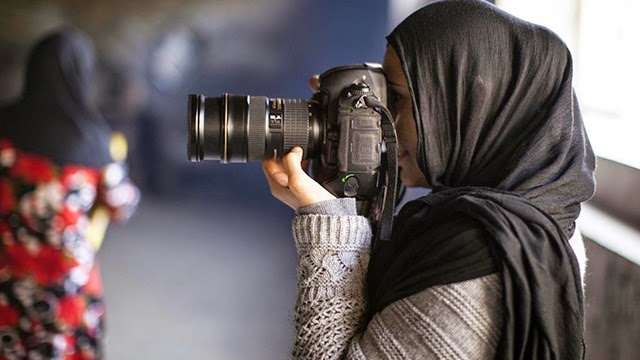
It's so easy to take images for granted in our media-saturated, selfie-happy culture, but that's a luxury the subjects of Frame by Frame can't indulge in. This documentary explores what it means to the people of Afghanistan to have been forbidden by the Taliban to take or own photographs by following four documentary photographers who live and work in Kabul. Though there's been, as one of the photographers says, a "photography revolution" in Afghanistan since the Taliban were driven from power, it's still a new and fragile art form with very few professional practitioners. As a result, these photogs—Massoud Hossaini, Farzana Wahidy, Najibullah Musafer, and Wakil Kohsar—know each other well; in fact, Moussad and Farzana are married. They're united by their sense of mission—convinced that, as Najibullah puts it, a nation without images of itself "does not have an identity at all," and that it's their responsibility to help create an accurate visual record of their beloved, beleaguered country.
Dog Lady
We don't learn a thing about the title character of Dog Lady—not even her name—except what we can glean by watching her move silently through her world. But that tells us a lot, revealing a resourceful, unflappable and observant woman who's the undisputed alpha of the pack of dogs she lives with.
Sunday, March 15, 2015
SXSW 2015: Manglehorn and Fresno
In David Gordon Green's Manglehorn, Al Pacino turns in his third performance of the last year as a man in the grips of a post-midlife crisis. This time he's Angelo Manglehorn, a locksmith whose obsession with a lost love is preventing him from fully inhabiting his own life. Dreamily kind for the most part, but given to fits of furniture-hurling rage and truth-telling so blunt it borders on sadism, Manglehorn drifts through his own life, observing the often quirky people around him as if from a great, sad distance. In one emblematic scene, he happens upon a multiple-car pileup and strides down the line of automobiles as the slow-motion, blurred sound, and the bright red watermelon guts strewn over the cars (one of the vehicles was carrying a load of melons) give the whole thing a surrealistic vibe. His house looks depressed too: dimly lit and all dark, metallic colors, even the wood paneling tinted a faint, sickly green. His only hope of connection with another living being, aside from his beloved cat, appears to be Dawn (Holly Hunter), a demure bank teller with whom he plays out a painfully awkward, lurching courtship.
Danny Collins
We meet Al Pacino's Danny Collins after a tantalizing glimpse of the promising but petrified young singer as played by Eric Michael Roy, looking and sounding uncannily like the young Pacino, whose tortured-soul realism was Method acting at its most electric. Cut to the older Collins, a perpetually smashed, paunchy sellout dabbing on the spray tan before heading on stage to deliver yet another canned concert. It's a jarring juxtaposition, since Danny's expertly faked enthusiasm and outsized gestures evoke Pacino's jarringly jazzed-up speeches in big-budget hokum like Gigli, S1m0ne, Devil's Advocate, and Scent of a Woman. But the show Danny puts on for his geriatric fans is only one small piece of a beautifully modulated, gently bemused performance by the actor, who just might be identifying with his character's thirst to regain the artistic purity and passion of his youth.
Saturday, March 14, 2015
The Diary of a Teenage Girl
True to its title, Marielle Heller's adaptation of Phoebe Gloeckner's semi-autobiographical novel has the loosely structured, unfiltered feel of a young person's diary. The film cleaves to 15-year-old Minnie (Bel Powley) in mid-'70s San Francisco as she lurches toward self-knowledge, careening from tearful insecurity to defiant self-assertion to ecstatic experimentation. Her voiceover narration and Powley's impassioned, emotionally naked performance capture the way things can feel simultaneously terrifying and thrilling at that age, as well as the way new experiences can make someone—especially someone young—feel like a whole new person.
Friday, March 13, 2015
100 Words On ... Listen to Me Marlon
This absorbing documentary about a massively talented and tormented artist is based on private audio recordings Brando made for himself, publicly released here for the first time. It illuminates Brando’s complicated relationship to his chosen career—his initial delight in acting, the contempt he developed for showbiz that curdled that joy, and his hard-won respect for his craft—as well as his passion for civil rights, hatred of American imperialism, powerful charisma, playful sexuality, and wretched parenting skills. The bulk of the footage is unfamiliar, like the scenes of Brando at home on Tahiti or rehearsing with Bertolucci for Last Tango in Paris. Marvelous excerpts from the lectures of his teacher Stella Adler present acting as a way to develop self-awareness, self-control, and, perhaps most importantly, self-acceptance.
Written for The L Magazine
Wednesday, March 11, 2015
Accidental Love
When Alice (Jessica Biel), a naïve young waitress in a small town in Indiana, is shot in the head by a nail gun, her life is upended. Her personality changes in ways that—typical of this tone-deaf film—are supposed to be funny but aren’t, at least not as they’re played out here. Uninsured and unable to afford surgery, she spots a young Congressman, Howard Birdwell (Jake Gyllenhaal) on TV and decides he can provide her and her friends with healthcare coverage. In a trek that’s part Wizard of Oz, part Mr. Smith Goes to Washington, she heads to DC with an unlikely posse: Tracy Morgan, as a man with a prolapsed anus, and Kurt Fuller, as a reverend with a boner pill-induced erection that just won’t quit. Har har.
Tuesday, March 3, 2015
The Second Best Exotic Marigold Hotel
Like its predecessor, The Second Best Exotic Marigold Hotel is a charming example of what great actors can do with mediocre material. The film unfolds, like a landlocked episode of The Love Boat, by cutting between parallel storylines. Most of these involve sex—never shown, but clearly implied—or romance between two elegantly dressed, immaculately coiffed seniors. The audience also follows wide-eyed young Sonny (Dev Patel) and wise-owl Muriel (Maggie Smith), the co-owners of the Indian hotel turned active adult-retirement community of the title, as they work to line up a loan to expand into a second hotel. Meanwhile, Sonny prepares to marry his improbably hot fiancée, Suneina (Tena Desae), nearly blowing the whole thing by paying too little attention to her and too much to his hotel.
Merchants of Doubt
An issues documentary that scores its points through a seductive combination of clearly stated arguments and pithy humor, Merchants of Doubt diagrams the methods corporations use to stop or stall political action on things that would be good for public health, but bad for their bottom lines. Most of the film's running time is devoted to the decades-long campaign, funded by big oil companies, to stall political action on climate change by casting doubt on the scientific consensus that it's a serious problem caused mainly by human actions. But some of its most fascinating detective work is devoted to piecing together the playbook used by climate-change denialists and other disinformation campaigns that was developed by big tobacco companies to bury or discredit scientific evidence that smoking is unhealthy.
Thursday, February 26, 2015
Voice Over
Voice Over played in Lincoln Center’s Film Comment Selects 2015 series on March 3.
Voice Over sketches a portrait of an upper-middle-class family in Chile, flitting from one highly charged plot point to the next (a birth, a funeral, an illicit affair, the dissolution of a marriage) without probing too deeply into any of the characters or feelings involved. That can make it feel a bit like an upscale soap opera, as beautiful sisters Sofia (Ingrid Isensee) and Ana (María José Siebald), their flawless skin generally lit to a caramel glow, speculate in upscale settings about other members of their family, with an occasional break to have sex (Sofia with an inappropropriate boyfriend; Ana with a blandly supportive husband) or take care of their children.
Wednesday, February 25, 2015
The Golden Era
The Golden Era will play in Lincoln Center’s Film Comment Selects 2015 series on March 1.
"I can't tell if anyone will read my stuff later. But I'm quite sure that the gossip about me will go on and on," laments writer Xioa Hong (Wei Tang) on her deathbed. Ironically, despite pointedly registering that complaint, The Golden Era does just what she dreads. Shunting her writing to the side to focus on her tragic love life and early death, Ann Hui's film reduces an intriguing sounding woman—one who, by the film's own account, made a name for herself as a writer without conforming to conventional mores, either about how to write or how to behave—to a Camille-like figure of pity, picturesquely tubercular, ill-used by men, and admirable mainly for the gallantry with which she faced an avalanche of bad luck.
Wednesday, February 11, 2015
100 Words on ... My Man Godfrey
As daffy Park Avenue princess Irene Bullock, Carole Lombard sometimes veers from comically disarming child-woman to annoying brat, but her character’s wide-open innocence is the perfect foil for the guarded grace of William Powell’s Godfrey in this shimmery, silver-and-black Deco dream. Characters are deftly revealed or reformed as Godfrey leaves a camp for homeless men to be the butler—and the voice of reason—for Irene’s pampered, “nutty” family. Helped by a stellar supporting cast (this film was the first to get Oscar nominations in all four acting categories), director Gregory La Cava, who started his career in animation, maintains an atmosphere of controlled chaos, whether he’s packing the frame with a roiling mass of bad behavior or homing in on Godfrey and Irene as they play out their improbable, inevitable courtship.
Written for The L Magazine
Monday, February 9, 2015
Gett: The Trial of Viviane Amsalem
Gett: The Trial of Viviane Amsalem is part of a recent spate of excellent films about—and often by—Israeli women, including Zero Motivation, S#x Acts, and Jellyfish. But while those others feature situations that could easily have played out in any industrialized Western nation, Gett's Viviane Amsalem (Ronit Elkabetz) is trapped by misogynistic religious laws that feel shockingly archaic.
Wednesday, February 4, 2015
Seventh Son
Time-lapse photography, a bombastic soundtrack, and a swirling 3D camera partial to taking aerial shots of mountaintops and whooshing down into underground prisons are just some of the tools Seventh Son employs to grab audiences—and that's just in the first one or two minutes. In one scene, smoke appears as if it might spill right into the movie theater, but director Sergei Bodrov mostly uses the 3D format as a way of heightening the effect of scary things flying rapidly across the screen. And if you've seen one witch transform herself into a dragon and swoop toward the camera, you've seen them all, so by the third or fourth time you may find yourself thinking how much more lifelike Peter Jackson's Smaug felt, or how much scarier that flying-cloud-of-smoke effect was when it depicted Dementors in the Harry Potter films.
100 Words on ... The Palm Beach Story
Gerry (Claudette Colbert) is a gloriously self-assured young beauty whose determination to leave her husband for someone who can keep her in ball gowns and diamonds would be hateful if she weren’t so matter-of-fact about it—and so in love with the comically earnest hunk (Joel McCrea). With Robert Dudley as a cranky but lovable old millionaire, William Demarest and a gaggle of other distinctive character actors as the rowdy members of the Ale and Quail club, and Rudy Vallee as a sweet nerd who just happens to be one of the richest men in the country, Gerry has plenty of suitors. She spars with them gently, sparkling with game merriment and irrepressible joie de vivre in this cheery raspberry to marriage and other pious institutions. Written for The L Magazine
Tuesday, January 20, 2015
Cake
Cake is a study of grief that drowns in a cold bath of grim self-pity. It introduces the prickly, disheveled Claire (Jennifer Aniston) at a workshop for chronic-pain sufferers, where she's pressed to talk about the recent suicide of a group member named Nina (Anna Kendrick). Their leader (Felicity Huffmann) seems infuriatingly certain that her processing formula will allow the group to efficiently dispense with feelings as complex as the shock of losing a colleague to a temptation many are wrestling with themselves. In the face of that programmatic, bullying "empathy," Claire's sardonic defiance reads like heroic truth-telling. But as the film drags on, the character's brusque insistence on speaking her mind is almost always applied to undeserving targets, like her still loving and supportive ex-husband (Chris Messina) or her saintly housekeeper, Silvana (Adriana Barraza), whose empathy floods every scene she's in, setting Claire's chilly self-absorption into even sharper relief. In time, Claire's behavior begins to read as the bitterness of an entitled person who doesn't much care how her actions affect anyone else.
Wednesday, January 14, 2015
Gangs of Wasseypur
A cheeky repudiation of traditional Bollywood treacle, director-cowriter Anurag Kashyap’s gangster saga is a little bit Tarantino, a little bit Coppola, a little bit Scorsese, and ultimately all his own. Thanks to title cards and a voiceover by Nasir Ahmed (Piyush Mishra), a friend of the gangster Khan family around whom the action revolves, the two-part, 5-hour-plus saga charts the bloody rise and fall of three generations of the family while providing a crash course in Indian politics from shortly before independence to the present.
100 Words On... His Girl Friday
Perhaps the greatest of prewar Hollywood’s comedies of remarriage--not to mention one of the all-time great newspaper stories--His Girl Friday is a fast-talking, word-drunk joy. Roz Russell and Cary Grant spar and spark as Hildy Johnson and Walter Burns, Hawksian heroes who see clearly, feel deeply, and keep the patter light. As a canny newspaper editor and his ex-wife, who is also his star writer, they’re so effortlessly in tune with each other and so good at their jobs that Hildy’s attempt to quit and keep house for her sweet, boring fiancé (Ralph Bellamy) is clearly doomed. But oh, the fun to be had in watching Walter contrive to make her stay, in a battle of wits they both wound up winning.
Written for The L Magazine
Tuesday, January 13, 2015
Play and Involuntary
For Ruben Östlund, a movie camera is an instrument of provocation and exploration. Often shooting his subjects from above or from a great distance in order to emphasize their relationship to one another, he studies his own culture like an anthropologist, dissecting social norms and looking for patterns in the ways individuals relate to one another.
Friday, January 9, 2015
Taken 3
The latest, and ostensibly final, installment in the Taken series has landed on our doorstep with a heavy thud. Directed by the aptly named Olivier Megaton and co-written and produced by Luc Besson, the film is, like its predecessors, a numbing exercise in overkill. Once more, ex-special ops agent Bryan Mills (Liam Neeson) goes into superhero mode, this time to find out who murdered his ex-wife, Lenore (Famke Janssen), and pinned the blame on him. And once more, ubiquitous aerial shots, swirling cameras, and pounding music strain to make even something as innocuous as an establishing shot of Los Angeles's jammed freeways feel as significant as the dispiritingly frequent chase scenes, gunfights, and beatings. Broken up into quick cuts and often filmed from confusing angles, the action seems aimed less at cluing us in on what's happening than simply amping up our adrenaline—and masking the impossibility of some of Mills's literally superhuman feats and escapes.
Tuesday, January 6, 2015
Episodes Season 4
Television veterans and real-life couple David Crane and Jeffrey Klarik do all the heavy lifting on Episodes, writing every word and directing and producing each episode. Klarik says he writes for revenge, and one can feel the sting of anger in sequences like the montage in the second episode of the show's fourth season. Grotesquely cheery insincerity reaches monumental heights as network executives shower the show's main characters, husband-wife writers Beverly (Tamsin Greig) and Sean (Stephen Mangan) Lincoln, with compliments on the new TV series the pair are pitching, then promptly suggest changes that would undo its very essence.
Friday, December 19, 2014
Talking to Tim Burton
If style is substance, Tim Burton is a very substantial director indeed. From his first feature, Pee Wee's Big Adventure, Burton visually inventive style has done much of the work of gothacizing his humanist narratives, often through comically exaggerated costumes and sets, matter-of-fact dollops of surrealism, and wide-eyed, well-meaning misfit protagonists. Burton's latest, Big Eyes, is about another alienated innocent marooned in a middle America that's nowhere near as calm and comfortable as it's pretending to be. But in many other ways, the film feels strangely un-Burtonesque. Margaret Keane, its main character, painted the lookalike portraits of sad children with enormous eyes that spread like kudzu throughout the U.S. in the 1950s and '60s. But the more popular her work became, the more isolated she felt, forced as she was to keep a secret that had been cooked up by her husband, who wanted the world to think he was the artist behind her "big eyes" paintings. I spoke with Burton last week about what Keane's story has to say about the suburban American dream of the Cold War era and why he opted for a more subdued visual approach in telling her story.
I guess you must like Margaret Keane's paintings, since you own a couple of them.
Well, yeah. But "like" is a funny word. I grew up with them.
Wednesday, December 17, 2014
Big Eyes
Director Tim Burton and the story of Margaret and Walter Keane, a tale of extreme weirdness hidden under the manicured surface of two middle-class American lives, were made for each other. There’s even something Burtonesque about the Keane paintings that give the film its title, portraits of children with sad, deadpan faces and eyes so huge and flat that one of the film’s characters compares them to “big stale jellybeans.” After all, it’s not much of a stretch to imagine Winona Ryder in Beetlejuice or Johnny Depp in Edward Scissorhands as Keane kids in Goth getups. But this “based on true events” tale is a Burton film without much Burton, its costumes, settings and sometimes on-the-nose dialogue all disappointingly straightforward.
Friday, December 12, 2014
Best Movies and Performances of 2014
Happy happy, merry merry, and welcome to list time.
First, here's Slant Magazine's 25 Best Films of 2014 list, which was compiled from the lists contributed by about 20 of us regular Slant contributors.
Next, Slant's 20 Best Film Performances of 2014, which I also contributed to.
And here's my personal Top 10 list for 2014, plus 10 runners-up.
Wednesday, December 10, 2014
Ida
Night and Fog, another great film about the Holocaust, warns of the danger in treating the Shoah as a one-time event buried safely in the past, perpetuated by evildoers who were fundamentally different than our presumably humane and civilized selves. “Are their faces really different from our own?” its narrator asks. Ida uses an investigation into the annihilation of a fictional Jewish family in Poland to pose the same question, contemplating the horrible helplessness of the ordinary citizens caught in the maws of the Nazis’ murderous totalitarianism. With minimal dialogue, luminous black and white cinematography and penetrating performances by open-faced Agata Trzebuchowska as the contemplative title character and sharp-faced Agata Kulesza as her gallant but cynical aunt Wanda, Paweł Pawlikowski's quietly devastating film limns one family’s losses with delicate precision.
Saturday, December 6, 2014
The Color of Time
By submitting nearly everything he creates for public approval, regardless of whether it's substantial enough to hold up to that kind of scrutiny, James Franco does no favors to not-ready-for-prime-time works like The Color of Time. The multihyphenate gathered students he had taught at New York University's film school to write and direct this fictional imagining of the life of poet C.K. Williams, which, despite stellar performances in the main roles, feels nearly weightless and painfully derivative.
Friday, December 5, 2014
100 Words On ... In Bloom
The Georgia of In
Bloom, which is set in 1992, is no country for young women. Life is
relentlessly bleak for 14-year-old Eka (Lika Babluani) and Natia (Mariam
Bokeria), who are surrounded by joyless, mean-spirited adults, ignored or
hectored at home, and harassed after school, Eka by bullies and Natia by a
macho suitor who refuses to take no for an answer. But Natia’s incandescent courage,
Eka’s quiet self-reliance, and both girls’ fierce loyalty and love for each other
keeps a flickering ray of hope alive in this ferociously well-acted story of
life in the struggling post-Soviet republic.
Written for The L Magazine
Wednesday, December 3, 2014
Concerning Violence
Less a documentary than an illustrated essay, Concerning Violence begins with a mini-lecture by a Columbia University professor on the significance of Frantz Fanon’s classic critique of colonialism, The Wretched of the Earth, which the film sets out to elucidate.
Monday, November 24, 2014
The Kingdom of Dreams and Madness
With its meandering pace and frequent cutaways to plants or animals, Mami Sunada’s documentary about Japan’s Studio Ghibli in some ways mirrors the studio’s animated features. But while there’s greatness in the nonsense and nonsequiturs of soulful films like Spirited Away and The Tale of the Princess Kaguya, which touch on nearly everything that really matters in human existence, Sunada’s goals seem far more modest. Providing a fan’s-eye view of the studio with an emphasis on director Hayao Miyazaki, she shadows Miyazaki as he goes about his daily routines and films business meetings and press conferences. And, in voiceovers she reads in a girlishly enthusiastic tone of voice, she fills in details about Miyazaki’s long, often complicated relationships with director and cofounder Isao Takahata and producer Toshio Suzuki, the two other main creative forces behind Studio Ghibli.
Despite the director’s fan-girlish gusto, the documentary is no hagiography. The studio seems cool at first, reminiscent of a tech startup given the calisthenics the staff do every day at their desks and the in-house cat (which Sunada often cuts to) and daycare center. But then an animator says many of her colleagues have been worn down by trying to meet Miyazaki’s demands, losing their motivation and their hope. “If there’s something in you that you want to protect, you may not want to be with him too long,” she says carefully. You sense the chilling effect of Miyazaki’s dark side in the halting precision with which she chooses her words, and in the diffidence nearly everyone but Miyazaki’s young assistant, Sankichi, shows around him. In one telling scene, Miyazaki completes the script to The Wind Rises and Sankichi urges the staff to come celebrate in his studio. A few people tentatively enter, stand around awkwardly for a few moments without saying a word, then sidle back to work.
Meanwhile, a portrait emerges of Miyazaki as an artist who finds creative freedom by adhering strictly to routines. Sunada repeatedly shows him climbing the stairs to his studio, where he works, six days a week, from precisely 11 in the morning to nine at night. Part of every Sunday, his one day off, is spent cleaning up the local river that he and a group of fellow nature lovers took on as a cause years ago. Sunada’s admiring questions and Sankichi’s bubbly enthusiasm bring out a playful looseness in the director, who confesses that even he doesn’t know “what was going on” in Spirited Away, and who talks about the horrors of WWII and the nuclear disasters that helped shape him as a pacifist and a passionate ecologist. He also expresses serious reservations about the future of the planet and the work to which he has devoted his adult life. “How do we know movies are even worthwhile?” he asks. “If you really think about it, is this not just some grand hobby?”
Unfortunately, The Kingdom of Dreams and Madness is hesitant to show the great work that resulted from that “grand hobby.” Apparently assuming that her viewers are familiar with all of Studio Ghibli’s films, Sunada never includes any clips from the classics she refers to, and only rarely shows bits of The Tale of The Princess Kaguya and The Wind Rises, the films Takahata and Miyazaki were completing during the making of this documentary. More than once, music swells and people tear up on screen after they’ve watched climactic scenes of which the audience is shown only snippets. A film about filmmakers should leave one wanting to see the fruits of their labor, so as to better appreciate what makes them so special, but Sunada’s doc becomes talky and static in ways that Studio Ghibli’s work never are.
Written for Slant Magazine
Friday, November 7, 2014
Getting On Season 2
Unlike the American version of The Office, which turned the original BBC show's odious main character into a loveable goofball, Getting On closely follows its British progenitor's lead. The series features cringe-inducingly self-deluded, insensitive characters, focusing on their awkward relationships and borderline incompetent care in a farcical depiction of the frustration, stagnation, and unlikely moments of grace at a hospital geriatric ward. But like the American Office, its take on its characters is ultimately forgiving, a kind of bemused acceptance.
Wednesday, November 5, 2014
100 Words On... The Man Who Came to Dinner
George S. Kaufman and Moss Hart, who wrote the play this film was adapted from, set a whole cupboardful of plates spinning in this madcap comedy. Sheridan Whiteside (Monty Woolley), a razor-tongued metrosexual writer, falls during a visit to a bourgeois Midwestern couple and commandeers their home for the Christmas holidays while he recovers. Holding court in their parlor while his exiled hosts cower upstairs, Sherry receives famous visitors and outré gifts, hatches convoluted plots, and issues outrageous orders with the blithe assurance that they’ll be followed to the letter.
Monday, October 27, 2014
Braddock America
Another portrait of a former manufacturing giant hollowed out by the global economy's race to the bottom of the wage scale, Braddock America revisits depressingly familiar ground for anyone with an even cursory knowledge of the rusting of the Steel Belt. Films on this subject constitute a genre of their own, and this one stays mostly on well-trodden ground, contrasting present-day images of abandoned houses gone to seed, near-empty churches, and dynamited buildings with archival footage of the enormous steel mill that once offered the men of Braddock, Pennsylvania and their families a ladder to the American dream. Braddock America may lack the humor, creativity, and rib-jabbing cheekiness of classics like Roger & Me, but it's also mercifully free of the ruin-porn shots that turn so many contemporary films about struggling cities into self-consciously arty exercises in the romanticization of decay. Its goal is relatively modest: to capture the story of one town as it was experienced by a number of its residents. The stories they tell, usually addressing the camera directly, form an oral history of a golden era for America's working class—especially those who were white and male.
Tuesday, October 14, 2014
The Tale of The Princess Kaguya
A magnificent cherry tree in bloom, the ultimate Japanese symbol for mortality, exudes a striking emotional resonance in The Tale of Princess Kaguya, an adaptation of a Japanese fable by Studio Ghibli cofounder Isao Takahata. The soft colors, graceful movements, and clean lines that depict the animated figures and their environments, and the frequent close-ups of beautiful flora and fauna, embody the ineffable beauty of life on Earth that is one of the film's main themes. Meanwhile, the title character's transformation from the giddy, near-perpetual motion of her childhood to the mournful stasis of adolescence is a potent illustration of its feminist critique of what is traditionally supposed to constitute a happy life for a girl.
Monday, October 13, 2014
Citizenfour
Citizenfour screened on October 10 and 11 at the New York Film Festival. It opens in theaters on October 24.
Huddled in a Hong Kong hotel room, Edward Snowden and the three journalists he handpicked to release his incendiary evidence about the massive spy networks used by the U.S. National Security Agency (NSA) to gather information on everyone in the United States and millions more abroad discuss how to get their news to the public. Snowden wants to come out publicly as the source of the information, he says, to show the NSA "I'm not going to let you bully me into silence, like you have everyone else." Yet he doesn't want to enable the media to turn away from the damning information he compiled to make him the story, focusing on who he is and why he blew the whistle. In Citizenfour, Laura Poitras shows how Snowden and his print collaborators, Glenn Greenwald and Ewen MacAskill, succeeded in doing just that. As the third of the journalists chosen by Snowden, the one documenting his story on camera as it unfolds, Poitras also teaches by example, providing a privileged insight into Snowden's personality and motivation while keeping the focus on government spying.
Birdman
Birdman screened on October 11 at the New York Film Festival.
Like the self-serious director in Sullivan’s Travels, Alejandro Gonzáles Iñárritu has seen the light, but where it took a stint in a chain gang to show Sullivan the pretentiousness of his highminded ideals, Iñárritu just had to hit middle age. In the Q&A after the New York Film Festival press screening of Birdman, Iñárritu said turning 50 made him do a lot of thinking about how his ego has been a “huge” driving force in his creative life, telling him one minute that he’s great and the next that he’s nothing, in what he described as “a constant bipolar process.” The film that thinking inspired him to make, a lightfooted cautionary tale about the perils of selfishness and ambition, is a welcome change from meretricious bummers like 21 Grams and Babel, which attempted to improve our moral fiber by rubbing our noses in melodramatic misery.
Thursday, October 9, 2014
St. Vincent
From the moment boozy misanthrope Vincent (Bill Murray) agrees to help his new next-door neighbor, struggling single mom Maggie (Melissa McCarthy), by babysitting her bully-magnet son, Oliver (Jaeden Lieberher), St. Vincent's outcome feels preordained. But the rusty familiarity of the premise is consistently enlivened by Vincent's prickly but humane sensibility. A vein of mostly verbal, often mildly sardonic humor imbues the film, even in places where Vincent never goes, like Oliver's classroom, whose kind but firm teacher (Chris O'Dowd) bombards the students with a cascade of bemused one-liners. Meanwhile, the contrast between Vincent's world-weary rebelliousness and the earnest middle-class world around him provides a few nicely gonzo sight gags, as in Maggie finding Oliver diligently pushing a gas mower in tight circles around the patch of dirt where Vincent lies in a plastic chaise longue, his ever-present drink on a nearby table and his old Walkman cranked up to blast '70s rock. "I'm teaching him the value of work," Vincent explains faux-innocently.
Wednesday, October 8, 2014
Mr. Turner
Mr. Turner played this weekend at the 52nd New York Film Festival. Sony Classics will release the film theatrically beginning December 19 in New York City.
“When I peruse myself in the glass, I see a gargoyle,” the great English artist J.M.W. Turner (Timothy Spall) tells Mrs. Booth (Marion Bailey), his kindhearted landlady. Mrs. Booth, from whom Turner rents a room when he visits the seaside town of Margate, deflects his self-criticism, saying she believes him to be a good and sensitive man. In fact, according to writer-director Mike Leigh’s engrossing biopic, they’re both right. A man of artistic genius and enormous feeling, Turner was capable of behaving with great sensitivity. He could also be an unfeeling lout.
Subscribe to:
Posts (Atom)