Wednesday, February 29, 2012
Let the Bullets Fly
The circle may have finally closed on Tarantino-ization with this Chinese film, which seems to borrow as generously from QT as he borrowed from Hong Kong masters.
A gorgeously filmed chow fun western set about 100 years ago in southern China, in “the age of warlords,” as the opening titles put it, Let the Bullets Fly keeps tossing us curve balls, from its comic train robbery opening to its wry coda of an ending.
Thursday, February 23, 2012
Oscar-nominated shorts
Whether you’re a hard-core fan of short films or you just want to see as many nominees as possible before entering the office Oscar pool, there’s a lot to enjoy in this year’s Oscar-nominated shorts.
The strongest category is the documentaries, a parade of pain packaged with strong messages of hope and perseverance, so you don’t feel as if you’ve suffered for nothing.
Friday, February 17, 2012
Safe House
If the trailer for Safe House has you thinking you’ve seen it all before, you’d be right. But if you like a solidly made thriller with lots of fighting, that shouldn’t keep you from enjoying this one.
The déjà vu starts with the premise, which is part Training Day and part Haywire. As he did in Training Day, Denzel Washington plays an ethically compromised veteran of a law enforcement agency (this time around, the CIA) who schools a naïve recruit (Ryan Reynolds) on how things really work. And, as in Haywire and countless other spy-versus-spy movies, Denzel and Reynolds’s characters are agents on the run who must fight for their lives as they figure out who is trying to kill them and who—if anyone—they can trust.
Shot largely with that grainy, high-contrast, desaturated look that signals gritty reality in so many pictures these days, Safe House doesn’t do anything new, but it goes through its paces with style.
Wednesday, February 15, 2012
Cirkus Columbia
If you admired the intent behind Angelina Jolie’s In the Land of Blood and Honey but wished you could have seen it done with Eastern European indirection rather than big-footed American sensationalism, you’ll want to check out Cirkus Columbia.
As he did in No Man’s Land, writer-director Danis Tanovic sets this modest but not insubstantial film in his homeland of Bosnia and Herzegovina in the early ‘90s. Tanovic adapted the script from a novel of the same name, which addresses the turmoil that ripped the former Yugoslavia apart by focusing on one broken family.
Monday, February 13, 2012
The Secret World of Arietty
No wonder anime auteur Hayao Miyazaki had wanted to make a film about the Borrowers for pretty much his whole career, until he finally co-wrote this one a couple years ago. Mary Norton’s children’s books are a perfect match for Miyazaki’s adult-friendly children’s movies, with their strong female lead, their inventive take on living light on Mother Earth (what are Borrowers if not the ultimate recyclers?), and their deep respect for a child’s sensibilities.
But something softened that life force in The Secret World of Arietty, which feels as if it were made by Disney rather than just released by the mouse house here in the U.S.
Saturday, February 11, 2012
Albert Nobbs
As numbingly inert as its title character, Albert Nobbs is a triumphant actor’s exercise that never quite succeeds as a movie.
That may be partly because its star, Glenn Close, is a co-writer and co-producer, having worked for years to get the movie made after playing the part onstage in 1982. But it probably has even more to do with director Rodrigo García (Mother and Child), whose films often feel a bit hollow and contrived despite featuring great performances by great actresses.
Wednesday, February 8, 2012
The Dish and the Spoon
The light is beautiful, the backgrounds artfully softened, and the actors charming, but The Dish and the Spoon starts to flatline just a few minutes in.
We start out in a car with Rose (Greta Gerwig), sniffling her way through the Lincoln Tunnel in a winter coat and pjs. Greta makes Rose easy to relate to as she rolls past seedy strip malls, scarfing down doughnuts and beer. Then she picks up a soulful teenager (Olly Alexander) and her story quickly devolves into a series of scenes that feel like acting exercises.
Friday, February 3, 2012
The Grey
The Grey is one of those macho-adventure-gone-terribly-wrong movies that aims to give you a vicarious scare, shaking you out of your over-civilized stupor and awakening you to the need to live life to the fullest and then die like a man, unafraid and unburdened by regret.
It opens with promise as John Ottway (Liam Neeson), hired by an oil company to kill the wolves that would otherwise kill the oilfield workers, stops a wolf in its tracks with one expertly fired bullet and then helps it die, laying a compassionate hand on the animal’s flank as it breathes its last ragged breaths. The terse authority of Neeson’s manly voiceover and the wolf that doesn’t so much as snarl when Ottway strokes it make it clear that we’re in mythic/fairy tale territory, and it’s a solemn, contemplative region I’d have been glad to commit to if director-cowriter Joe Carnahan had just done the same.
Wednesday, February 1, 2012
Pretty Poison
One of the greatest actresses and beauties of her generation, Tuesday Weld had an emotionally raw yet subtle quality on camera and a brash, sometimes crude way of expressing contempt for Hollywood—-and for social mores in general—-in real life that made more than one admirer compare her to Marlon Brando. But there doesn’t seem to have been room in the pantheon for an actress who was so openly defiant and independent-minded, especially during the gender-inflexible Eisenhower and Kennedy years when she got her start. So, while postwar Hollywood made Brando the poster boy for naturalistic method acting at its brilliant best, Weld became a cult figure, celebrated by those of us who love her for the feral intelligence and world-weary skepticism that make her characters so compelling even when the movies she’s in are … well, let’s just say not so compelling.
But when the film she stars in is as fierce or unconventional as the actress, you’re in for a real treat. That’s the case with Pretty Poison, a black comedy with then 23-year-old Weld in the title role as teen heartthrob Sue Ann Stepanek.
Thursday, January 26, 2012
Haywire
With flat, dark eyes that project about as much emotion as the chunks of onyx they resemble, mixed martial arts (MMA) star Gina Carano is not quite ready for her closeups in Haywire. She also seems a little uncomfortable in the dresses her character has to keep putting on to disguise herself, as stiffly self-conscious as a little girl playing dress-up in her mother’s clothes, and to add insult to injury, director-cinematographer-editor Steven Soderbergh had to digitally manipulate her voice in post-production to achieve the cool confidence he was after. But Carano relaxes in action, owning the screen in the medium and long shots that focus on not just how good her banging body looks but how well it moves.
Soderbergh built this film around Carano (with the help of screenwriter Lem Dobbs) after seeing her MMA cage fighting, in much the same way that he created The Girlfriend Experience for porn star Sasha Grey. The chilly super-competence of these post-feminist heroines is a good fit for Soderbergh’s cool, controlled style, and their slightly unconventional routes to success resonate with his ethos as a filmmaker.
Friday, January 20, 2012
The Iron Lady
“It used to be about trying to DO something. Now it’s about trying to BE someone,” sneers The Iron Lady’s Margaret Thatcher (Meryl Streep) of our changing social values. She’s right, of course, but the irony of The Iron Lady is that it’s a textbook example of that trend.
Not that examples are hard to come by. Celebrities who are famous just because they look good in the spotlight aren’t anything new (remember the Gabor sisters?), but for the last 10 years or so they’ve been multiplying like flu victims in Contagion, with Paris Hilton in the Gwyneth Paltrow role. A few of the reality shows that dominate network TV ratings are built around people who can actually do something extraordinary: How amazing is it when those contestants on Project Runway make stylish outfits out of office supplies? But mostly, we watch reality shows not because of what their stars can do but because of who they are and how they behave—-or, better yet, misbehave.
Wednesday, January 18, 2012
Crazy Horse
Asked for her definition of eroticism, one of the members of the Crazy Horse’s staff offers this: “Seduction without offering yourself. Restraint.”
That’s not a bad way of describing Frederick Wiseman’s thoughtful, undogmatic approach to filmmaking, which layers on information without commentary, letting viewers draw their own conclusions. But Wiseman’s exploration of Paris’ Crazy Horse cabaret, which bills itself as the world’s classiest purveyor of nude dancing, is the opposite of a seduction.
Friday, January 13, 2012
Tinker Tailor Soldier Spy
In ex-British spy John le Carré’s Cold War novels about his former profession, the main weapons are intellectual brilliance and psychological acuity and the prize is a secret concealed within a secret. You wouldn’t think something that heady would be very cinematic. But the winner in le Carré’s mind games is generally the best watcher, the one who notices the most about his environment and the people around him, and that makes his stories ideally suited to a visual medium like film.
While body-rush fantasies like the Mission Impossible TV and movie series turn the spy/counterspy game into a question of who has the best techno-toys (and, in the movies, Xtreme fighting skills), le Carré is pure head rush, a mental game with the added thrill of feeling scarily plausible. Done well, films of his stories sharpen your senses, making you notice things and tune into frequencies you wouldn’t ordinarily pick up on. They give you the psychological equivalent of the thrill you imagined experiencing as a kid if you’d bought a pair of those X-ray vision glasses they used to advertise in comic books. And Tinker Tailor Soldier Spy, the latest adaptation of one of the author’s George Smiley books, is very well done indeed.
Monday, January 9, 2012
The L Magazine's 2011 Film Poll
Here's The L's annual poll of its regularly contributing critics. We each pick 20 movies, ranked in order of preference, and the editors compile our choices into a Top 25 list.
1. The Tree of Life (Terrence Malick)
Like the God of Job, Malick can leave his supposed intimates struggling to make sense of themselves within his cosmos: he's burned through who knows how many editors, worked sound teams to the bone, and left composers and many actors feeling cheated. But his methods have also inspired devotional loyalty among those who've achieved their capacity for grace under his eye: in The Tree of Life, he coaxes the work of a lifetime out of Brad Pitt, Jessica Chastain and Emmanuel Lubezki (and Jack Fisk, whose realization of Malick's hallowed spaces is his own life's work). And by prodding us to engage with our own capacities, he makes us into better, more open, attentive moviegoers. And people? Sure. Mark Asch
Friday, January 6, 2012
Women Behaving Badly
We’ll know feminism has finally taken root when the female leads in the stories we tell ourselves behave just as badly as the male leads do. We haven’t gotten there yet, but two current movies are giving us an idea of how things might look when we do.
Lisbeth Salander (Rooney Mara), the title character of David Fincher’s remake of The Girl with the Dragon Tattoo, is as grimly antisocial and borderline fanatical as any male movie vigilante (think Charles Bronson or Clint Eastwood’s Man With No Name). This is one woman who could care less what people think of her, mainly because she doesn’t think much of almost anyone else. In fact, the whole purpose of the spiky Goth getup that gives the movie its name is to keep people at a safe distance.
Thursday, December 29, 2011
My 2011 Top 10
1. The Tree of Life
The winner of this year’s main prize at Cannes and the subject of millions of pixels’ worth of online debate, Terrence Malick’s fifth feature as writer/director over the last 38 years is to cinephiles what Halley’s Comet is to astronomers: an eagerly anticipated and rarely seen phenomenon. Read more
2. Certified Copy
A French expat living in Tuscany with her teenage son drops in on a lecture by an Englishman on a book tour. (He’s James Miller; she never gets a name, but since she’s played by the great Juliette Binoche, she hardly needs one.) She leaves him her card through his Italian translator, and he shows up the following Sunday for a visit that turns into a day-long date.
The winner of this year’s main prize at Cannes and the subject of millions of pixels’ worth of online debate, Terrence Malick’s fifth feature as writer/director over the last 38 years is to cinephiles what Halley’s Comet is to astronomers: an eagerly anticipated and rarely seen phenomenon. Read more
2. Certified Copy
A French expat living in Tuscany with her teenage son drops in on a lecture by an Englishman on a book tour. (He’s James Miller; she never gets a name, but since she’s played by the great Juliette Binoche, she hardly needs one.) She leaves him her card through his Italian translator, and he shows up the following Sunday for a visit that turns into a day-long date.
Tuesday, December 27, 2011
Talking to Pariah Director Dee Rees
After a brief post-college career in marketing, Nashville native Dee Rees returned to college to major in film at NYU. She wrote the script for Pariah, which recently won her a Breakthrough Director prize from the Gotham Independent Film Awards, while interning on her professor and mentor Spike Lee’s Inside Man. I talked to her earlier this month in the Waldorf Hotel.
I was interested to read that Toni Morrison and Toni Cade Bambara were two of your favorite authors, since they’ re favorites of mine too. What do you like about them in particular?
They write about coming of age in a different way, and identity and self and what is home. Their characters always had internal conflict. For me growing up, those were the stories that made me feel like I was not by myself.
Pariah is so detailed and emotionally authentic that it feels very personal, but you grew up in Nashville and it’s also very specifically about a slice of African-American and gay culture in Brooklyn. Did you have to do a lot of research to get the Brooklyn part right?
I don’t research. I just write and then check afterwards. When I was coming out, I was living in Brooklyn and going to these gay clubs, so this is the scene I was kind of thrust into.
Thursday, December 22, 2011
The Adventures of Tintin
The two Spielberg movies opening this week represent the two sides of this prodigiously talented but often disappointing director. A mashup of deeply personal themes (mostly boys with daddy issues and/or with no parents in sight) and high-gloss Hollywood technology and tropes, Spielberg’s work seesaws between moving and maudlin. War Horse is gorgeously composed old-school schmaltz, with its relentless score and heroic low-angle shots of blue-eyed heroes against great expanses of sky. But if that stale hunk of cornbread is Spielberg at his most suffocatingly sentimental, The Adventures of Tintin is the director at his best: playful, energetic, and brimming with genuine wonder.
Friday, December 16, 2011
Coriolanus
The theory that the United States is poised to fall like the Roman empire, and for pretty much the same reasons, is hardly new, but it’s rarely been presented more compellingly than in Ralph Fiennes’ X-treme Shakespeare version of Coriolanus.
In an impressive directorial debut, the actor transposes the classical Rome of Shakespeare’s play to an ashy, underlit modern-day Europe (the film was shot in Bosnia), packing the screen with all the markers of modern warfare and civil unrest. Brutal battles between Rome and its Volscian neighbors feature Humvees and RPGs, shot-up cars with slaughtered civilians spilling out of their half-open doors, and terrified prisoners in dank torture chambers. Meanwhile, hordes of Romans take to the street at home like so many 99 percenters, protesting the hoarding of goods by a thin slice of the oligarchy while the rest of the people starve.
Friday, December 9, 2011
Like Crazy
A connect-the-dots love story, Like Crazy works as much because of what it leaves out as because of what it includes.
Director Drake Doremus, his co-writer Ben York Jones, and editor Jonathan Alberts often start or end a scene in the midst of an action or skip months at a time in the otherwise linear timeline, so we have to keep figuring out what we just missed. That helps maintain interest in what might otherwise have felt like a pretty standard story about a first love that burns alternately hot and cold but just won’t fizzle out.
Thursday, December 8, 2011
Daguerréotypes
Daguerréotypes is playing on December 12 at the Maysles Cinema.
An openhearted, unpretentious film genius who often seems to be reinventing her medium as she goes, Agnès Varda is particularly gifted at uncovering fascinating stories where most people would never think to look. In Daguerréotypes (1976), she turns her camera on her own neighbors, the shopkeepers of Rue Daguerre, the street where she then lived—and still does, 60 years after she first moved in.
She plays with theatricalism, opening with and frequently cutting back to the magician who stages a show on Rue Daguerre while she’s filming, and who will, she promises, “erase logical ideas … and lull an already still world.” But this is at heart a quiet work of unobtrusive observation, an exercise in what you can see if you look long and closely enough at any “average street with people passing, talking … the silent majority with a dreadful mask,” as Varda puts it in voiceover.
Wednesday, December 7, 2011
London River
A Frenchman of Algerian descent, London River writer/director Rachid Bouchareb works in the didactic-humanist tradition of Alejandro González Iñárritu and Fatih Akin. When their films are good, they’re very, very good, but when they’re bad they drown out their own artistry, beating the drum so loudly for brotherhood and justice that you pull back from the story instead of leaning into it and wind up feeling numb.
London River doesn't have the emotional complexity or unpredictability of Bouchareb’s greatest film, Days of Glory, but it’s not his worst either. Grounded in a real event, the July 7, 2005, suicide bombings of three subways and a bus in London by Islamic extremists and filmed in a raw, pseudo-documentarian style, London River seems bent on reminding us that we’re all brothers and sisters under the skin and that Muslims can make excellent neighbors, but stellar acting by its two leads saves it from playing like mere propaganda.
Thursday, December 1, 2011
Hugo
Martin Scorsese’s latest film and his first children’s movie, Hugo starts with a tracking shot even longer and more thrilling than the one at the start of Goodfellas. After swooping down from the sky, though the streets of 1930s Paris, and into a train station, the camera slows down to introduce us to the station where almost all the action will take place. It ends with a closeup of Hugo (Asa Butterfield), an orphan who lives in a hidden room above the ceiling, as he peers out at the passing pageant.
Hugo’s child’s-eye view exaggerates and simplifies the world of the station, but Scorsese and his team bring it to richly detailed life. Whole subcultures (like the cozy bistro’s blasé musicians) and subplots (like the budding romance between Richard Griffiths’ sweetly awkward middle-aged man and his kindly crush, played by Frances de la Tour) are sketched in just a few strokes.
Friday, November 25, 2011
House of Pleasures
Like Julia Leigh’s Sleeping Beauty (due out next Friday), Bertrand Bonello’s House of Pleasures is a feminist film about prostitution with the languorous, trapped-in-amber feel of an ominously fractured fairy tale. But where Leigh’s alienated stranger in a strange land is almost entirely defined and ultimately engulfed by the male gaze, Bonello offers up the comforts and pleasures of female friendship as a response to the cold menace of unchecked male domination.
Except on the rare occasions that their madam (Noémie Lvovsky) or clients take them out, the dozen or so prostitutes in House of Pleasures are not allowed to leave the well-appointed Parisian brothel where they work, during the end of the 19th century and the beginning of the 20th. And we stay right there with them, the camera hugging close to study their faces or capture the intimate groupings they fall in and out of all day and night. Having sex in the private rooms upstairs, mingling with the johns in the ground-floor parlor in a nightly cocktail party, or banding together to sleep, eat, and prepare for work from the very early morning to the late afternoon, they live out a kind of parody of bourgeois domesticity in which nothing is as it seems except their mutual love and support.
Thursday, November 24, 2011
Fall Harvest
It’s that time of year again when distributors dump high-gloss and high-class Oscar hopefuls into theaters almost faster than we can keep up with them. Here are a few of my favorites that are playing now.
After their uncomfortable flirtation with neutered political commentary in 2008’s Harold and Kumar Escape from Guantanamo Bay, it’s a relief to see Harold (John Cho) and Kumar (Kal Penn) return to their absurdist roots in A Very Harold and Kumar 3D Christmas. This sweet stoner comedy is a loosely strung-together series of goofs on 3D gimmickry, classic scenes and tropes from other movies, and the growing Harold and Kumar canon (“We’ll see you in the fourth one,” Neil Patrick Harris tells the boys at the end of his third anarchically hilarious H and K cameo). There’s a happy ending too, of course, in which Kumar learns that you can grow up without giving up your joie de vivre. Or your weed.
Saturday, November 19, 2011
100 Words On: Incendies
With so much heart-rippingly real drama in Incendies’s story of civil war in an unnamed Middle Eastern country—the wholesale slaughter and torture of civilians, honor killings, the vicious cycle of revenge that makes perpetrators of victims and vice versa, and the necessity and impossibility of forgetting the past once the battle has ended—the Chinatown-esque contrivance at its heart is just too much.
Thursday, November 17, 2011
J. Edgar
Clint Eastwood is smart and savvy, a polished professional whose long career probably owes a lot to the talent he’s proven, both as an actor and as a director, for whittling things down to a fine polish. In rounding off his own rough edges, he lessens the risk of alienating viewers, but he also removes the passion and personality that can make a movie great.
He’s at his best when he sticks with the entertaining and solidly constructed genre movies, like The Outlaw Josie Wales, that make up most of his output. Now and then, he’s displayed a winningly light touch with a simple romance or character study (The Bridges of Madison County, Bronco Billy), and he’s directed a handful of original, quirky, deeply personal films that leave lasting emotional footprints, like his tribute to Charlie Parker (Bird) or his two very different meditations on violence and the cinematic antiheroes who were once his bread and butter: Unforgiven and Gran Torino.
But more often than not, he overreaches when he tries to make a statement or yank at our heartstrings, winding up with a clunker like Changeling or the Flags of Our Fathers/Letters from Iwo Jima diptych.
Wednesday, November 16, 2011
Tomboy
Like writer/director Céline Sciamma's Water Lilies, her sophomore feature is a sensitively observed, impressionistic tale of an inarticulate adolescent girl picking her way through the gender identity/sexuality maze.
The title is a bit of a red herring, though. This isn't just a film about rejecting the trappings and physical limitations of traditional girlhood for an elongated period of freedom; it's about male impersonation and a young girl's awkward first steps toward embracing her own lesbianism.
Friday, November 11, 2011
This Is Spinal Tap
At 11:11pm tonight, 11/11/11, BAM hosts a screening of "the movie that goes to 11," This Is Spinal Tap. It also screens at 7pm, to be followed by a Skype Q&A with stars Christopher Guest and Harry Shearer, in character as Nigel Tufnel and Derek Smalls.
The mockumentary has become such an accepted film and TV trope that, as shows like Modern Family and The Office have proven, you can sketch in that frame with the broadest of strokes, just letting your characters mug for the camera or sitting them down in front of an imaginary interviewer to comment on the action every so often. But Christopher Guest doesn’t play that game. His largely improvised, almost painfully realistic, artfully artless mockumentaries commit, both to their ludicrously earnest characters and to the cheesy conventions of bad documentary films.
Wednesday, November 9, 2011
Critiquing a Critic: A Life in the Dark
I started reviewing movies (not very well) in 1978, at the peak of Pauline Kael’s brilliant career and the height of my own wandering-in-the-desert phase. Alienated, aimless, and only just starting to believe that other people might be interested in what I had to say, I was still in the habit of damming up my opinions until they tumbled out in an often inchoate torrent.
My neo-hippie distrust of the mainstream media and instinctive allergy to the East Coast preppie-industrial complex prevented me from discovering Kael in the New Yorker, the elevated if uneasy perch she occupied from 1968 to early 1991, but her voice was strong enough to penetrate even my defensive fog. I don’t remember when or where I picked up a paperback copy of Reeling, Kael’s fifth fat collection of reviews and essays about the movies she loved, but I remember the thrill with which I first encountered her passionate, proselytizing prose and brilliant insights.
Friday, November 4, 2011
In Time
Writer-director Andrew Niccol’s movies must sound great in pitch meetings. The Truman Show (1998), the only script he wrote and didn't direct and, not coincidentally, by far his best movie, is a prescient look at how horribly wrong things can go when reality TV gets mixed up with reality, period. Simone (2002) is about what will happen to us humans once we’ve taken artificial intelligence far enough to create digital “people” who can pass for real. Lord of War (2005) is about the international arms merchants who feed our perpetual state of war. (It’s against them, but that doesn’t mean it can’t have some fun with those guns. Picture a bullet’s-eye view of something getting blown up and exploding into a huge fireball.) Gattaca (1997) is about a couple of beautiful kids on the run in a winner-take-all world where genetic engineering has run amok and the wall separating the haves from the have-nots is practically unbreechable. In Time is another take on that same theme, plus a cautionary message about the growing wealth gap. (It’s against that too. Hey, those Occupy Wall Street kids will love it!)
Wednesday, November 2, 2011
Bombay Beach director Alma Har’el: Documenting the demise of the American dream
Israeli director Alma Har’el was making a music video when she got hooked by the location, a gone-to-seed resort community on California’s Salton Sea, and two young brothers she found living there. One of the two, sad-eyed Benny Parrish (pictured above with Har’el), became one of main characters of Bombay Beach, Har’el’s first documentary and a gorgeous, quietly eloquent meditation on life on the geographic and economic edge of America.
Elise Nakhnikian: You got pretty amazing access to the people in this film. How did you get them so comfortable with the camera?
Alma Har’el: I think it was a combination of things. One is that I moved there for four or five months while I was filming. The second is that I had no crew. It was just me. I did the sound and the camera, so it was very intimate. The third is that I used a very small, cheap home video camera that it didn't have the kind of threatening presence that some cameras have. And the Parrishes, I think, trusted me very much because they saw this music video I did with their son.
That started the trust and the relationship. Pamela [Benny’s mother] just really appreciated the creative process in general, and she always wanted to take photos herself and do creative things. They’re a creative family. A lot of people have creativity and don’t get to express it.
Also, I was a pain in the ass. I just wouldn't leave. (Laughs) So they had to get used to it.
There’s a sort of innate power differential, usually, when you have a camersomeone’s doing the shooting and someone’s getting shot—
Okay. I didn’t feel that.
I was going to say that it wasn’t so much there in your movie. Did you think of it as a collaboration with the people –
What would you say the power comes from? Just the fact that you have the power over them because you have the footage?
Well, one person is choosing what’s going to get shown and how it’s going to get shown, and which parts do and don’t get used.
Yeah, yeah. That is true, but I made it my first priority on this film to use stuff that wasn’t hurting the people I was filming and that was acceptable for them.
Did you collaborate with them in deciding what to shoot?
No. But there’s a lot of stuff that I decided not to put in because I knew that they wouldn’t be comfortable. Especially the back story of Benny’s dad. His family story goes back another generation. Benny’s father’s story is very interesting, but he didn’t want to appear in the film.
A lot of people ask me about all sorts of rules of documentary that I have to say I’m not familiar with, what’s just truth and just showing life and what’s not, and what’s legitimate, and what’s moral, and all these things. I think what’s most important to me – and maybe the only thing that I really cared about – was that the family I’m filming would be happy with the film when I finished it.
So did you show them a rough cut and take out things they didn’t like?
No, I never showed them a rough cut. They saw the film at Tribeca [Film Festival].
So you just trusted your own instincts about what they’d be comfortable with?
Yeah, it was more like an instinctive thing.
One of the things that comes through really clearly in your film is the wealth gap in America and how poor people are usually invisible to us as a culture. Do you think you see that more clearly because you’re not a native so it’s new to you, or is that something you’re familiar with from Israel?
Both. I’m definitely familiar with these sort of outskirts-of-society ghost towns that are in the desert, because we do have that in Israel. I actually, for a while, spent a lot of time in one of those in Israel. I like those places. I feel that you can very much get lost but at the same time find yourself in them, and feel something very direct about life, and see things clearly for what they are. So I responded to that.
But I also just didn’t know that America had such a side. I obviously grew up on the image of Hollywood in Israel. Coming there and seeing how people lived, and seeing the broken, turned-on-its head American dream, where a kid has to move from Los Angeles to Bombay Beach to make it to college (laughs), and just seeing the health system and just the whole thing. But at the same time, seeing the beauty and the dignity that these people have in their lives. The whole combination felt like something I should capture.
And it also very much relates to the music I love. I love Bob Dylan and Beirut [whose songs are featured in the film]. This is music that I listen to all the time. They’re kind of two bookends of America to me.
Bob Dylan is obviously the blood of this country, and he’s at the same time such an outsider. He’s both one of the most American things you can think of and he also encapsulates so much history and promise for a different America. Bob Dylan in the 60s, and the whole folk thing, rose against a lot of the stuff we see today, like Occupy Wall Street. I won’t say hippie, but what do you call that?
Beatnik?
Yeah, I guess. But obviously, it didn’t go that way. And then you have Zach [Condon, Beirut’s leader], who is kind of like a modern version of the troubadour. Zach is very much an American – grew up in the desert, by the way, in Santa Fe and Albuquerque – but he’s free of a lot of history that I feel some artists carry.
I find that both of them have the ability to be genuine and authentic, and at the same time they both have so much style and so much presence and flavor. Their authentic selves and who they are as artists always shines stronger than whatever aesthetic decisions they take, but there’s so much beauty to their style and to the choices that they make.
Speaking of style, can you talk about the look of your film–the soft, warm colors and the soft feel you get by using shallow depth of field?
Yeah, I call it a digital super-8. I fell in love with this camera when I was working with an incredibly talented DP called Matthias Koenigswieser, who shot a music video for me for Jack Peñate. We did this music video in black-and-white on this very small camera, the Canon Vixia, which costs, like, $600 in Best Buy. I loved the softness of it and I loved the colors.
I took that camera to do one more video for Beirut, which was Concubine, the one I was telling you about. I had no budget so I shot it myself. That was the first time I shot anything myself, but this camera was so small I didn’t need a crew. So one thing led to another, I guess they say in English.
But I couldn’t shoot with heavy [professional film] lenses. I was running around with the kids and I was so scared I was going to drop them. Each one was, like, $10,000 and I didn’t have very much insurance. So I brought them back and I went on eBay and bought still camera second-hand lenses. They were a lot lighter and smaller, and not very expensive – just a few hundred bucks. Part of the reason that the film has sort of a vignette to it and a shallow depth of field and a softness is that I used those lenses, and some of them were older and some of them were cheaper and some weren’t as sharp.
The whole way this film was done was half inspiration, half desperation.
Did doing this make you want to do more of your own shooting?
I love shooting. I love it.
The sound is amazing too, at least now that I know you did it. I understand that sound is one of the hardest things to get right.
I recorded all the sound on two lavalier mikes, so the kids could run around and do whatever they wanted. And then in post, I had this great guy named Dror Mohar who does sound, who just as a favor came there with me for a few days and recorded a lot of background and a lot of texture and sound. When we made the film, we added a lot of that and cleared up the sound that I had recorded. So that definitely gave it the sort of clarity and richness that it has now.
But we also kept it very minimalistic. I wanted it to be very quiet, because that’s what it is like over there. It wasn’t an action film where I needed tons of sounds.
There’s a lot of sorrow in this film, which is mostly imposed by outside forces: gun violence, the criminal justice system, racism. But it’s not a sad movie because there’s so much beauty. That’s partly because of the look we’ve been discussing, but it’s also because of the relationships between the people: There’s a lot of love and kindness there. So I’m wondering how you thought about this as you were putting it together. Did you think of it as a story about individuals, or about relationships between people, or about the relationships between people and the forces that shape their lives?
All of the above. [laughs] All of the above and me. And music.
I didn’t set out to talk about an issue. I really like the idea of how, as we grow up, we have a certain mythology about our families that we build in our heads. We hear broken stories and we know certain things and we kind of make it all up. And then we take these stories on ourselves, like Benny says, ”I was in jail for 100 years.” He doesn’t really know what jail is, but he knows his father was there and he knows it was terrible. So he says he was there, and he comes up with this whole story about how it was terrible and how it had scorpions in it and no TV and they killed kids.
I wanted to capture how we all live with half-broken, half self-invented mythologies that we carry from our pasts and our parents and our countries, and how it leaves room for the imagination, because it is so broken. That place, the Salton Sea, has such a past, and I come from a country that had such a promise and turned into such a violence place.
I grew up in a place that had a lot of beauty in it and a lot of togetherness, and at the same time a lot of violence, a lot of conflict. I didn’t really care when I was a kid, but as you grow up you realize how much it was the backdrop for everything. I think that’s the same thing with this place: the reality of the American dream and its promise. What happened to it?
You used composition and framing really nicely to make points you never spell out. Like the California girl poster that looks so out of place in a bar, or the dead fish in the foreground of shots that are about something else altogether.
One of the things that really drew me to this place is that I felt like the environment and the decay and the cultural references tell such a story that you don’t need to say anything. And I love that, because when I live my life and I go to new places, there isn’t a freaking narrator telling me what to think about everything and explaining every little thing to me.
Wednesday, October 26, 2011
Take Shelter
Like the recurring nightmares that torment its main character, Curtis (Michael Shannon), Take Shelter is frustratingly slow-moving at times, but it lays down shock waves of dread that keep rippling outward long after it ends.
At first, Curtis hides his terrifying dreams and waking hallucinations—and, most importantly, the deepening paranoia they both reflect and intensify—from his wife, Samantha (Jessica Chastain). But when he finally trusts Sam with the truth, he learns the strength of the family bond that is his main motivation for trying to keep it together, and this story’s true subject.
Writer/director Jeff Nichols stages the family’s everyday life as unshowily shot kitchen-sink realism. They’re in the heartland of America, not just geographically—Curtis, Samantha, and their adorable young daughter live in a small town in Ohio—but economically, perched as they are on the uneasy edge of middle-class comfort. An elegant cut early on takes us from the big drill Curtis and his work buddy, Dewart (Shea Wigham) operate on their job site to the sewing machine Samantha is running as she sews to supplement her husband’s income. Meanwhile, references to strained family budgets and close-ups of the mac and cheese, fried pork chops, and potato salad piled onto dinner plates keep reminding us that everyone’s finances are as shaky as Curtis’ state of mind. As Curtis’s brother warns him: “You take your eye off the ball one minute in this economy and you’re screwed.”
Against that backdrop, Curtis’ dreams and hallucinations are that much more dramatic. Set during or just before spectacular, CGI-assisted storms, they are usually bathed in the brilliant, soft light of a bright sun filtered through a thick layer of clouds. The light, those clouds—broad blue-gray brushstrokes above a color-saturated blue-green landscape—and the frequent slashes of lightning or rustle of wind through the leaves are all charged with a sense of potentially catastrophic excitement. Into this surrealistic setting come figures right out of Hitchcock or zombie movies: swirling flocks of black birds and shadowy human forms that pound at locked doors or break car windows, pulling Curtis’s daughter out and away from him forever.
Curtis doesn’t know whether his dreams and waking visions are a sign of the schizophrenia that overtook his mother when she was his age or visions of a coming apocalypse that only he can see. And so, even as he seeks psychological help, he risks bankrupting his family to expand their underground storm shelter into a bunker. We don't know what to believe either, since Nichols keeps both possibilities wide open right down through the ending, which can be read literally or as another of Curtis’s visions.
Trying to figure out whether he’s a prophet or a madman gives us something to do while the pace lags during a slow, often repetitive first hour or so, during which Curtis and his family play variations on the same few themes, often with predictable consequences. But the tension builds as Curtis falls apart, coming to an almost unbearably suspenseful peak in a riveting sequence in the storm shelter.
Shannon signals Curtis’s vulnerability and instability largely through body language. Moving like a prisoner of some unseen force field, he seems stiff and tentative and awkward at the same time that his square jaw and tall body radiate menacing power. Even when his face isn’t lit from below or pooled in shadow like something from a horror film, we’re uncomfortably aware of how close he is to erupting and hurting someone, maybe even the wife and daughter he lives for.
Chastain matches Shannon’s realistic intensity beat for beat as Samantha, who is as loving a mother as the one she played in The Tree of Life but much tougher and more competent—a real woman rather than an idealized childhood memory. (Between this, her tough Mossad agent in The Debt, and her sweet peroxide ditz in The Help, Chastain has already shown more range this year than most actors do in a lifetime’s worth of roles.) When the two go head to head, especially in the storm shelter scene, Take Shelter stops meandering in and out of blind alleys and coalesces into a moving portrait of a loving family under siege.
Written for TimeOff
Thursday, October 20, 2011
Drive
In one of his deceptively haimish digressions, businessman/gangster Bernie Rose (Albert Brooks) tells the unnamed star of Drive (Ryan Gosling) about the movies he used to produce. “One critic called them European,” Rose says. “I thought they were shit.”
That’s a neat little in-joke, since director Nicolas Winding Refn is a Danish critics’ darling (Drive won him the best director prize at Cannes this year). Refn specializes in highly stylized, pulse-pounding arthouse films about hard guys in no-win situations who see extreme violence as their only way out—or, in the case of the title character in Bronson, their sole means of expression. But that line is the only hint of irony I detected in Drive. This movie-movie appears to be dead serious about resurrecting the hard-guy American vigilante films that flourished in the last half of the last century, and updating the tradition with a Refn-sized dose of grossly graphic violence.
Gosling’s driver works in a garage during the day and moonlights as a getaway driver for professional thieves. (He also has another part-time job, but I won’t ruin the surprise by telling you what that is, since it’s revealed in a tasty little bit of misdirection.) Like the taciturn tough guys played by Steve McQueen and Clint Eastwood in their prime (Bullitt was Refn’s main model for Drive), he communicates almost entirely through action, his Zen-like default mode of quiet watchfulness punctuated by brief but bloody rampages.
Even his courtship with the girl next door, Irene (Carey Mulligan), consists almost entirely of doing things together without speaking. Gosling is convincing enough as a lover to sell his half of their wordless montages, with the help of Mulligan’s melting eyes. But the expressionless stare he adopts to play tough and the slow-blooming smile he reveals one or two times too many read to me as damaged sensitivity in retreat, not smoldering anger or coiled intensity or whatever they’re meant to imply.
But not even not quite buying Gosling as a ninja-style master of evasion and hand-to-hand combat spoiled the movie for me, since there’s so much else to enjoy. Bryan Cranston and Christina Hendricks do a lot with a little in underwritten roles, and Kaden Leos is charming as Irene’s son. And Brooks makes an excellent villain, kvetching and kvelling like somebody’s loveable grandpa while plotting nefarious stuff. Just watching him kill a man with a fork is pretty much worth the price of admission. As A.O. Scott put it, “In his self-authored comic roles, Mr. Brooks often exudes a passive-aggressive hostility, a latent capacity for violence held in check by neurosis and cowardice. He lets you assume the same in Drive until the moment he stabs someone in the eye with a fork. It’s a shocking and oddly glorious moment — something a lot of us, without quite knowing it or being able to explain just why, have been waiting 30 years to see.”
Drive is generally a little light on that kind of texture or emotional resonance, but from the terrific opening scene, it’s very good at transmitting information efficiently and maintaining tension and suspense. That first scene culminates in a cat-and-mouse car chase, which our guy wins as much by knowing when and where to stop as he does by being driving fast and furiously. He never speaks a word in that sequence either, but by the time it’s over we know just how smart he is and how cool he stays under pressure.
Then there’s the style Refn soaks the script in. Some is pure noir, like the rays of light that occasionally slice through darkness to create vivid black-and-white patterns, the faces half-drowned in shadow, and the chocolate-brown night-time scenes and deserted back streets that show LA as anything but a sunny paradise. Other choices—the romantically morose, synth-heavy pop music pounding away in the background; the slow, stately pans and slow motion that turn violent crescendos operatic; the fondness for overhead shots—evoke the work of Michael Mann.
That’s an awfully high bar to try to reach, and Drive doesn’t hit it, since Hossein Amini’s self-consciously stripped-down script lacks the emotional depth that makes Mann’s best antihero tragedies so great. But if you’re looking to get lost for a couple hours in a smartly plotted, beautifully acted popcorn movie, Drive can take you there, and that’s no small accomplishment.
Written for TimeOff
Monday, October 17, 2011
The Descendants
The Descendants was the closing film for the New York Film Festival yesterday. It opens in U.S. theaters on November 18.
Part Coen Brothers and part James L. Brooks, Alexander Payne makes comedies about serious stuff like the abortion wars and midlife crises. His characters may verge on caricature and his scripts on contrivance, but nuanced acting and lingering close-ups make their emotions feel vividly, even painfully real.
His best film since Election, aside from the segment he directed in Paris, je t’aime, The Descendants is based on a novel written by a young woman (Kaui Hart Hemmings), which may explain why the two girls in the story feel so well-rounded. But then, Payne has always gravitated toward interestingly prickly female characters, from the glue-sniffing title character of Citizen Ruth to Election’s endlessly ambitious Tracy Flick and the impetuous biker played by Sandra Oh in Sideways.
The main women in this story are Matt King’s wife Elizabeth (Patricia Hastie) and the couple’s two daughters, 10-year-old Scottie (Amara Miller) and 17-year-old Alex (Shailene Woodley), both of whom are acting out like crazy as the story begins.
Elizabeth never speaks a word (we see her first as a gigantic face filling the screen with delight as she rides in a speeding motorboat, then as a comatose husk of a body in a hospital bed), but we get a pretty good sense of her through the things other people say about her—and to her as she lies there, a pale slate for other people to scrawl their emotions on.
Her injury leaves her workaholic husband to care for the daughters to whom he has always been an absent presence. Matt, Alex, and Scottie have to come to terms with Elizabeth’s condition. They also have to learn how to be a family in a whole new way, since Matt has been just the “backup parent” up to now, as he says in a voiceover that dominates the first part of the film but fades away in the second, as he finds people other than himself to talk to.
As if that weren’t enough, everything Matt thought he knew about his marriage is upended when Alex tells him that Elizabeth had been having an affair before the accident that knocked her out.
Hawaiian culture is as strong a presence in this film as Omaha was in Citizen Ruth or California’s wine country was in Sideways. We don’t see much of the state, but what we do see is heavy on aging beach bums (“In Hawaii,” Matt tells us, “some of the most powerful people look like bums and stuntmen.”) and light on picturesque volcanoes and beaches. More than halfway through the film, Matt asks a cousin who’s driving him and his girls from the airport on Kauai to make a detour to the family holdings. (Another subplot has Matt guiding a huge clan of cousins to a decision about how to dispose of 25,000 gorgeous acres of Kauai that belong to the family, since their great-great-grandmother was a Hawaiian princess.) “Let’s see the land,” he says, and he might be talking to us, since the magnificent vista we’re about to be treated to is the first we’ve seen since the movie started.
Matt is supposed to be an ordinary shlub but, as good as Clooney is here, he can’t quite pull off ordinary. He does manage to look tired and unglamorous, his shoulders tensely awkward and his waistband too high. When Matt finds out about the affair, he takes off running with none of Clooney’s natural grace, his elbows flailing and his feet slapping the ground noisily.
But the real power of Clooney’s performance rests in his eyes, which always let us know just what Matt is feeling, whether he’s warily greeting a cousin, confronting his wife’s lover in a near-paralyzing rage, watching his daughters in frustrated silence, or gazing into space, stunned at the news of another betrayal.
Matt is not the only character whose soul is bared. All but the most minor characters have at least one emotional scene where they get to reveal their true face, often triggered by news of Elizabeth’s dire condition. (Grief is always closely linked to anger in The Descendants, and people generally cope with a blow by attacking somebody else.) But the excellent cast—particularly Clooney, Woodley, and Robert Forster as Elizabeth’s fiercely devoted father—keeps the rolling epiphanies from feeling rote.
Written for The House Next Door
Saturday, October 15, 2011
The Artist
The Artist screens tomorrow at the New York Film Festival. It opens in U.S. theaters on November 23.
The Artist is a feather-light gimmick spun into a feature-length film. Writer/director Michel Hazanavicius’s tribute to silent movies starts with a movie buff’s tongue-in-cheek premise: What if we made a silent movie about the silent film era, where the stars all act the same way in their real lives as they do in their film-within-a-film movies?
The film begins at the end of Hollywood’s silent film era, as star George Valentin (Jean Dujardin) and aspiring starlet Peppy Miller (Bérénice Bejo) meet cute and fall for each other. The rest of the movie chronicles their long journey to a happy ending while their careers careen in opposite directions as he laughs off the talkies as a fad, fading into impoverished obscurity, while she embraces the new technology and becomes one of its biggest stars.
The two mug like Gloria Swanson in Sunset Boulevard, exaggerating the already extreme expressions and gestures employed by most of the stars of the teens and early '20s. George flashes his blindingly white grin on the red carpet like Dudley Do-right, and Peppy’s signature move—onscreen and off—is a two-fingered whistle followed by a blown kiss. But then everyone in this world overacts, even the studio head (John Goodman) who bellows things like “the public is never wrong!” and the audience members who radiate oversized emotion at a screening, some clapping their hands to their cheeks in amazement.
The best thing about The Artist is its look. Crisply lit black and white photography, and anti-panoramic 4x3 aspect ratio, periodic iris cuts, and the clearly phony painted backdrops in some of the film-within-a-film scenes evoke early American films nicely. So do the distinctive faces and forms of supporting players like James Cromwell as George’s faithful manservant, Ken Davitian as a pawnshop owner, and Goodman’s blustering studio chief.
Dujardin, whose mustache, piano-key smile, and heroic poses make him look like a cross between Gene Kelly and John Gilbert, also channels Douglas Fairbanks and Fred Astaire, among others. Peppy is the quintessential perky, spunky, beautiful but sexless early American movie heroine, while the icy wife who ditches George on his way down (Penelope Ann Miller) conjures up the grim, lace-collared, straw-man matriarchs played by the likes of Esther Dale when the jazz babies were sending up Victorian values. Even the adoring Jack Russell terrier that sticks like a burr to George is a doppelganger for the dog who played Asta in the Thin Man movies.
The Artist is as much about what we know (or think we know) about how those movies were made as it is about the movies themselves. We laugh knowingly when a series of credits illustrates Peppy’s rise, starting with one that misspells her name at the bottom of a long roll, and the story of George’s John Gilbert-like descent bangs out a comfortingly familiar chord.
But there’s something a little disingenuous about the whole thing, which feels like a spoof masquerading as a tribute. Singin’ in the Rain covers similar ground, looking at how careers rose or fell when Hollywood discovered sound, but it’s upfront about its attitude toward the mugging that was rampant in the silent era, portraying it as loveable but laughable. In The Artist, Peppy voices that sentiment (in title cards) and then apologizes for it, saying she didn’t really mean it, but why not? Watch a truly great actor in one of the truly great films of the silent era – John Barrymore in Don Juan, Buster Keaton in just about anything – and you’ll see no mugging or posturing or winking or two-fingered whistles, just comedy, tragedy, and raw human emotion.
The Artist could have used a few more little bits of business like the one where Peppy fondles George’s jacket, putting her arm through one sleeve and then around her own waist to pretend that he’s holding her. It also could have used a lot fewer scenes that tell us things we already know in not-clever-enough ways, like the recurring bit where George’s wife defaces pictures of him, adding florid mustaches and goofy glasses. Instead, it relies too much on the charm of its leads, making their exaggerated gestures feel a bit desperate at times.
This might have made a lovely 15- or 20-minute short, if anyone out there would fund such a thing. But at 100 minutes, it’s a joke stretched too thin.
Written for The House Next Door
Friday, October 14, 2011
The Ides of March
Toward the end of The Ides of March, Governor Mike Morris (George Clooney), a presidential candidate maneuvering to win the Democratic primary, gains the crucial support of a powerful senator by promising to appoint him secretary of state if elected. It’s an important compromise that Morris earlier vowed not to make, since the senator “wants to cut the top 10 floors off the United Nations.”
Political protests are toppling governments around the world. In our own country, people on both the right (the Tea Party) and the left (Occupy Wall Street) are becoming increasing vocal about their disgust at the corporations and other unfielded players who call so many of the shots in our political system, controlling politicians mainly through financial contributions but also by delivering blocs of special-interest voters. The time seems ripe for a mainstream movie with the guts and the smarts to dramatize the pressures that make candidates speak in slogans and backtrack on important decisions, sometimes even betraying their own core principles. I had hoped that The Ides of March would be that movie—certainly Clooney, his frequent creative partner Grant Heslov, and the excellent case of this film would have been up to the challenge—but it turns out to be something much blander and less interesting.
The Ides of March is not about its leading candidate or the choices he makes. Morris is never even seen or heard from in Farragut North, the book on which Clooney and Heslov based their screenplay. He has a couple of brief but important scenes in the film, but for the most part he’s in the background if at all, a face on a heroic campaign poster, a body in a makeup chair, or an orator briefly glimpsed on a monitor or half-heard from backstage while making another in a series of plainspoken, left-of-center speeches.
In fact, this movie isn’t even about the political process. It’s just another coming-of-age story about an ambitious young man—in this case, media-handler prodigy Stephen Myer (Ryan Gosling, who goes from starry-eyed to dead-eyed without showing us much in between)—who gets a job in a cynical system that he fully intends to reform but gets corrupted by instead.
Stephen’s road to ruin passes through some pretty dirty double dealing, both by him and by his campaign-management colleagues. Rather than finding the fun in their one-upmanship, the way Duplicity did with corporate espionage, or locating an interesting middle ground between outrage and pathos, like Up in the Air or The Informant!, The Ides of March goes for a moralistic gravity that makes the film feel as naïve as crack reporter Ida Horowicz (Marisa Tomei) accuses Stephen of being before his change of heart.
The film’s relatively humorless authorial hand weighs even heavier when a pretty young intern (the always vivid and sympathetic Evan Rachel Wood) winds up in mortal danger after developing clandestine relationships with both Stephen and another key player. There are some good lines (after planting a rumor with the gullible media about Morris’ opponent, Stephen tells an assistant: “I don’t care if it’s true. I just want to see him spend a day denying it”), but at least as many feel scripted and glib. “Mark Morris is a politician…. He will let you down, sooner or later,” says Ida in a speech that might as well come packaged with a blinking neon sign that spells out “foreshadowing.”
Paul Giamatti and Philip Seymour Hoffman turn in rock-solid bookend performances as the former allies turned rivals who head up the competing campaigns. The film kicks into high gear whenever either or both of these grizzled pros is on screen, with Hoffman in particular giving it a much-needed jolt of rumpled realism.
But then Stephen gives the camera another long tragic stare or Morris delivers another liberal-wet-dream speech, making a clear, cogent, uncompromising and unapologetic case for secular humanism or abortion or higher taxes on the rich, and we’re reminded that The Ides of March is nothing more than a comfortingly familiar fable for fans of CNN. After all, no one who talked the way Morris does could remain a serious presidential candidate in this country for long.
Written for TimeOff
Thursday, October 13, 2011
Policeman
Policeman will play at the New York Film Festival on October 15 and 16. It is not scheduled to open in U.S. theaters.
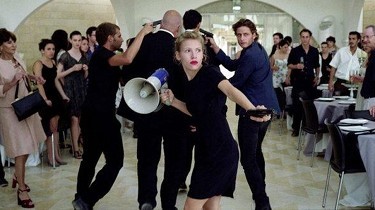
Why does everything always have to be about the Palestinians? Natanel (Michael Aloni) asks Shira (Yaara Pelzig) as she reads the first draft of a manifesto she’s writing for their tiny group of anti-capitalist rebels. Can’t we just make this about what’s happening within our country—the social equities, the wealth gap, the relentless violence?
Natanel gets his wish in Policeman, an Israeli film that was one of NYFF sleeper hits among the press and industry types who saw it last week. Israel’s conflict with the Palestinians is just one small part of the backdrop here. The showdown is between two insular tribes with a shared love of violence: the young protesters and a clique of not much older cops, whose fatal collision has the somber inevitability of a Greek tragedy.
Writer/director Nadav Lapid starts with the cops, all members of an elite counter-terrorism unit. An insular pod of hard-driving, hard-bodied, testosterone junkies, they’re the kind of guys for whom a new arrival at a backyard barbecue sparks a noisy orgy of back-thumping and chest-bumping.
After marinating in their culture long enough to get to know their leader, Yaron (Yiftach Klein), pretty well, we switch to the protesters. Natanel and Shira are humorless, near-expressionless true believers, but their sidekick Oded (Michael Moshonov) is more like a faithful puppy than a comrade. Impressionable and emotionally volatile, he seems to be loyal to the cause mainly because he’s hopelessly in love with Shira.
We linger a while with this group, too. In a Q&A after the press screening, Lapid explained the logic behind his unusual and effective way of showing the two groups consecutively rather than cutting between them from the start. He dispensed with the parallel cuts, he said, because he didn’t want the focus to be on when or how the two groups would meet. “The question for me was, who are these people? Who are these groups? I tried to describe their existential essence.”
Natanel is officially in charge of the protesters, but it soon becomes clear that Shira is the group’s emotional fulcrum, the one who naturally winds up in charge, as Yaron does with his buddies. She and Yaron each get one lingering extreme close-up that underscores the parallels between the two as they stare into the camera, all willpower and seemingly unshakeable self-confidence.
The two groups meet after the “killer babies,” as the bride contemptuously calls the young protesters, take three hostages at a society wedding. They take hostages to attract media attention to their manifesto, but they chose these particular ones for a reason: they see them as guilty of a long string of capitalist crimes that include privatizing the nation’s salt mines and cruelly exploiting their workers.
Lapid grants every character his or her dignity, and he makes most easy to empathize with even if they’re not particularly sympathetic. Touching ties between fathers and children help humanize the people involved, motivating heroic acts from both hostages and hostage-takers in the final showdown. But there are no feel-good happy endings in Policeman. These characters are boxed into rigid roles, and though their actions can make things marginally better or (more often) worse, there may be no way out of the mess they wind up in.
Hmm, maybe this is a metaphor for the Israelis and the Palestinians after all.
Written for The L Magazine
Wednesday, October 12, 2011
Substance Over Style: 2011 Trenton International Film Festival
The 2011 Trenton International Film Festival will run from October 14 through 16 at the Mill Hill Playhouse in Trenton.
"The theme running through this year's selection is the complexity of human relations—in communities, in larger societies, and between individuals and people of differing religious and political beliefs,” says Trenton Film Society Executive Director Cynthia Vandenberg of the 2011 Trenton International Film Festival. “In each of the films we see how people can transcend the normative behaviors that surround them and how, consequently, they challenge others to do the same."
Watching the films in this year’s festival, you get the sense that the programmers were more interested in substance than style. In the opening of Scheherazade: Tell Me a Story, for instance, the camera drifts around the Cairo apartment where the main character, TV journalist Hebba (Mona Zaki), lives with her husband Karim (Hassan El Raddad), a reporter yearning to become editor-in-chief of his state-owned newspaper. The intention is probably to introduce us to the power couple’s über-consumerist lifestyle, but badly lit spaces and painfully slow pans make it hard to see anything much. And in the opening scene of Kinyarwanda, a dark room looks washed-out as the camera shoots toward the light pushing through the windows, the saturation levels briefly and distractingly correcting themselves whenever someone walks between the camera and the window and temporarily blocks the glare.
The storytelling and acting are often a little rough around the edges too. In Scheherazade, Hedda replaces the political programming on her show with personal tales of everyday women to please Karim, who’s been told he won't get the job he’s angling for if he doesn’t put a lid on his outspoken wife. Most of the stories Hedda airs are interesting, if only in a gossipy sort of way, but the movie feels inorganic and schematic, thanks in part to ham-fisted dialogue. “You veil me, take my money, impose your conditions and your mother’s. If marriage just means having sex, I’ll pass on you!” one of Hebba’s guest yells at her fiancè during a flashback, in a speech that would sound graceless and unnecessary even if we hadn’t just heard him do everything she accuses him of.
The festival’s opening film, Kinyarwanda, is fictional, but it’s based on testimonials from Rwandans who found refuge at a mosque and a madrassa during the 1994 genocide of Tutsis by their Hutu countrymen. Its earnest effort to document the bravery of those who resisted the calls to slaughter and to explain the reconciliation process that followed sometimes feels didactic. Some of the actors are also stiff, including Zaninka Hadidja, who plays young Jeanne, a central character who goes on the run after finding her parents murdered in the home she shared with them.
But if Hadidja does not have sophisticated acting chops, she does have an innate sweetness and strength of character that radiate out from the screen, almost as compelling as a commanding performance. And the stories that unfold in the film’s overlapping multipart narrative, in which a scene glimpsed in one segment may be played out in full in another, are so inherently dramatic that they can’t help but capture your interest.
At the same time, Kinyarwanda never lets you forget that life has a way of getting in your face even in the midst of a genocide. More than once, like when Jeanne’s parents fight over the affair her mother has just learned that her father was having, the murderous talk on the radio and the rampaging mobs outdoors are just a dim background accompaniment to a heated exchange about something else altogether.
That’s not to say that the filmmakers soft-pedal or ignore the horrors that were part of that genocide, but they make them clear without rubbing our noses in them. Instead, they focus on acts of heroism by brave people who risked their own lives to save others and on the resilience of the human spirit.
Kyrgyzstan’s The Light Thief stars writer/director Aktan Arym Kubat as the man everyone calls Mr. Light, an electrician who jerry-rigs connections for village elders and others who can’t afford to pay for electricity. Either an antic drama or a comedy with a heavy heart, it’s an unusual, sometimes uneven mixture of light and dark, silly and serious.
At times, the film seems to be lurching from point to point like the boyishly open Mr. Light and his friends after they’ve been on a bender. If it’s not moving from one loosely connected set piece to another–Bekzat the town capitalist, tries to bend other people to his will; Mr. Light gets electrocuted and survives; the village major dies; Bekzat tries to woo a group of Chinese investors–it’s showing us seemingly random shots of village life, the horses and donkeys as well as the people. It’s interesting, in a purely ethnographic sense, to see how these people work, play, and keep house, but it’s not always clear what a given scene has to do with the main story, which is about the enlightenment and eventual disillusionment of the charmingly naïve Mr. Light.
Uruguay’s A Useful Life stars Jorge Jellinek, who is an actual film critic and looks it. His Jorge, a pale and pudgy mole of a man, is a longtime employee of a grant-supported arthouse whose sheltered routines are shattered when his cinema loses its funding, forcing him to rediscover the modest pleasures and unexpected joys of real life. Filmed in black and white with a droll sense of humor that comes out mostly in the visuals (Jorge gets his first heroic close-up as his head is being shampooed, and that shot is followed by an artily askew one of the shampooer’s upside-down face), A Useful Life could have been a clever film student’s response to the challenge: “Make a film about the most uncinematic subject you can think of.” It’s a deliberately small-scale character study, an island of sly subtlety in a sea of films with far grander intentions.
Written for TimeOff
Subscribe to:
Posts (Atom)