Showing posts with label Random thoughts. Show all posts

Tuesday, January 11, 2011

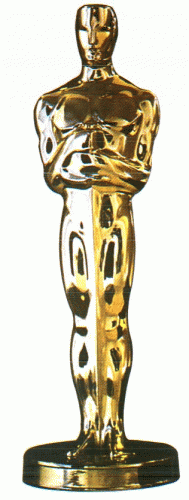
Getting Ready for Oscar

There are less than 50 days left to catch the nominated films before the Oscars air on the last Sunday in February, so here's a rundown of movies I expect to see nominated in a couple of weeks. Even if they don’t get any love from Oscar, most are all well worth watching.

The Social Network's combination of first-class filmmaking and social significance is catnip to the Oscars, as it has been to just about every other awards program this year, so I’m betting it’ll be nominated for best picture, director, and screenplay and for at least one acting award. All three of its leads (Jesse Eisenberg, Andrew Garfield, and Justin Timberlake) deserve the statue, but Garfield has gotten most of the awards so far, maybe because his character was the only one of the three you can actually relate to.

The King’s Speech is another kind of Oscar candy, a beautifully acted historical drama with snob appeal (we Yanks just can’t get enough of those royals) and a strong populist streak (the king’s quirky self-taught therapist treats his crippling stutter by daring to treat him as a friend). The movie is likely to be nominated for an Oscar, and Colin Firth is almost sure to get a best actor nod for his buttoned-down yet emotionally flayed portrayal of King George VI, a very private man forced to assume a very public role.

Black Swan is all but certain to be nominated for best picture, best director (Darren Aronofsky), and/or best actress (Natalie Portman as prima ballerina Nina Sayers in the title role that slowly drives her mad – and, of course, as her choreographer incessantly reminds us, in the white swan role Nina inhabits so effortlessly).

Inception, 127 Hours, and The Town are all likely contenders for best picture and/or director too, and James Franco should get a best actor nod for his impressive physical and emotional work in 127 Hours. True Grit, The Fighter, The Kids Are All Right, Winter’s Bone, and Blue Valentine are also likely to get best picture or screenplay nominations and almost sure to nab some in acting. I thought Mark Wahlberg’s unshowy but rock-solid performance in The Fighter was the best work he’s done since Boogie Nights, but he’ll probably be passed over by the Academy as his character was in real life, overshadowed by his crack-addicted brother Dicky (Christian Bale), whose motor mouth alpha-dog antics are just the sort of thing that wins trophies. That said, Bale has earned whatever accolades he gets for his Dicky, a volatile antihero with electric eyes, a hungry stride, and a comically outsized ego that might actually be almost justified.

Jeff Bridges will probably earn another richly deserved nomination for his laconic Rooster Cogburn, an outlaw disguised as a lawman in True Grit, the Coen brothers’ pitch-perfect adaptation of Charles Portis’ martini-dry Western satire. Bridges’ teenage costar Hailee Steinfleld may get some love in the supporting actress category for nailing 14-year-old Mattie’s humorless self-righteousness and unbending backbone. I’d like to see Matt Damon recognized too, since he’s very funny as a preening Texas Ranger who turns out not to be as useless as you’d expect, but I think Oscar prefers Damon as a more conventional hero.

And The Kids are All Right may well earn a supporting actress nomination for the amazingly intelligent, emotionally transparent Annette Bening. Bening turned in a standout performance last year in the tasteful tearjerker Mother and Child, but I liked her even better in the funny and warmhearted Kids, which takes the temperature of family life in a particular place and time in American history as precisely as a John Updike novel.

Melissa Leo in The Fighter, Jacki Weaver in Animal Kingdom, and John Hawkes in Winter’s Bone could all win best supporting actor or actress nominations for their work in much darker family stories (Jennifer Lawrence may also get a best actress nomination for her real-as-dirt work as Winter’s Bone’s Ree Dolly). Hawkes’ Uncle Teardrop is the closest thing Ree can find to an ally while scouring her fist-tight and lethal Ozarks community in search of her missing father. Leo and Weaver both portray toxic moms, though Leo’s is all head-tossing sound and fury while Weaver’s coyly aging “Grandma Smurf” is a piranha disguised as a goldfish.

Other possible nominees worth catching include:

  • Michelle Williams and Ryan Gosling for their exquisite acting in Blue Valentine, a realistic domestic downer about the birth and death of a love affair;
  • Likely best foreign film nominees Mother, A Prophet, Biutiful, and Carlos;
  • Best documentary candidates Exit Through the Gift Shop, Inside Job, A Film Unfinished, Marwencol, Last Train Home, The Tillman Story, and Joan Rivers: A Piece of Work;
  • Toy Story 3, which is almost sure to win Best Animated Feature, and Despicable Me, The Illusionist, and Megamind, which may also get nominated; and
  • The excellent ensemble casts of Mike Leigh’s Another Year (Lesley Manville is a likely supporting actress nominee), Rabbit Hole (Nicole Kidman could nab a best actress spot for this one), Please Give (Catherine Keener is a long shot for best actress) and Greenberg (mumblecore queen Greta Gerwig was widely and deservedly praised for her sort-of-mainstream debut in this one).

Written for TimeOFF

Saturday, September 25, 2010

Emails With my Editor: George Clooney


When I think of a blog, I think of someone writing about what he or she is thinking/feeling/doing, in a conversational style that invites comments. In my favorite blogs the line between reader and writer is blurred, with reader comments enriching the original post by building on or arguing with it.

I started Girls Can Play mainly because I wanted someplace to park the reviews and interviews I do for the publications I write for, but I also hoped the blog format would invite readers to leave their own thoughts. A few of you have commented (and earned my eternal gratitude), but on the whole, this has remained a parking lot for my opinions.

I’d like to turn this parking lot into a living room, a place where there’s always an interesting conversation going on. (Actually, I guess what I have in mind is a salon, but that’s taken.) I know you have it in you; I just don’t know quite how to bring it out. So I’m trying something new.

Anthony Stoeckert, my editor at TimeOFF, also loves movies and writes about them when he can for his own blog. He’s a smart guy and a good writer with a conversational, welcoming writing style, so I've always enjoyed "talking" movies with him via email (we've never met – or even talked on the phone). We thought some of our exchanges might work as blog posts, starting with this one.

This is a lightly edited conversation (we pruned it back some after going off on too many tangents) that started with some speculation about The American. That part contains some spoilers, so skip to Anthony’s second comment if you plan to see The American and haven’t yet.

I’d love to hear what you think: about Clooney, about his movies, about why you do or don't like leaving comments on blogs? About something one of us said? And what about the idea of running more chats like this between me and Anthony. Would you like to see more or not?


ANTHONY: I saw The American yesterday and loved it. I had a discussion with my wife's uncle, he didn't like it much, and I noticed the New Yorker reviewer didn't care for it, so it's nice to see I'm not alone.

I have a question: When the woman tries to shoot Clooney at the end, did her gun backfire or did Pavel shoot her? I thought the gun backfired (and that perhaps Jack rigged it that way, knowing he was Pavel’s target). But my wife's uncle thought Pavel shot her. I had no doubts that the gun backfired, but now I'm wondering, what was Pavel doing there if he didn't plan on killing both of them?

ELISE: I was wondering the same thing – or a variation on it.

I have to say, I just assumed that Pavel shot her. But now that you mention it, Jack did hesitate before delivering the gun -- he took it out of its case, remember? I wondered what that was about, though I didn't think about it for long. Now you have me wondering again. The part of her face that was destroyed was the eye over the eyepiece, which might jibe with a backfire -- as if I really know what a backfire injury would look like. I like your theory, though.

Since I assume Pavel did it, I was trying to figure out why Pavel he shot her – or rather, why he shot her before she shot Jack. You would think, if he were wanted her and Jack dead, that he would just wait until she shot Jack and then shoot her, grab the gun, and go.

The theory I came up with was that Pavel had always intended to kill both her and Jack – and probably the woman who came out to test the gun with the flower target, too – so there would be no one left who could trace this very expensive hand-made gun to him. I mean, why spend thousands of dollars (what they paid Jack plus his living expenses plus the two women’s time and travel expenses) for something as easy to come by as a gun, unless it’s crucial that it be totally untraceable? But the shooter messed up Pavel's plan by waiting for such a public occasion to target Jack. Pavel didn't want to risk people rushing up after hearing her shot and before he could get away -- they might see him fleeing. So he took her out before she could shoot, knowing that Jack would follow and he could get him then. That could be totally off base, of course, but I need to come up with something that might make sense of that scene.

I actually found it interesting that I had to mull it over that way. It shows how much faith the filmmakers had earned -- I felt sure they had a good reason for what happened, though they didn't spell it out any more than they did any of the who-what-why of the stalking of Jack that was going on throughout the movie.

P.S. I'm glad you liked it too. I saw it with my husband, who didn't like it at all. He and I have very similar taste in movies, but we really disagreed on this one. He thought it was just a string of clichés -- the whore with a heart of gold, the hero who dies just as he's finally about to break free, etc. But I think the truism that what matters is not what story a movie tells but how it tells it is particularly true of genre movies, and I thought this one portrayed those familiar elements creatively enough to make them feel fresh.

ANTHONY: I'm finding myself loving George Clooney movies lately. I didn't think much of things like Good Night, and Good Luck and Michael Clayton. And at the risk of sounding dopey, I just didn't understand a minute of Syriana.

Now with Burn After Reading, Up in the Air and The American (not to mention The Fantastic Mr. Fox), I think he's on a roll. He's a rare movie star who just demands my attention, I can't take my eyes off him (OK, maybe my eyes swayed during some of the scenes with Violante Placido).

Speaking of which, this is also the first movie I've seen in a while that is genuinely sexy. The main characters are ridiculously attractive — the most attractive assassins ever, and the most beautiful prostitute in history — but all of the aesthetics of the movie are beautiful.

ELISE: I like George Clooney a lot too. Was just watching him on a Roseanne rerun last night and thinking how frustrating it must have been for him to be cast as a callow pretty boy.

His career is a lot like Warren Beatty's, in the way they've both transcended their looks (while using them in a smart way) and taken control of their careers early on by becoming producers and directors. They've both done stuff that reflected their politics, too. And they're both very smart, savvy guys who have made some really good movies. I think Clooney generally chooses his roles well and makes interesting movies as a director -- though I hated Leatherheads.

I liked Good Night, and Good Luck when I saw it, since I was hungry for a liberal parable at the time, but I don't have any desire to see it again. Michael Clayton holds up better in my memory -- I'd happily see that again. I remember it as an smartly done, beautifully shot genre film -- not unlike The American in that sense, and with Clooney playing a similarly trapped/frustrated character. What did you not like about it?

ANTHONY: What I didn't like about Good Night, and Good Luck was that it just seemed to re-enact events, especially Murrow's broadcasts. I'm no expert on Murrow, but I didn't learn anything new about him, or McCarthyism, because of the movie. Gene Siskel had a test for movies based on real-life events: Is it more insightful or interesting than a documentary about the topic would be? I'd say Good Night, and Good Luck failed that test. It did, however, lead to one of my all-time favorite Oscar jokes, when Jon Stewart said that, coincidentally, "Good Night, and Good Luck" are also the words uses Clooney to end all his dates.

I should see Michael Clayton again, I don't remember it enough to be fair about it. But I recall thinking it was a pretty standard story, not as layered or as much of a statement about the times we're living in as a lot of reviews led me to believe it would be.

About The American: A lot of people just hate it. Someone left a biting comment on your review, and NewJerseyNewsroom.com's review of it was hateful, as were all of the comments left under it. I hate to sound all smart and superior - and as with almost every movie, I'm sure there's an argument to make against it - but I wonder if people just aren't patient enough these days to watch a deliberate, quiet character study. I've read a few jibes at the scenes where Clooney builds the gun, I loved those scenes: I liked watching the character's competence, and the way he used those elements to build the gun.

ELISE: Interesting point about fiction films needing to be better than documentaries about the same subject. That makes me think about Milk, since I liked The Times of Harvey Milk, a documentary about him, much better than the fiction film. In my review for you guys, I said it takes a great fictionalized film to beat a good doc if you’re telling a real person’s life story, since the impact of seeing the actual person gives the documentary an edge. Maybe a documentary that covered the same ground as Good Night, and Good Luck would have been better, but I liked what Clooney was doing with the look and the mood of it enough to think it worked as fiction. I also liked how Clooney used actual footage of McCarthy rather than having an actor impersonate him -- which was blending documentary with fictionalized reenactment, come to think of it. And what I liked best about the film was the choice Clooney made to focus on what happened behind the scenes -- how hard it was to get that interview on the air and how close it came to being squelched. Like you, I didn’t learn anything new about what McCarthy was doing or how Murrow showed him up in that interview, but I saw that as just the background for the real story, which was how journalists can beat back demagogues and change the political landscape if they do their job right and stick to their guns.

But ironically, the message that made me like that movie so much is exactly what makes me not so interested in seeing it again. I was really frustrated at the time with how our media had amplified the lies the Bush Administration was putting out about WMDs to justify going into Iraq, so I felt this urgent need for a reminder about the role reporters are supposed to play in a democracy. I still feel that need, but not so urgently at the moment.

That's probably why message movies usually have a short shelf life: Something that seems important when it comes out can quickly feel irrelevant or dated or overly familiar. I think Good Night, and Good Luck will hold up a lot better than, say, Gentleman's Agreement, though. I guess the people who made that one thought audiences needed to be reminded that Jews are people too, in the wake of the Holocaust, and maybe they were right. But geez, could that screenplay have been any more painfully obvious and sanctimonious? Clooney’s movies -- even the ones he just acts in -- are almost always intelligently made, even when they’re just okay.

Tuesday, June 1, 2010

RIP Dennis Hopper


If, like me, you're still thinking about what we lost when we lost Dennis Hopper on Saturday, you might want to watch this lovely video essay tribute by Matt Zoller Seitz.

In a brief written essay that accompanies the video, Seitz writes: "The piece offers glimpses of Hopper the method actor, Hopper the monologue master and word-jazz babbler, Hopper the scenery-gnawing villain, Hopper the substance abuser and ex-substance abuser, and Hopper the filmmaker (a facet that often gets overlooked because, while Hopper appeared in nearly 60 films and hundreds of hours of TV, he directed just seven motion pictures). Other notable aspects of Hopper—the twentysomething enfant terrible briefly blacklisted in Hollywood for arguing with directors; Hopper the photographer and art collector; Hopper the rock 'n' roll gadfly; Hopper the Civil Rights-era Democrat who became a Reagan Republican and then switched back late in life; and on and on—aren't represented here. That's a job for biographers. The focus here is on Hopper's life force: his personality, his philosophy; his thrilling, often contradictory, sometimes abrasive or ugly sense of what acting and filmmaking and art and life should be."

Tuesday, May 4, 2010

The 2010 Orphan Film Symposium: A Crash Course in Film History


Now that half the population seems to be filming the other half at any given moment, now that YouTube uploads 24 hours of new video a minute, how do moving image archivists decide what to save?

I’m thinking about that because I just went to the seventh Orphan Film Symposium, a biennial orgy of watching and discussing neglected, mostly uncopyrighted moving pictures from around the world. Going to Orphans is like standing behind a favorite uncle’s shoulder as he rifles through his old treasures in the attic: Some stuff is purely wonderful, some is strange enough to be fascinating, and some doesn’t interest you nearly as much as it does him.

The films and videos shown at Orphans, all shorts or excerpts, don’t always last as long as the talks that precede them. Each gets an introduction, sometimes from the filmmaker but more often from the archivist who catalogued, studied, and restored it. The presenters talk about how and why the films were made, placing them in artistic and historical context.

The symposium is just the exclamation point that punctuates an ongoing exchange among its participants, showcasing some of the work they’ve been engaged in since their last meeting. A collegial vibe unites the 300 or so arty-academic preservationists, curators, filmmakers, professors, students, and assorted other film buffs. They’re predominantly American, but there’s a large and growing contingent from other countries – including 17 of this year’s presenters.

You get a sense of their sense of this community in Streible’s affectionate introductions of the people introducing the films, who may be half-jokingly described as "the world’s most famous film archivist – for the last two years, anyway" or "the world’s leading expert on 17.5mm film in Europe before 1910." You also see it in things like the thank-you gift Streible got from the group, a clock in the shape of a frog to commemorate the star of Ro-Revus Talks about Worms, a funky educational short starring a rubber hand puppet in the shape of a bullfrog that has become the Orphanistas’ unofficial mascot.


So what do they preserve? Mostly newsreels and other commissioned short films, advocacy films, home movies, underground or experimental films, and short animations, plus a smattering of outtakes, raw footage, and other equally noncommercial odds and ends. There’s even some vintage porn, most of which looks touchingly innocent by today’s standards.

The politics of the orphan films are solidly liberal-lefty. Most date from the first half of the 20th century, but some are older and many are newer, a few even brand new. Two young women won this year's Helen Hill Award for recently completed work, Jodie Mack for Yard Work is Hard Work, a whimsical mixture of animated and filmed footage that sends up the notion of marriage as the land of "happily ever after," and Danielle Ash for Pickles for Nickles, a stop-motion film about Brooklyn's rapidly changing storefronts.

Most orphan films are by and about people you've never heard of, but even archivists aren't immune to the star factor. Streible, who teaches cinema studies at New York University, says he's looking for things that have "kind of a wow factor." That often seems to translate to neglected works by well-known artists, like the intermittently interesting Warhol factory films screened this year, or Henri Cartier-Bresson's first film, With the Abraham Lincoln Brigade in Spain. Made by Cartier-Bresson and Herbert Kline in 1938 to raise funds for Americans wounded in the fight for republican Spain, Abraham Lincoln Brigade is a beautifully composed mixture of dignified individual portraits and group shots that vibrate with idealistic energy.

Some of the orphans are interesting mostly for their historical significance, like Tales from Tamiment, a promotional film from 1932, and a remarkably clear partially restored version of the seminal A Trip Down Market Street.

Shot in 1906, A Trip Down Market Street records the view from a cable car moving down San Francisco's Market Street to the Ferry Building, then surveys the scene to the left before ending. As the streetcar makes its leisurely way down the street, pedestrians, horse-drawn carriages, and early automobiles cross in front of it seemingly at random, since the streets are too new and the traffic too slow to require lanes or laws, let alone lights. It's a mesmerizing view of a thriving city just before the earthquake of 1906 changed everything. The Orphans screening was accompanied by a moody score, which seemed to foreshadow the coming quake.

Tales from Tamiment is a jauntily captioned silent portrait of a Socialist summer camp in the Poconos in the early '30s. Its energetic, apparently unstaged footage showed campers participating in a wide range of physical activities, competing in a beauty contest, mugging for the camera, or just hanging out. The spontaneity, collegial close-ups, and gently self-mocking humor made it feel surprisingly contemporary, despite a range of tints that made it look as if it had been left to seep in a series of pots of differently colored teas.

Episode 4 of Orson Welles' Sketchbook, a slyly subversive and deliciously entertaining tale, is a reminder of how much surveillance we've come to accept in these terrorized times. Part of a series Welles recorded shortly after the end of WWII, it starts with him sketching a line drawing, marker squeaking on the page. Then he shows us the drawing and starts to spin the rambling story that goes with it, facing the camera or looking down as if lost in thought. Welles' orotund voice draws us in as he slides from one masterfully told anecdote to the next, winding up with a rant about the then-new practice of demanding documentation and personal information when people cross national borders. "There's something about being ticketed and numbered that gives a man a feeling of being a piece of baggage or a convict," he says before calling on his listeners to refuse to go along with this outrageous invasion of privacy. You can see it on YouTube, divided into parts one and two.

The Cry of Jazz, a 1959 film, anatomizes a volatile junction in the racial evolution of the United States. The film was introduced by a very enthusiastic Jonas Mekas, who called it "a masterpiece" and remembered seeing it first when it came out, in "a busy, very busy time" for New York independent filmmakers. The only film ever made by composer Edward Bland, who shot it on a shoestring, it's aggressively uncinematic, essentially an essay captured on celluloid. It starts painfully slowly, the only action a stiffly acted and worded argument between an uneasily biracial group of jazz fans in Chicago. But it warms up when one man commandeers the discussion, carving out a coolly intelligent case for how the structure of jazz mirrors the barriers faced by black people in America. Bland illustrates some of his points with documentary footage shot in segregated Southside Chicago, but unlike the well-meaning white liberals who made One Tenth of Our Nation, a 1940 documentary also shown at Orphans, he doesn't focus only on deprivation and hardships. Instead, he looks at how black Americans faced with "a futureless future" react by making the most of the now, showing supple dancers jitterbugging, beautiful young men striding down the street with rhythmically asymmetrical steps, and other vivid examples of people making the most of a moment.

Other orphans are notable mainly for their artistry. Rebecca Baron and Douglas Goodwin of CalArts are conducting inventive experiments with the medium of film, exploring how digital compression affects the 35mm image by digitalizing iconic film sequences and then taking out the key frame. They showed five of their short films at Orphans. The originals they started with were always clearly recognizable, yet their footage looked entirely new. Galloping cowboys and Indians from The Searchers dissolved into and out of the background as if birthed by the earth, breaking up into pixilated squares of color that flowed past the stationary background. The dancers in a floral-themed Busby Berkeley bit devolved into purely organic shapes, their individual bodies disappearing into the larger pattern. And, in the pair's most interesting experiment, Ernie Gehr's Serene Velocity, a mandala-like meditation on a hallway in which metronomically timed changes in focal length create a sense of movement, is converted into pure lines of bright white dancing on a black background. It's an utterly stripped-down abstraction, nothing but light, dark, and movement—and yet, almost magically, it clearly evokes the original.

Other highlights:

  • let's just kiss + say goodbye: This witty 1995 Robert Blanchon film pieces together nonsexual bits of gay porn films, often scored to the 1976 song that gives the movie its title. Absurd, badly acted, and patently staged, these encounters somehow add up to a poignant sideways look at the specter of death that was then stalking the gay community (Blanchon died of AIDS in 1999.)
  • A scene from a Warhol factory film showing Warhol with a clueless reporter. A mirror image of the one in Don't Look Back where Bob Dylan spars with reporters, this shows Warhol as bemused as Dylan was contemptuous. He deflects a series of dense questions by spacily admiring the light reflected onto the ceiling by a giant disco ball, gently inviting his interviewer to join him. The reporter winds up on the floor next to Warhol, clutching his mike as they stare at the ceiling.
  • A didactic German short from the early '30s about how to create a soundtrack by drawing soundwaves directly onto celluloid.
  • A kitschily vivid excerpt from 1908's The Life of Christ in which Jesus moves soulfully through the stations of the cross while actors in colorized clothes emote in the background with the stylized gestures and expressions that dominated during the silent era.
The 80 films shown at Orphans 7 spanned almost the whole history of filmmaking, providing a crash course in filmmaking technique and the creative process and teaching us something new about our shared history. I left Orphans—just after midnight on a Saturday night—feeling grateful to the people who save all those frozen moments in time, making sure they come to life for at least one more audience. Film is a shark that must keep moving to stay alive, but without archivists and preservationists and historians to keep track of where we've been, how would we know where to go? Written for The House Next Door

Thursday, March 18, 2010

SXSW 2010: The Lost Day

SXSW has been great in general, but things went more south than south by southwest yesterday afternoon, and I didn't manage to see a single movie. I blame the SXSW music festival, which has just started and is jamming up all the streets downtown and making a competitive sport out of the search for a parking space. But that's not the whole story, of course.

I'd always planned on a slow movie day Wednesday, figuring I'd need a break by then. So I really didn't mind when I got up too late to write my blog post for Slant before the noonish screening I'd been planning to go to. Instead, I headed up South Congress, stopping for some nachos and a couple of Shiner Bocks at El Gallo, and did a little shopping for Mexican tchotchkes at Tesoros. Then I sat in the sun in Threadgill's courtyard and listened to a couple of bands who were part of the free SXSW bill (ironically, one was from Brooklyn, though I never would have seen them if I'd stayed in NYC.)


Every time I come back I head for Threadgill's, since it's one of the few places I know that still feels like the Austin I fell in love with in 1977. There was a big dog there yesterday, and a kid with a furry hat with ears on it, and lots of cowboy boots and long-haired men with fuck-you messages on their T-shirts and pretty women in snug blue jeans. Better yet, James McMurtry was inside, doing a short but potent set that wasn't supposed to be free but was for me, since the waitress never hassled me about eating or drinking anything. Someone even came over and brought me a chair to sit in -- sweet.

But then I went back to my room to try to nap off a headache I just couldn't shake (I thought it was the unaccustomed afternoon beer and sunshine, but it turned out to be caffeine withdrawal), and I woke up like Alice, in a twisted new reality. Only mine was no wonderland; it was Austin colonized by the trendy part of SXSW.

The lines for the film festival were worse than usual this year, at least for me (there's no special treatment for press any more, wah wah), so I've gotten used to showing up at least 45 minutes early -- more like an hour, if the movie's in one of the small theaters or if it's likely to be really popular. I thought I was cutting it close when I left for my evening movie, but I'd forgotten about the extra traffic, not to mention all those damned horses in the road that force traffic to inch along for blocks in a single direction, like cows to the slaughter.

I was listening to KUT's live coverage of a SXSW showcase at Stubb's, hoping they'd get to Sharon Jones and the Dap-Kings before I had to park, but they were just about to take the stage when I finally found a space, got out of my car, and scurried to the Ritz for James Franco's movie about the making of Saturday Night Live.

Only, by the time I got there, I was about 6 spaces too far back to get in.

Damn!


Well, Stubbs was just a couple blocks away. Maybe I could just go hear the Dap-Kings live. I headed over to the wrong door, found out my film badge would get me in (cool!), went to the right door, and saw the line to get in. It had to be at least an hour long, maybe more if nobody inside left for a while.

Damn and double damn.


Sixth Street depresses me when it's all jammed up like this. It looks to me like Bourbon Street, which I've always hated, not the Sixth Street of my memory, a dive-y strip of pawnshops and tattoo parlors (and these were the days before middle-class kids got tattoos) and the original Antone's. I know I'm sounding like a grumpy old fart, but hey, that's how I felt. So I got back in my car, catching the last half of the Dap-Kings while I extricated myself from downtown and headed up to Kerbey Lane Cafe.

I felt a lot better after a call to my husband, a late dinner, and a little time with the current Chronicle, which seems to put out a new issue every couple hours during the music part of the festival, but oddly, it was the drive back to the hotel that finally put me right. I meandered for a while, passing old haunts like the Dobie Theater, the Hole in the Wall, and the house where the Texas Observer used to be when I was their movie reviewer (there's an "office space for rent" sign in front of it now, which felt a little strange). Just driving around was soothing, I realized -- something I'd forgotten, after three years as a car-free New Yorker. Especially here. Like Bob Wills said, there's something about those miles and miles of Texas....


Someone in one of the lines I was in this week asked if I still have friends in Austin. I have precious few, I told her, but that doesn't bother me much when I'm here, because Austin itself is a friend of mine.

P.S. In case you're wondering, I shot the pictures a few years ago, when I was in town for another SXSW film festival.

Thursday, June 25, 2009

Farewell, Farrah. Do Blondes Really Have More Fun?


By Elise Nakhnikian

I'm not usually moved by by celebrity deaths, but the news of Farrah Fawcett's passing stabbed me with a shard of that sorrow and pity you feel when someone dies before they had a chance to fulfill their potential.

Strange way to think about someone who got so much more than her share of fame and attention, I know: That poster of her with the corkscrew curls and piano-key grin apparently sold several hundred thousand copies a month at the peak of her popularity. But I think the attention she got for her looks was like the poison in Sleeping Beauty's apple, freezing her in time and keeping her from developing her potential as an artist.

I say "artist" because I think that's how Farrah saw herself, at least when she was young. She studied art at UT in Austin before getting snatched up by the clanking maw of the entertainment machine, which promptly spat her out as the international symbol for California Girl and the original blonde on Charlie's Angels.

Amazingly, she was only on that show for one season, but she was identified with it and with that poster for the rest of her life, assumed to be a not-quite-real, none-too-bright has-been whose only claim to fame were a fortuitous combination of hair, teeth, and bone structure.

I met her in the early '80s. It must have been six or seven years after she'd escaped from the show, but she was still really prickly about it. I was living in her home town of Corpus Christi at the time, working for Corpus Christi Magazine, which sent me to interview her in New York where she was starring in an off-Broadway version of Extremities, a fairly simplistic but hard-hitting story of a woman who turns the tables on a rapist. Fawcett was really good in the part, much to everyone's surprise -- not that that helped her get many good parts afterward.

That wasn't the only thing about her that suprised me. She was smaller than I'd expected, as stars usually are, but she was also much stronger. Muscular and wiry, with ropy veins in her arms, she came off as an athlete, not a beauty queen.

She was clearly smart and funny, though she and I didn't laugh much. She was too busy countering the stereotypes everyone held about her. The article I wrote is in some box deep in my storage space and doesn't seem worth digging out at the moment, but I remember that one of the first things she said to me, maybe the first, was the phrase: "In my defense..." That was before I'd said a word, but I didn't need to: she knew what I was thinking.

People who knew I was going to interview her loved to show me how clever they were by asking things like "Find out who her dentist is." When I got back home and wrote an article that talked about how good she was in the play, another editor at the magazine added a snarky lead about how "Of course she'll never win a Tony." I fought to get that out of there, but they wouldn't let me eliminate that snide tone altogether. I won a journalism award for that piece, but I always felt like it was tainted by that faint undertone.

But hey, sneering at Farrah was just one of those things the smart set did back then: It proved you were in the know.

Lord knows I did it myself, when I was an alienated young hippie type and you couldn't escape that poster of hers. Aaron Spelling's now-ubiquitious brand of plasticine cheesecake was new then, so Charlie's Angels made a handy target for my friends and me, when we were bemoaning the death of the handmade and the heartfelt and all that other, less manufactured stuff we were so pleased with ourselves for appreciating.

I didn't learn much about Farrah when we met -- she'd had years by then to fill in the chinks in her armor -- but she gave me a lot to chew on afterward. You don't get looks like that without working at it, so some part of her must have enjoyed the attention her beauty earned her. But how frustrating it must have been to have dealt with all those stereotypes and sneers over the years. And what a shame that hardly anyone in the industry ever seemed to see what she was capable of as an actress.

Good on Robert Duvall for giving her that juicy part in the Apostle. She played the hell out of it, too.


Sunday, March 22, 2009

Girls Can Play


I bought this poster in a used bookstore in Corpus Christi in the early '80s. It may have been the best 5 dollars I ever spent; it's been up every place I've lived in since.

I've never seen the movie, but that's okay; stories about dying beauties aren't exactly my thing. But I love that 1930s design, and I love the title.

The Depression years were my favorite period for Hollywood movies. It's partly the sense of style -- the dresses, the clean geometric lines of those Deco sets, the melodramatic intensity of movie posters like this. But mostly I love the fast-talking couples in the great screwball and remarriage comedies of the '30s and early '40s.

Cary Grant and Roz Russell in His Girl Friday, Grant and Katharine Hepburn in Holiday and Philadelphia Story, Irene Dunne and Grant again in The Awful Truth and My Favorite Wife, Joel McCrea and Claudette Colbert in Palm Beach Story, Myrna Loy and William Powell in The Thin Man, Hepburn and Spencer Tracy in Adam's Rib, Barbara Stanwyck and Henry Fonda in The Lady Eve... If you've seen these movies, you know what I mean. If you haven't, go find them; you're in for a treat.

Those girls could play.

Friday, September 5, 2008

Pixar Picks


By Elise Nakhnikian

I don’t think the people at Pixar are capable of making a bad movie—though Cars veered dangerously close to the line—but there are the Pixar movies you like and the ones you fall in love with. And for me, the best are the ones that shake off the constraints of the natural world, like a dog drying off after a dip.

Take Wall-E — at least, up to what my husband calls the Titanic portion of the movie. Until the two little love-bots start running around the space station, calling out each other’s names for what feels like forever, the premise is ingenious, funny, and poignant all at once. It’s also exaggerated just enough to make you think about the growing gap between nature and the American way of life without getting preachy or self-righteous. The setup on the space station is interesting too, until it degenerates into a standard chase scene/showdown, but the great parts of this movie are the huge chunks that need no dialogue at all, just music and sound effects and the occasional coo or cry or clip from Wall-E’s favorite movie, Hello Dolly. Best of all is the first half hour or so, a wordless ballet of motion, music, and sound effects. It’s weird and wonderful, instantly recognizable yet strange, like a dream so intense it wakes you up. This is the kind of movie Max Fleischer would have made if they’d had CGI in his day.

Better yet, take Monsters Inc., The Incredibles, or almost any of Pixar’s shorts (Netflix rents a DVD that holds about a dozen). These great Pixar movies are all set in a dada world that operates by its own rubbery rules. In these worlds, the monsters kids see in their closets or under their beds at night are real – and more scared of the kids than the kids are of them. A babysitter faced with a spontaneously combusting toddler winds up with her chin in one hand and a fire extinguisher in the other, spritzing the baby periodically while looking bored as only a teenage girl can look. A young alien hovering above Earth in his spaceship practices his abduction technique – badly – on a human teenager who’s so deeply asleep that he never wakes up, though the alien kid flings him around like a pinball, destroying his house in the process. And a little plastic snowman working to bust out of his snow globe comes off like the bastard son of Buster Keaton and Harpo Marx, radiating hapless intensity while producing a series of increasingly outlandish tools (a hammer? A jackhammer?? A bundle of TNT???) from who knows where.

The not so great Pixar movies start with much less original premises. Think Ratatouille. Very good but not great, right? And what’s it about? Two odd-couple losers pair up and show all the naysayers that they’re winners after all. Or Finding Nemo, the sweet but predictable story of a youngster who learns independence while his overprotective dad learns to let go. Or, worst of all, Cars, that big wet kiss John Lasseter and crew blew to faux authenticity. Every character and relationship in that movie is a cliché, from the postcard-picturesque gas stations and tourist traps of Route 66 to the “homespun” humor of Larry the Cable Guy.

Even when the story and characters are stale, Pixar can make them palatable. Pixar movies are beautiful to look at, with carefully observed textures and movements and ambient sounds. They have fun with music – especially the shorts, which are often built around a song. And they always work in some nice bits of business around the edges. Even the credits are funny.

Pixar’s crew is smart about how they mimic the lighting and camera angles of live-action movies, too, creating drama or heightening the humor with conventions like low angles, slow pans, and key lights. And they’re always in the forefront of CGI technology. It’s impressive to see how far they’ve come in the 20 years since Tin Toy, a short about a rampaging baby as seen by his terrified toys. The toys look amazingly realistic, but the baby does not, since the look of human skin and hair is a lot harder to replicate than the look and movements of plastic or metal toys.

But best of all, the Pixar people never lose sight of the fact that technique is just a means to an end. What makes their great movies great is the stories they tell, and the vivid worlds they conjure up. Pixar’s best flare like comets: beautiful, bright, unforgettable.

Tuesday, March 25, 2008

Just My Imagination: America, America


There’s something about the way we watch movies, all that dreaming in the dark, that gives them a pipeline to the subconscious. You never know when something – a mood, a moment, a gesture, a line – will jump that screen/brain membrane to tattoo itself onto the insides of your eyelids.

It could be a great movie, an okay one, a really bad one. It could even be a movie you’ve never seen.

That’s how it is for me and America America. When I first read that Elia Kazan had made a movie about a Greek and an Armenian who emigrate to this country from Turkey around the turn of the last century, a ghost of that story moved into some empty attic in my brain. In the years since, I’ve seen stills from America America, read what I could find about it, and hung a beautiful Polish poster of it in my living room. I still haven’t seen it, but I think about it far more than I think about hundreds of movies I have seen.

My Armenian great-grandfather, the family patriarch, sent my father’s family to this land of opportunity when Dad was 13. The old man wanted my father, who he doted on, to make something of himself, and he probably would have been pleased at the result: Dad got a good education, became a professor, and made a comfortable living doing work that he loved. But those gains came at a price, a severing of the past that must still ache for Dad sometimes like a phantom limb.

One summer, we were walking on the beach when he stopped in his tracks. “It’s strange to have to talk to my children in English,” he said. Suddenly I saw my childhood from his point of view. How odd it must have felt to watch his thoroughly American kids experience things he never had, to realize how foreign the tastes and sounds and experiences of his own childhood were to us.

My father never liked to talk about his past, and so, more than his boyhood culture or his family’s history, his legacy to me was the aching in his phantom limb, that immigrant’s sense of isolation.


I tried forging my own connections to what Dad called “the old country” in college, studying Armenian language and history, but academic lectures left me cold. I got more from art: Arshile Gorky’s paintings of his mother, Michael Arlen’s Passage to Ararat, Peter Balakian’s Black Dog of Fate, and the America America of my imagination.

Kazan was the kind of artist who I trusted to help me understand the world that both his and my father had come from. A co-founder of the Group Theater, which in turn launched the Method Acting revolution, Kazan was a great director of actors. The best of his work brims with energy, humor, and the resonant moments that can flow from even a hackneyed script when it’s acted with naked emotional honesty. And when he worked with writers like Budd Schulberg and Tennessee Williams, Kazan got close to greatness.

He also had a talent for capturing the feel of a particular place and time. On the Waterfront tackled corruption on the docks of New York City. Panic in the Street was a breakneck race through New Orleans, its plot a thin excuse to introduce a range of vivid, authentic-feeling characters and locations. A Face in the Crowd, a funny, full-blooded dissection of TV’s power to create demagogues, was so prescient in its understanding of that new medium that audiences pretty much tuned it out when it was released in 1956.

America America was Kazan’s most autobiographical film, one of the few he wrote as well as directed. It was also his favorite (“I don’t think it’s my best film,” he said. “It’s my favorite film.”) He based the story on the life of his Uncle Joe, an opportunist who came to this country on his own as a young man, showing the hardships that had turned a too-trusting boy into a too-tough adult.

“More than any of his films it achieves that simple and rather artless realism that was at the heart of his aesthetic,” wrote Richard Schickel in his biography of Kazan. But Kazan was after more than just realism. By emphasizing the essential elements of his uncle’s story while faithfully recreating a specific place and time, he said, he was aiming for “realism raised to the point of legend.”

Realism raised to the point of legend. I like that phrase. That’s a good description of the concentrated, complicated sense of melancholy I feel when I look at the mournful young man on my Polish movie poster. Since I don’t read Polish, the words across his face don’t get in the way of imagining the story behind that ineffably sad face. Even the movie itself doesn’t get in the way, since I haven’t seen it.

According to Wikipedia, America America has been on video since 1994, but it’s not easy to find. It was never in a video store when I’ve looked for it, you can’t rent it through Netflix, and I’ve never come across it in a revival theater or on late-night TV. But it’s beginning to feel a little perverse not to have seen it.

So I plan to be there next Wednesday, when it will be screened for a Princeton University film class. It’s time to see how the real thing compares to my dream.