Thursday, June 30, 2011

Bonding with Aza Jacobs over Hallucinogens and More


Best known in arty zip codes in New York and LA, Azazel Jacobs is by far the most mainstream member of a staunchly unconventional family (his dad is avant-garde pioneer Ken Jacobs and his sister is video artist/performer Nisi Jacobs), with a BAM Cinématek retrospective on his resume and the second of two nationwide releases rolling out this Friday: Terri, the story of an overweight teenager and the assistant principal (John C. Reilly) who makes a project of him. But his upbringing has given him a healthy respect for people who resist the pressure to conform, a theme that keeps popping up in his films. Like his movies, Jacobs is a winning blend of hip and accessible, emitting a snark-free force field that turned a hotel room into a comfortable free-speech zone.

I didn’t see The GoodTimesKid, but I’ve seen almost all the rest of your movies. I liked them all, but I particularly connected with Nobody Needs to Know.
Really! No way. Where were you when that film came out? We got nobody. Letting that thing off the shelf and allowing it as a download was one of the best things I ever did. It was almost impossible to get into festivals, and the idea of distribution was completely impossible. So when I hear that it’s finding its way to homes, it’s just… it’s really encouraging. I get these random emails maybe like once a month, or someone on Facebook will contact me or I’ll meet somebody.

I love the film. Every time a critic would point out what was wrong with it, I’d go, “Yeah, I know that! I worked on it! I understand everywhere that it failed, and I can point out a bunch more places. But look how hard I tried, and how high I aimed!” I don’t think I’ll ever have those guts again.

Really?
No way.

Why not?
I wasn’t really risking anything. It wasn’t going to be a calling card. And I had maybe a better, more self-important image of who I was and what I could do. I just don’t have that kind of strength or willingness to fight any more. It’s a constant fight to make a movie where you’re trying to change the world. It left me exhausted and unsure what it was about movies that I liked any more. The GoodTimesKid is what brought me back into it, that reminded me, this is what it’s about. But my aspirations are much lower. They’re just generally to make films that I really care about and let the world go how it goes.

Terri feels like the most mainstream movie you’ve made. This is your widest distribution so far, isn’t it?
Yeah, it is.

Was trying to reach a broader audience part of your thinking when you were making it?
I think the pure thing would be for me to say no, but I’m sure it played a part, in that I got a taste of what it feels like to communicate with a lot of people with Momma’s Man. That did very well for the size of film it was, and it came out in theaters across the world. And that gave me the ability to tell a bigger story.

I have a lot of stories inside of me; some of them are bigger than others, and I felt like I wanted to take advantage of whatever momentum I had to tell one of these bigger stories. Because who knows what’s coming next?

Your father claims you told him that you want to make movies that people see.
It’s not that I don’t find what he does extremely respectable, it’s just that the stories I want to tell, I felt, could be accessible for more people.

I listened to an interview your dad taped after Momma’s Man came out in which your mom felt awful because people had come up to her afterward crying, asking for advice on how to raise their own problematic adult children. Are you getting very personal responses to Terri now from, like, former fat kids?
It’s not just fat kids. It’s kids that felt marooned growing up, that felt alone. It’s true I had this dream of making movies that people see, but that’s kinda snarky. Because the reality is that, even if my father’s films emptied out most of the theater, there’d always be at least one person left who said they felt less alone in this world, who saw something familiar that they thought they were crazy for seeing before. And I feel the same with Terri. I’m definitely getting that kind of response from people that say yes, yes, this is true. It was ok for me not to be that way. There was no way for me to fit in.

You also said in that interview that you wanted to make actual money with your movies, buy-a-house money. Have you been able to do that?
I have. I’ve been making a living from my movies since getting out of AFI, for almost the whole time, the past 10 years. Sometimes it’s a better living than other times, but it’s never been anything to complain about, the fact that I keep being able to work. That’s why I’m in Los Angeles. It’s been extremely embracing for me in allowing me to think about work first and everything else second.

Your dad obviously feels like he can’t make a living from his films without compromising his artistic vision, and your sister presumably feels the same way, since she’s a teacher. What made you so weirdly almost-normal, coming from that family?
It was the Clash. Honestly, it was The Clash. They were constantly playing both sides of the field. They were saying and doing things that weren’t for the money and still making money, still selling out shows, still doing contradictory things.

I’m full of contradictions. I mean, I land yesterday in New York City and there’s a car waiting for me, and this is the life! I love it, you know? Just a little big of cuddling and I turn into a docile kid. It takes very little to feel like—you feel worthy, you know? You feel like you’re valuable. I’m hoping there’s a way that I can do all those things without being hypocritical.

Do you and your dad watch movies when you’re together?
Yes.

What have you watched lately and liked?
Well, now I’m in Los Angeles, so right now we’ll talk about movies, and I get films from them on a weekly basis, DVDs. A Harold Lloyd collection just showed up. The Busby Berkeley collection. They’re constantly giving me things that he tapes off TCM. I pushed Frownland his way. The last time we sat in the theater, besides my own work, we went to see War of the Worlds together and we actually both really enjoyed it.

Let’s talk pjs. Iris starts wearing them instead of her pretty dresses when she rejects the New York hipster scene in Nobody Needs to Know, and Terri wears them to school after giving up all hope of fitting in. Did you ever wear your pajamas in public, and if not, do you wish you had?
Growing up in the city, I was way, way too self-involved to do anything that would be comfortable. It was at least an hour in front of the mirror figuring out how to put my hair up this way or lace my shoes this way. So if there’s anything that comes from, it’s probably some kind of envy. I definitely like these people that don’t give up. They just become. They give up on a certain thing, and it allows them a freedom that hardly anyone has.

You said you used to be a kind of cowardly mean kid in high school, but everyone who works with you now talks about how supportive you are, and you seem very kind in person. And, more importantly, Terri has a loving and nonjudgmental attitude toward all its characters, even when they do stupid things. Did you make a conscious decision to become a mensch at some point, or did it just happen naturally over time?
I think two things happened. One, hallucinogens were really important for me to step out of myself and my own issues.

What age were you then?
15. Now I’ve got too many fears built up to really be able to experience anything like that, but at that age, I had no experience with the things now that scare me now from being able to trip, because I feel like I could dwell too much on them.

That was important, and also falling in love for the first time, at 19. I remember a lot of the kids that I was still friends with from high school being really disappointed in the person I’d become. They really, really missed the dick-y version of me because, I think, I was a lot of fun. I was quicker at making fun of everything and judging everything. And then suddenly—I think this happens to anyone that falls in love—none of that matters and a whole new world opens up to you. And even though that love didn’t last, it constantly stayed with you and made you realize your world was expanded.

Also making movies. It’s a constant state of learning how to open up and realizing how much more you get when people really care about what they’re doing. The fight, for me, with each movie, gets less and less about something external—how are we going to get that crane over there? Those little things that can become very personal, like “Do not change my vision.” First of all, I’m assembling a group of people who have seen my work and are asking me to do what they know I can do. And secondly, there’s a much bigger fight out there. The fight is not onscreen or on set. It’s making work that you care about and getting it out into the world.

You said John C. Reilly brought a lot to his part, that brought that character to life, stuff you’re still discovering as you watch the film.
Every time. What drew me to Patrick Dewitt’s script in a big way was the amount of space that was inside the script that I could see, that I had a way in. That people weren’t rushing to get to one point, to the next point, the next point. There was space to be in these situations and experience them and see how could we explore this story in visual ways and with sound and in every way that film can offer. And John was fantastic at being able to find those spaces and explore and fulfill them in a richer way, building up Fitzgerald’s character. I think that he brings a gravity to a character that could very much have served as a one-note joke.

He doesn’t come off as a joke at all. I thought he was the moral center of the movie.
For me, he’s the landing strip. He’s the runway. Especially in the beginning of the story, we’re trusting where the movie is going because John is there. Every time we hit a scene with John, you feel it with the audience: people feel comfortable because they know him. And because he’s letting them know, we’re stuck in a room and it seems like nothing is happening, but keep going. Trust me. This is going someplace interesting.

Also, his character just confronts things so directly. He just says what’s happening in a way that you wish people would do in life but they rarely do. It’s refreshing.
Yeah. He is good at what he does because there are things that are immature about him, including the fact of coming down and saying what you mean. Which was probably the biggest motivation for me in wanting to tell this story. What other age is there when people have these moments when they say exactly what they mean?

I love the audition scenes in Nobody Needs to Know. There’s so much in there that I imagine actors can relate to in terms of how things can go horribly wrong. Do you ever hear from actors who thank you for making the film?
No. I don’t know how you’re even seeing the movie. But to get back to your question, I wonder sometimes if the film could have been more successful if it was just entirely about the audition scenes. That would be kind of sellable concept: the director that doesn’t know what he wants and keeps on casting. That would be something I would probably do now. But I like that I wanted to say something about everything.

Yeah, that movie was about a lot of things. But ultimately, to me, it was about how phony people can get when they’re trying to be part of some scene, becoming an actress or a New York hipster or whatever. You have several examples of that, not just the auditions. And then Iris says no and reclaims her dignity.
Yeah. It’s true. I thought that if we could give credit to the people that say no to doing horrible things all the time, what an encouraging world this would be. When we walk by some horribly offensive billboard, maybe it took years for them to cast it, because so many thousands of people said “No, I won’t be part of that thing.” But we’ll never know. Maybe they had to scrape the bottom of the barrel to get to that place. I like that idea.

Yeah. But I also think, “Nah, there aren’t that many people who say no.” But maybe I just think so because we don’t get to see them.
Yeah, I’m being hopeful. You can see where the hallucinogens came in. [laughs]

You know Cary Grant was a big hallucinogens-taker.
I had heard that. One of the first times that I tripped, I thought, wow, this whole world was built on tripping! It’s made for people who are tripping!

When I did it as a kid, I felt like it was a way of just really being in the moment. I grew up in a city and then moved to Indiana. I really hated being there, but when I took acid it was like, “Wow, look at the leaves and listen to the wind! It’s all so beautiful!” I appreciated where I was for the first time, in a way.
Absolutely. I just got in last night so I went back to my parents’ place, and for me this place is full of memories and ghosts. So I’m up bringing my bags up the stairs and I had this memory of spending a couple of hours on that first level of stairs with my best friend Izzie after we had both eaten mushrooms for the first time in City Hall Park across the street. I remember sitting in City Hall Park and me going, “This grass is really green.” And Izzie said “Yeah, it’s green,” and I went, “No, it’s REALLY green, man.” And he went, “It’s true, man! It is really, really green.” [laughs]

Written for The L Magazine

Wednesday, June 29, 2011

Muhammad Ali, The Long-Lost Movie


This Friday evening at Anthology Film Archives, Anton Perich presents, for the first time, a compilation of video footage of Muhammad Ali taken in the early 1970s.

Ever since brain-trauma-induced Parkinson’s slowed down his elegant body and trickster tongue, it’s hard to watch Muhammad Ali box. But that’s only because it was so exhilarating to watch as he talked, moved, and interacted with people—especially kids—in his prime.

There are some long boxing sequences in Muhammad Ali, The Long-Lost Movie, but mostly we just get to tag along as the champ goes about his daily life, training (the sight of him skipping rope is a beautiful thing), talking to people, or overseeing the workers who are realizing his vision of a country retreat that he describes with the ghost of a grin as being fit for “old Jesse James, Belle Starr—American outlaws.”

Anton Perich shot the footage in 1973 and ’74, when Ali was preparing for his Rumble in the Jungle with George Foreman. Perich first went to Ali’s Deerlake, Pennsylvania camp with Victor Bockris and Andrew Wylie, who had contacted Ali because they were interested in his poems. The two invited Perich, who was shooting a lot of video at the time for a groundbreaking underground cable TV show here in New York, to document one of their meetings.

“I thought I was going to go there for 16 minutes or something, so I used the camera I used for my TV show,” Perich told me. “I never had any tripod or anything, and my camera was always really bad.” Perich visited the camp several more times over the next few months, collecting hours’ worth of half-inch black-and-white video on his Sony Portapak. He played some of the footage on his TV show, but most sat in boxes for years, some of it getting lost in moves and the rest probably deteriorating somewhat. Last year he started going through the tapes, digitizing the half-inch videos and editing them into this two-hour movie.

The result looks so raw that Ali breaks out of one of the monologues he delivers to Bockris and Wylie to deliver an impromptu rap about it: “I like your interview and I admire your style, but your camera’s so cheap I won’t talk to you for a while.” And if the visuals are mostly pretty crude, the sound is worse, sometimes fading out so much that it’s hard to hear the champ (hopefully the ace projectionists at Anthology will be able to compensate for that). As Perich puts it: “You have the most sophisticated mind and body imaginable in front of you and you’re capturing it with the most primitive instrument imaginable.”

But that crudity is less of a handicap than you might think. Anthology is billing this as a “home movie,” and that feels right. The amateur-hour quality of the footage merges with the relaxed, intimate encounters to create what feels like an unfiltered look at Ali on his home turf. When Perich does film Ali fighting, in a long bout staged for a bunch of enthusiast kids, he’s so close to the ring that you can hear the fighters breathing.


The film opens with a lot of footage of Wylie and Bockris (I only know it’s them because Perich told me, since there are no subtitles or voiceover to tell us what’s going on; Bockris is the one who looks like Adrien Brody), touring the camp and talking to Ali, whose soft, quick voice covers a lot of ground. His interviewers react with awe as he reads poems and sayings that sound like the aphorisms you’d find in a fortune cookie, indisputably true but not necessarily earthshaking: “The man who has no imagination stands on the earth. He has no wings; he cannot fly." But the depth and originality of his thinking emerge as he talks about things like how African-Americans need to become self-sufficient or the world of hurt he sees in store for the U.S. (He compares the nation to a poor person pretending to be rich, someone with a refrigerator full of food who will be able to keep up the pretense of being just fine only until that stash runs out.)

Amazingly approachable considering that he may have been the most famous man in the world at the time, Ali gives the filmmakers all the time and space they need. He’s just as generous with the people—especially the women and kids—who hang on him like pilot fish on a whale as he moves through the grounds of his camp, standing shyly beside him as if they can hardly believe their own fortune or chanting his name like a prayer as they vie for his attention.

Ali could have done and been almost anything (and he knows it too: he’s not bullshitting when he calls himself The Greatest). Except that he couldn't, of course, given the time and place and skin he was born in. What he made of boxing, one of few roads to fame and fortune open to a poor black kid in apartheid Louisville in the 50s, was amazing, but what a price he paid. Perich’s found footage of the great man in his prime is a piece of American history. It’s also an aptly human-scaled tribute to a champion who has always been—first and foremost, fully and deeply—a human being.

Written for The L Magazine

Monday, June 27, 2011

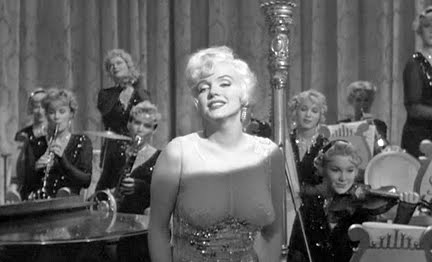
Some Like It Hot


If the aliens who inherit Earth ever need proof that Marilyn Monroe was magic, all they’ll need to do is watch Some Like It Hot.

True, the Billy Wilder/I.A.L. Diamond script has flashes of brilliance, starting with the line that ends it all. And true, the rubber-faced Joe E. Brown, who delivers that last line as calmly as a Windsor asking for tea, is just one of several great character actors whose expressive mugs and body language animate this late-50s farce in the sophisticated style of Hollywood’s pre-War Golden Age. Jack Lemmon is also very funny as a newly minted female impersonator, strutting his dubious stuff with a relish that feels fresh more than half a century later. And under the broad comedy that director Wilder keeps flapping at us, like a red flag at a bull, is the cold shiv of social satire that gave his best work its bite, this time aimed at the sexual and gender stereotypes that imprisoned Americans in the Eisenhower age.

But, as Lemmon himself has said, Some Like It Hot was “really just a five-minute burlesque sketch stretched to two hours.” The first few minutes are sheer farce, all jut-jawed gangsters and leering innuendo (Wot, guys dressed as dolls? Yer killin’ me!). Then Monroe makes her famous entrance, sashaying down the platform “like Jell-o on springs,” as Lemmon’s Jerry marvels. The waiting train toots steam at her tightly wrapped pear of an ass, she scoots out of the way with a hop and a backward glance, and we’re hooked.

Monroe plays Sugar Kane, a wounded bird of a singer and ukelele player who fronts an all-girl band. Jerry and his hound dog of a running mate Joe (Tony Curtis) have joined the band to shake off the gangsters who are pursuing them because they had the bad luck to witness a mob hit. Joe and Jerry, an early version of the odd couple Lemmon later played with Matthau, are fretting and sniping at one another when they get to the station, but the moment they spot Sugar, all else is forgotten. Their luck has changed—and so has the movie’s center of gravity.

Monroe’s exaggerated, Betty Boop sensuality finds perhaps its most comfortable home in this comedy of sexual manners. So does her crack comic timing. (“I don’t want you to think I’m a drinker. I can stop any time I want to,” she says, before the briefest of pauses and the whispery kicker: “Only I don’t want to.”) But the biggest gift she brings to Some Like It Hot is her heart-melting vulnerability and apparent sincerity, which turned what could easily have been just another cross-dressing farce into the American Film Institute’s best movie comedy of all time and one of Out magazine’s 50 essential gay films.


Some Like It Hot is too madcap to bother with motivation, or much of anything else resembling normal human behavior. The women in the band behave like tweens on their first sleepover, and all the men in the Florida resort where the band is playing go for Jerry’s comically klutzy Daphne or Joe’s purse-lipped Josephine, ignoring the radiant Sugar even after she purrs a torch song in that dress that makes her look naked from the waist up. Even more improbably, Jerry helps Joe land Sugar even though he wants her for himself, and even though Joe is a womanizer who plays the poor girl like a piano. And Joe does a 180 at the end, actually becoming the white knight he was pretending to be.

Yet Monroe is so magnetic you buy whatever Wilder is selling. After all, we think, who wouldn’t change course if they got into her orbit?

Written for The L Magazine

Tuesday, June 21, 2011

The Trip


“It’s really exhausting, keeping all of this going all the time, isn’t it?” the actor playing Steve Coogan’s father asks Rob Brydon, Coogan’s traveling companion, after another of Brydon’s nearly nonstop impressions. “Exhausting for us all,” mutters the half-envious, half-disgusted Coogan.

Coogan is right: the schtick can get tiresome in The Trip. But the joke within the joke is that Brydon’s compulsive kidding is far less wearisome than the self-aggrandizing self-pity that makes Coogan so fond of posing soulfully on lonely bluffs. And the prize inside the whole Cracker Jack box is that Coogan, Brydon, and director Michael Winterbottom are annoying us on purpose. "My idea was always that it was about two people in their 40s, in a midlife period, who just have very different attitudes to life," Winterbottom told the LA Times. "But like a lot of comedians, they are quite competitive, and it's funny seeing middle-aged men behave like that, wanting to be the best. And it's also quite sad."

Coogan and Brydon play frenemies based more or less loosely on themselves, comedian/actors whose relationship consists mainly of one-upping each other in inventive ways. Coogan has spoofed his bad reputation several times before, in Winterbottom’s 24 Hour Party People and Jim Jarmusch’s Coffee and Cigarettes, but this particular partnership grew out of Winterbottom’s Tristram Shandy: A Cock and Bull Story. Coogan and Drydon played the same characters in that film, their improvised riffs providing some of its funniest moments and inspiring Winterbottom to suggest and then executive-produce a six-episode BBC series called The Trip. The movie was distilled from the footage of that show.

An insecure narcissist straining to maintain what he sees as his rightful place as Brydon’s superior, The Trip’s Coogan is constantly seething or sneering, obsessing about the relative sizes of their rooms, sulking when someone recognizes Brydon but not him, or bragging about his insistence on working only with “auteurs.” Meanwhile, the happy-go-lucky Brydon does impressions and makes jokes, his cheery soft-shoe routine an amusing contrast to Coogan’s self-important strut.

The pretext that gets them together is a magazine assignment Coogan accepted to review a series of haute-cuisine restaurants in the north of England. He took the assignment to impress a foodie girlfriend just before she decided they needed to take a break. So he ungraciously invites Brydon to take her place, and the road trip is on.

“I quite like people, in between laughing, to feel discomfort. I'm not sure why," Coogan told The Guardian. “Rob is less comfortable with discomfort. I think he walks away from conflict, whereas I gravitate towards it.” The discomfort created as Coogan pushes for moments of truth that Brydon tries to avoid provides much of the movie’s tension, while the Stan-and-Ollie power imbalance between the two provides most of the rest (There are also awkward moments between Coogan and just about everyone else he interacts with: the women he compulsively beds along the way, his parents, his absent girlfriend, his ex-wife.)

But for all their sparring, the two share a trunkload of cultural references and a genius for mining them for comedy. That makes them feel strongly connected, like rivalrous brothers, and it gives the movie its comic kick. Some of their bits, including dueling Woody Allens and Michael Caines and an imagined costume-drama call to battle that begins with the usual “We rise at daybreak!” and soon degenerates to “9:30-ish,” are brilliantly funny. So is Ben Stiller’s cameo in one of Coogan’s dreams, where he appears as a slick Hollywood agent promising Coogan films with all the hot directors, including the Coens, the Wachowskis, and Tony and Ridley Scott—“all the brothers!”

Coogan and Brydon are so focused on their tug of war that they almost forget to comment on the fetishized food they eat at every stop, but one foamy green concoction gets its just desserts. “The consistency is a bit like snot,” Coogan muses before adding brightly: “But it tastes great!”

By the end of The Trip, we may not know any more about the two main characters than we did at the beginning, but we’ve grown to care about them the way much they care about each other: against our better judgment and despite how easily they can get on our nerves.

Written for TimeOFF

Friday, June 17, 2011

Human Rights Watch International Film Festival 2011: Life, Above All, Diary, and When Mountains Tremble


Moving pictures can do so many things so well. They teach us empathy for other perspectives. They invent new worlds or show us the old one in a whole new way. They give us the catharsis of a good laugh or cry. They show us the worse that nature—human or otherwise—is capable of, and inspire us to do better. And because they can capture and preserve whole shards of life, they're better than any other art form at evoking the texture of daily life and the passage of time.

So I’m always disappointed by movies that only want to tell us how we should think or feel about a social or political issue. I wouldn't go as far as Capra did ("If you want to send a message, try Western Union"), but why not take advantage of the medium's versatility? Directors need to stage-manage reality, but don’t they also need to remain open to the surprises that help infuse life in a film? Not everyone has to be Terrence Malick, getting his cinematographer to stop what he was doing to focus on the butterfly that wound up touching down on Jessica Chastain's arm in The Tree of Life, but I suspect the filmmakers whose work feels most alive make movies partly to learn about what they're filming and to find out what happens when they start the camera rolling, while the ones whose work feels stillborn go in knowing just what they want to show or tell.

The closing-night film at this year's the Human Rights Watch International Film Festival, Life, Above All, is one of those message movies that feels more like a lecture about a problem than a window into a world. Maybe it just filters its story, the tale of a precocious 12-year-old girl in rural South Africa and the ostracism of AIDS victims that's hurting her family almost as much as the disease itself, through one too many outsider perspectives. Allan Stratton, whose young-adult book the film is based on, is a white Canadian man; Dennis Foon, who co-wrote the screenplay, is a white American man; and Oliver Schmitz, who directed the movie, is a white South African man.

Whatever the reason, the end result plays like a series of predetermined scenes rather than an organic progression of events. It's all very well-meaning and well-rewarded (the book won several awards and the film was South Africa's entry for this year's Best Foreign Film Oscar), but there's just not much life in Life, Above All.

After an infant dies of the disease nobody ever names, her mother gets steadily sicker while Chanda (Khomotso Manyaka), the eldest child, takes on more responsibility for her family. Then the mother leaves to die of the disease she can no longer hide, hoping to shield her children from the stigma of AIDS, and Chanda confronts the conspiracy of secrets and lies that drove her away.

Some of those secrets are way too obvious (guess what killed the nosy neighbor's son?), and some of the acting is a bit stiff, but the main problem with Life, Above all is that most of the characters and relationships are thinner than Chanda's AIDS-ravaged stepfather. Chanda's mother (a gorgeous, Madonna-like Lerato Mvelase) is so idealized she might as well wear a halo instead of a headscarf, and Chanda's best friend, Esther, functions more as a cautionary tale than an actual person (orphaned by AIDS, as Chanda is about to be, Esther is shunned by the entire town, forced into abject poverty and truck-stop whoring). But life has a way of leaking into even an overdetermined film like this one. The sense of defensive vulnerability that Keaobaka Makanyane, who plays Esther, carries with her, and the eerie blend of young and old in her beautiful, adult-looking face and chicken-bone shoulder blades convey more about Esther than any of her lines or actions do, making some of her scenes genuinely moving.

At the other extreme is Diary, a lyrical video shot by photographer and filmmaker Tim Hetherington (who co-directed Restrepo). It's scheduled to run on the 26th along with No Boundaries, a tribute to Hetherington, who was killed this April while covering one of the wars he had been documenting for years.

Hetherington shot and directed this 19-minute short, which he describes on YouTube as "a highly personal and experimental film that expresses the subjective experience of my work" and "an attempt to locate myself after 10 years of reporting." Its juxtapositions of perilously unstable situations in Africa with cushy drinks and dinners in New York and a backlit field in England are bound to get you thinking, but your thoughts will be your own: This is an exploration, not a manifesto.

Hetherington's elegantly beautiful photography finds its match in Magali Charrier's editing. I don't know which of them had the idea of including so many double exposures, but they work well in a movie that's largely about the ties and disconnects between people and cultures. After taking us to hell and back, Diary leaves us with a statement by Hetherington that goes a long way, I suspect, toward explaining why his work is so powerful: "There is a political situation or a war or a catastrophe and I go there to try to—I make pictures to try to understand what is happening there, for myself."

I was sorry not to see this year's opening-night film, Granito: How to Nail a Dictator. The premise is intriguing: It shows how co-director Pamela Yates's earlier documentary about the oppression of Guatemala's indigenous people by their own government helped alleviate the situation it documented when its footage of army atrocities became evidence in a war-crimes trial.

The festival is also screening the earlier documentary, When the Mountains Tremble. In an interview packaged with the DVD of that film, Rigoberta Menchú, the Quiché activist whose telling of her own story is braided through the documentary, asks us not to treat her people like "idols," reminding us that Indians are real human beings in functioning communities. It's a welcome warning, especially since the documentary itself sanctifies the Indians a bit, focusing solely on the suffering they have endured since their colonization by the Spanish and the community spirit behind their growing resistance.

But When the Mountains Tremble is saved from paternalism by MenchĂş's dignified and sophisticated narration ("At first we didn't understand the deep roots of our problem," she says, "[but] little by little we learned that we have the right to live and develop; to fulfill our human potential") and by the filmmakers' impressive access to people on both sides of the conflict. They interview complacent generals and complicit priests as well as labor lawyers and shy but eloquent young guerillas. At one point, they cut from a meeting between guerillas and a group of sympathetic villagers to the inside of an Army chopper that's dropping flyers onto a mountainside to warn the villagers not to fraternize with "subversives." It's a fascinating look at the battle for and against freedom in Guatemala, documented from both sides of the line by filmmakers who know how to get to the heart of a story.

Written for The House Next Door

Wednesday, June 15, 2011

Bringing Up Baby


“In moments of quiet I’m strangely drawn to you, but, well, there haven’t been any quiet moments,” David (Cary Grant) tells Susan (Katharine Hepburn) in Bringing Up Baby. No kidding. This fast-paced farce may be only the second best of Howard Hawks’ collaborations with Grant (the best is His Girl Friday), but it’s a world-class screwball comedy.

Even doing his best tamped-down Harold Lloyd impression as a milquetoast scientist, Grant leaks quarts of the seemingly unself-conscious charm and mordant sarcasm that made him so fascinating. The most versatile and irresistible male actor ever to make romantic comedies, he manages to make himself seem almost ordinary, even awkward for long stretches of time here, but just when you think he’s a wallflower, he finds the funny in straight-man passivity. In one of the movie’s best scenes, David fixates on a terrier during a dinner party, popping up to follow the restless dog out of the room every time he trots off. Susan knows why he’s doing it (the dog buried a bone David needs to complete a brontosaurus skeleton he’s been working on for years), but the hostess and her other guest think his obsession is proof that David is nuts—a “fact” they were convinced of in any case. Grant never breaks character or signals for our sympathy, maintaining the prickly dignity of an aggrieved academic who’s doing his best to maintain his temper. His deadpan expression, stiff posture, and curt responses to the guest who’s trying to engage him in conversation, and the crack timing with which he and the dog enter and exit the room, makes me laugh out loud at what could have been a throwaway bit.

Another reason Grant was great in romantic comedies was that he worked so well with his leading ladies. Hepburn preferred working with Spencer Tracy, but she was at her best with Grant. She sparkles and shines here, in what Peter Bogdanovich calls “the single most likeable performance of her career,” as an eccentric heiress who saves David from himself by falling for him and proceeding to rip his too-careful, too-quiet life to tatters. David resists as long as he can, but Susan is the original irresistible force, the unadulterated dose of chaotic life he needs to free him from his suffocating routines—and fiancĂ©e.

Bringing Up Baby was the first in a three-picture run of all-time classics Hepburn and Grant made together (they also made Sylvia Scarlett, but we all make mistakes.) The others were Holiday and The Philadelphia Story, and Hepburn is wonderful in all three, but she’s at her least earnest and most approachable here. The bubble of self-satisfaction that she always seemed to travel in doesn’t melt away altogether—Susan is so accomplished, beautiful, and overflowing with life that David can’t help but fall for her, but she never seems to stop talking long enough to hear a word he says—but it softens and takes on comic overtones. Like Hepburn herself, Susan doesn’t appear to need anyone else, but that’s an illusion. Hepburn can’t quite pull off the scene where Susan cries, asking David to assure her that he doesn’t want to leave. Instead, she convinces us of what she wants the way she always does: by going to work. When we see the single-minded intensity with which she pursues David, we know she’s in love.

Hepburn also shows a vulnerability here that she rarely displayed in other roles. Her Susan makes me wonder what she might have done with another spoiled beauty with a heart of gold, the ditzy diva Carole Lombard had played a few years earlier in Twentieth Century. Lombard made Lily naĂŻve and brattily willful. Hepburn might have given her a carefree confidence that could have been just as funny but less cartoonish, a relatable if often absurd woman rather than an obnoxious overgrown child.

Unfortunately, Baby was the only screwball comedy Hepburn ever made. Audiences didn’t respond well to it on its release, and she was eager to find a persona that people would like and shed her “box-office poison” label. Hawks never made another movie as silly as this one either, having concluded that Baby was a box-office bust because “There were no normal people in it. Everyone you met was a screwball. ”

But the long shots the director set up let his actors set the film’s breakneck pace, and Hepburn and Grant kept it going with seemingly effortless ease, mixing pratfalls with unobtrusive athletics (their famous joint walk out of a formal restaurant after he rips the back of her gown took more skill than you’d think). They’re also great with the verbal pyrotechnics, from fast talk ("There is a leopard on your roof, and it’s my leopard, and I have to get it and to get it I have to sing," Hepburn rattles off at 90 mph to a startled psychiatrist) to repetition (“I’ll be with you in a minute, Mr. Peabody!” David keeps singing out to the stuffy lawyer he’s trying to meet up with), to plain-vanilla comic absurdity (“He just follows me around and fights with me,” Susan says of David, with a sweet mixture of perplexity and pride.)

Hawks’ screenwriters never let the action let up, piling misunderstanding on misunderstanding and absurdity on absurdity. By the time the “baby” of the title, a leopard named Baby sent to Susan by her brother, makes his entrance more than 20 minutes in, inheriting a wildcat is just another minor complication.

Most of the humor in Bringing Up Baby, starting with the title, comes from subverting expectations. Contrary to what audiences of the ‘30s might have been expected to expect about gender roles, David is the nervous, sheltered incompetent and Susan the fearless leader of the two. Grant even thumbs his nose at the rumors that he and longtime roommate Randolph Scott were more than platonic friends, not only putting on a frilly woman’s robe but explaining why by exclaiming: “I’ve gone GAY all of a sudden!” And it’s fun to see the Susan and David head out to hunt for their lost leopard armed only with a butterfly net and a croquet mallet.

Russell Metty’s cinematography is beautiful too, its silvery black-and-white flattering Grant’s dark beauty and the flow of Hepburn’s glittery clothes as she strides through the night. I bet the new 35mm print they’ll be showing at Film Forum will look even better than the DVD I’ve been rewatching in recent years, too—not to mention the VHS tape I used to own.

David Thomson says men and women in Hawks’ films resort to “dazzling battles of word, innuendo, glance, and gesture,” to avoid the moment when flirtation becomes love and a couple starts to stagnate. “In other words,” he writes, “Hawks is at his best in moments when nothing happens beyond people arguing about what might happen or has happened.” That pretty well sums up Baby, in which lot of things happen but none of them matter in the least. None, that is, except the one thing we can predict from the start: that Susan and David will fall in love.

Written for The L Magazine

Tuesday, June 14, 2011

The Tree of Life


The winner of this year’s main prize at Cannes and the subject of millions of pixels’ worth of online debate, Terrence Malick’s fifth feature as writer/director over the last 38 years is to cinephiles what Halley’s Comet is to astronomers: an eagerly anticipated and rarely seen phenomenon. But I’ve also been talking to a lot of friends who had planned to give The Tree of Life a pass, having heard it was a pretentious or impenetrable snoozefest.

If you’ve seen and disliked any of Malick’s other movies (Badlands, Days of Heaven, The Thin Red Line, and The New World), you won’t like this one either. Like most great filmmakers, Malick has created a distinctive cinematic language, and in The Tree of Life he achieves perhaps its purest expression yet. But everyone who loves movies and doesn’t hate Malick should catch this one—preferably while it’s still in theaters, since this is a film that should be seen on as big a screen as possible.

The quote from Job that opens The Tree of Life sets up the one-sided conversation Jack (an amazingly expressive Hunter McCracken as a young man and a hollowed-out Sean Penn as an adult) has with God throughout the film. The childhood that left him so haunted unfolds in a cascade of scenes, most of which capture moments so universally human you almost feel as if you’d experienced them yourself. Jack and his brothers run through a carless street at the end of a long summer day; Jack’s family sits uneasily around the dinner table, trying not to set off their seething father; Jack’s mother picks up one of her three boys and spins him joyfully around their front yard. These moments feel absorbing and distancing at the same time, in part because of the wide angle lens that often pushes right up to the actors’ faces, pulling us into their internal worlds while still showing a wide swath of the world they inhabit, a context Malick never lets us forget.

Jack’s life is full of joy and family love, especially from and for his idealized mother, an eternally nurturing young beauty played by Jessica Chastain, who’s poised to become the next big thing in movies. At the same time, he’s learning about suffering and injustice, most persistently through his father's unpredictable bouts of violence and most painfully through the death of his brother, which happens when Jack is a young man but opens the time-skipping story.

Nonlinear and mostly nonverbal, Malick’s narrative favors feeling over facts, cutting to the core of a scene and leaving us to guess what came before and what follows. As 
Adrian Martin observes, “It is hard to find the decisive, dramatic moment when things happen in Malick’s films ... Malick likes to skip the middle of any story, any action, any state of mind or mood.”

Words are used only sparingly to fill in the gaps, the film’s rich soundtrack supplied almost entirely by Alexandre Desplat’s majestic score and by an army of sound designers, 34 of whom are listed on IMDB. The urgently whispered soundtrack, another Malick signature, inserts snippets of voiceover from Jack and his mother at intervals, but these often have nothing to do with the action we’ve seen, instead surfacing thoughts they would never have voiced in life. The mother often offers her children words to live by, while the son sticks to existential issues, lobbing prayers or questions (“Why should I be good if you aren’t?”) at a silent God.

This is, of course, the polar opposite of Hollywood’s standard expository narrative hand-holding, and it can make The Tree of Life feel opaque at times. But if you go with the flow (and I mean that literally: The handheld camera is always on the move, creating a sense of the relentless flow of time and energy), you’ll leave with a surprisingly detailed and coherent portrait of the O’Brien family. We may not know their last name (I looked it up online), but their emotional landscape becomes as familiar as their yard and neighborhood, where almost all the action takes place.

We also get a strong feel for what Martin calls “[the] unbridgeable distance from God and the cosmic realm, the vacuum of divine silence that fills the abyss of this gulf. All of Malick’s films resound across this distance and silence.”

And, as always in Malick's movies, we get a sweeping sense of the natural world that surrounds the characters, oblivious to and often subsuming their concerns. Emmanuel Lubezki’s gorgeous cinematography (he also shot The New World) and Malick’s eye for the unexpected combine to capture powerful images like light dancing on a bedroom wall at night, a giant swarm of birds seen from afar at golden hour as they create swirling patterns in the sky, or a stand of tall trees shot from the ground with a wide-angle lens that makes them appear to huddle together. (Shooting up at trees is to Malick what shooting up at people as they gawp at the sky is to Spielberg.)

Malick always salts in shots of that sort, but this is the first of his films to include a lengthy highlights reel of the creation of the universe and the evolution of life on Earth. (The army of visual effects artists he employed is even bigger than the sound team.) It’s the ultimate god’s-eye view, a perspective Malick brings to all his films. As Matt Zoller Seitz puts it: “Ninety-nine out of a hundred Hollywood movies are dedicated to the proposition that your story is important—and by ‘you,’ I mean the character that you are associating with, that is your surrogate. Terrence Malick stands completely in opposition to that. All of his films, to some degree, reinforce the idea that no, it’s not about you. You may think that it is, but it’s not. And this life that you’re living is just one infinitesimal piece of the cosmos.”

But please don’t let me give you the idea that The Tree of Life is coldly analytical or purely intellectual. As much as any movie I’ve seen this year, it’s suffused with reverence and regret, love and sorrow, and a Zen appreciation of the beauty of each passing moment.

Written for TimeOFF

Thursday, June 9, 2011

Barely Legal Film Festival

A lot of young talent, some raw and some very well done indeed, will be on display this weekend when the Trenton Film Society screens this year’s Not Quite Legal Film Festival. The juried festival showcases shorts by filmmakers between the ages of 14 and 21 who live in or go to school in Jersey. “We have filmmakers from South Orange, Princeton, Lawrence, Pennington, and many of the Monmouth County coastal towns (Manalapan, Manasquan, Red Bank, etc.),” says Cynthia Vandenberg, executive director of the film society. Most of the entrants are 17 or 18 years old, but a few are younger or older.

The eight shorts I saw, about a third of this year’s 23 entries, cover a gamut of adolescent concerns and frustrations. Most combine a vivid point of view with a sly sense of humor, but there’s nothing lighthearted about A Sedated Seat, a three-and-a-half-minute polemic from the past delivered in emphatic present tense by Zoe Pulley, Anni Epstein and Ethan Oberman. The film consists of an unseen DJ P-Cutta, sounding a lot like Amiri Baraka himself, reading Baraka’s 1979 poem Black Art to the soundtrack of J. Cole’s “Grown Simba.” The bleating sax and black-and-white images manipulated almost to the point of abstraction, many of them faded, scratched, and/or superimposed on one another, flicker an edgy accompaniment to the assertive reading of Baraka’s provocative words. (“We want poems that kill. Assassin poems. Poems that shoot guns. Poems that wrestle cops into alleys and take their weapons, leaving them dead, with tongues pulled out and sent to Ireland.”) The film ends about halfway through the poem, leaving us to ponder its startlingly contemporary sneer at “slick half-white politicians.”

The Tiger Beat Monologues is a well-written, well acted, nicely shot spoof of our voracious star-making machinery and the fame-starved wannabes who provide so much of its fodder. After a wry voiceover setting up the situation, the camera adopts the point of view of the unseen interviewer, watching former child star Freddy Gallo make a desperate bid to get back a little piece of the spotlight. Director Travis Maiuro, who plays Gallo, has something of the young Michael Keaton about him, getting steadily more outrageous as he ingests ever more inappropriate substances in a trendy restaurant (he winds up inhaling a nostrilful of Elmer’s Glue) while talking fatuously about his climb to semi-non-obscurity and back. Maiuro, a Bordentown Township native who told the Times of Trenton that his confidence as a filmmaker was boosted when he had a short accepted in the 2009 Not Quite Legal festival, had an entry in last year’s as well, which won the Best Cinematography award. His cinematography is handsome and intelligently done here too, the film’s bright, soft light and blown-out backgrounds highlighting Gallo’s purple shirt and childishly wide blue eyes.

Meghan Kaltenbach, another of last year’s Not Quite Legal winners (she got the Best Short Narrative Comedy award) is back with a confidently witty commentary on the hipster trend that has migrated from the bars of Brooklyn to the high schools of New Jersey. In a droll series of short takes, “Under the Undercuts” captures students as they talk about how you can tell who’s a hipster and why no hipster would ever be so unhip as to admit to being one.

”Simple Life Decisions” is the story of a new girl in school who tries to fit in by following the twisted lead of a bullying mean girl (played by writer-director Hope MacKenzie). The dialogue is too on-the-nose, the acting too stiff, and the sets too lifeless (there’s never anyone in the background, even in scenes shot in what is supposed to be the middle of a school day) for the realism MacKenzie seems to be aiming for. But the appealing Carly Deeter, who plays the new girl, pulls us in and earns her happy ending.

Andrea Massaro’s “What’s Your Fortune” is a nicely told joke that, like the fortune cookie of its title, contains a pointed little message. Kira DiSomma’s “We Used To Be Friends” and “Dark of the Night” by Alexander Winchell, who won the Best Documentary award in last year’s festival, feel more like music videos than narrative shorts. But both create and capture distinctive shards of time and space despite being virtually plotless and wordless, and that’s not as easy as it may look.

Written for TimeOFF

Tuesday, May 31, 2011

Bridesmaids


After going back and forth for weeks about whether to see Bridesmaids, I’m kicking myself for having avoided it so long. You’d think I would have been convinced by the viral movement that sprang up early on, calling all feminists to buy tickets so Hollywood would make more “chick flicks” that aren’t “vapid rom-coms or something about shopping.” But the more you care about feminism, the warier you get about movies that are supposedly about girl power or female friendship.

The muttering I’d heard about the diarrhea blowout in the dress shop didn’t help: would Bridesmaids lean too hard on gross-out humor for my taste? More than that, what put me off was what I’d seen of Kristen Wiig’s Annie in the trailers. I usually like Wiig, and there’s a sense of nerve-shot decency in even her most annoying characters that makes it hard to hate them, but when she starts playing endless variations on just one note she can wear out the funny pretty fast. Annie looked like she might be another Gilly or Penelope, tired long before she got retired. Like we need another movie about a tiresomely crazy chick.

But Annie turns out to be one of the most fully fleshed-out contemporary women to show up in the movies for ages. Wiig, who cowrote the script, is in nearly every scene, and the camera often lingers on her face to catch a kaleidoscope of emotions as someone else is speaking. Even—maybe especially—at her most ridiculous, Wiig makes Annie sympathetic, finding the loyalty, love and, yes, neurosis and insecurity that drive her a little nuts sometimes and make her nearly derail her best friend’s wedding and her own life.

Yet she’s no train wreck just because her life has gone off the tracks. Bridesmaids’ favorite comic tool is exaggeration. It takes almost every situation a little—or a lot—too far, but even its wildest slapstick is anchored in totally relatable emotions. In one of the movie’s sweetest scenes, Annie resorts to desperate measures to regain the attention of a lovely traffic cop she briefly dated and then dumped. That scene’s pleasures come as much from the suspense of waiting for his inevitable surrender as the joy of watching her ridiculous siege.

Realistic emotion blended with balls-out comedy and laced with a strong dose of nerdy discomfort is Judd Apatow’s signature style, of course, and Apatow is one of this movie’s producers. Aside from the bit in the dress shop, I suspect that a lot of what he contributed was the talent that maintained that distinctive tone, starting with director Paul Feig, one of the directors of Apatow’s so-funny-because-it‘s-so-true Freaks and Geeks. Maya Rudolph is Annie’s best friend, the warm, funny, grounded ur-BFF any woman would want; Jill Clayburgh (in her last role) is loving and comically ditzy as Annie’s mother; and a murderer’s row of funny women make the other bridesmaids “a stone cold pack of weirdos,” as Lillian affectionately calls them. Great comic actors, including Terry Crews as a fascistic exercise drillmaster, Michael Hitchcock as Annie’s uptight boss, and John Hamm as Annie’s odious “fuck buddy,” make even the small parts vivid.

Weddings are fertile ground for parody, and Bridesmaids digs in with gusto. The much-discussed gross-out scene turns out to be a welcome fart in the face of a snobbish, criminally overpriced bridal shop, but most of the humor is a little less obvious. After Annie messes up her maid of honor duties, Lillian hands the reins to fellow bridesmaid Helen (Rose Byrne), making Helen the victor in a battle for best-friend status that provides the movie with most of its funniest moments. Helen then proceeds to execute the “perfect” wedding, an obscenely upscale affair we see through the eyes of the broke and resentful Annie. The bridal shower is particularly ludicrous, each guest riding a white horse from the parking lot to the door of Helen’s palatial estate and leaving with a “party favor” in the form of a live puppy, so it’s fun to watch Annie crack, railing at the event’s over-the-top pretension and attacking “that fucking cookie,” a huge heart-shaped tribute to the bride and groom on display in the garden.

A sometimes wince-inducingly funny index of socially awkwardness, Bridesmaids has a heart as big as that cookie. Without resorting to snark, condescension, or cheap shots, it finds the funny in the winning trifecta of female friendship: love, loyalty, and competition.

Written for TimeOFF

Friday, May 27, 2011

Restless City


Living in New York is like going online: When you know you can find a world-class example of whatever or whoever you long for if you just look long enough, it’s hard to stop searching. Most of us zigzag between curling up in whatever niche we’ve carved out for ourselves to enjoy the moment a bit and hunting for something more, either online or IRL. Restless City makes that duality its subject, alternating between its main character’s ceaseless travels through this often hostile or indifferent city as he tries to establish himself and his delight in its capricious generosity and moments of unadulterated grace.

The niche Djibril (Sy Alassane) occupies is a hustling, bustling underground economy created and populated almost entirely by African immigrants. A musician who dreams of making it here, he starts his journey on Canal Street, part of our growing army of Senegalese street merchants, but soon graduates to courier. The community he moves in is a large, mostly nurturing world, and Djibril floats through it beatifically at first, meeting, greeting, and eating as he goes. Then he falls for a gorgeous prostitute, Trini (Sky Grey) and his life starts to take a predictable slide toward tragedy. But even as the plot turns pedestrian and predictable, the look and feel of the movie remain sumptuously evocative.

Cinematographer Bradford Young uses the same rich browns and reds, stately compositions, soft lighting and shallow-depth-of-field focus on the actors’ gorgeous faces that helped make Pariah another of the most compelling movies to come out of Sundance this year. Costume designer Mobolaji Dawod’s clothes are beautiful too—which isn’t surprising when you consider that director Andrew Dosunmu started out as a fashion photographer. Whether it’s Djibril’s snug brown leather jacket, the fly straw hat worn on the record producer he hopes to work with, or earth-mother Sisi’s (Danai Gurira) print dress and matching headdress, the costumes don’t just look stylish enough for the glossies Dosunmu used to shoot for—they help establish character.

There’s not a lot of dialogue in Restless City, but the words aren’t missed. Often, as we watch Djibril and the other main characters go about their business, it feels almost like a silent movie, its music (a mix of energetic percussion and operatic emotion) the only sounds we hear. As he rides his Vespa though the city, Djibril’s big red headset blocks out everything but the African music he’s listening to: He’s literally deaf to everything outside his immigrant cocoon. Even when it’s not filmed in slow motion, as it often is, the film’s contemplative pace also helps keep us inside Djibril’s reality—and helps stave off the sentimentality and cheap melodrama that could so easily have ruined this simple story.

Dosunmu, who’s from Nigeria, has directed music videos for Common, Erykah Badu and other “artists that know themselves as artists,” as he puts it; written a book about African soccer stars; and made a lively documentary (Hot Irons) about the African-American hairdressing competition subculture. But his main interest is making films about Africa and Africans that broaden the narrow set of images we’ve been fed about his homeland.

That may have been his main objective in Restless City, but it’s not his only achievement. His first feature is about being a diaspora African, but it’s also about the agony and the ecstasy of being a New Yorker, surfing that endless wave of possibilities toward some possibly unreachable goal.

Written for The L

Tuesday, May 24, 2011

Cave of Forgotten Dreams


Werner Herzog dates his fascination with Paleolithic cave paintings to age 12, when his imagination was captured by a book about the Lascaux cave. Many decades later, that obsession has paid off for us all. Cave of Forgotten Dreams is Herzog’s trippily reverent exploration of another French cave, discovered long after his childhood, which houses the oldest paintings known to man.

Like Herzog, I'm fascinated by what we can glean from archaeological finds about how people in ancient cultures lived and thought and felt. I even have a similar (though less intense) childhood memory of learning about the Lascaux cave drawings: I remember poring over a New York Times Magazine feature that helped me see them as sophisticated art rather than "primitive" artifacts. But my amateur interest turned out to be more of a drawback than a draw when I first watched Cave of Forgotten Dreams.

I left that screening feeling dissatisfied, grateful for the extended view Herzog had provided of the cave and its paintings but frustrated at having learned so little about the people behind them. Then I did a little reading and got a sense of just how little we know about those ancient ancestors. The second time I saw the movie, free of the obscuring scrim of my own unrealistic expectations, it was an entirely different experience -- and not just because I saw it in 2D, which I actually preferred outside the cave and didn't miss inside it. This time, what struck me was not how few hard facts Herzog turned up but how diligently he dug to get at whatever is there to be gleaned.

You and I will never see Chauvet Cave in person. The French government sealed it off from all but a few scientists upon its discovery in 1994, sparing it the fate of Lascaux, where the carbon dioxide and moisture introduced by an army of visitors fed fungi and molds that have disfigured some of the paintings. Herzog is the only filmmaker ever allowed in Chauvet long enough to shoot a feature, and even he worked under tight constraints. He was limited to a crew of four, granted just a few hours in the cave, and required—like everyone else who enters it—to stay on a two-foot-wide metal catwalk.

The catwalk is there to preserve the animal tracks, human footprints, stalagmites, bits of 28,000-year-old coal, “menagerie of bones,” as Herzog puts it, and other treasures that make the cave’s floor almost as rich an archaeological gold mine as its walls. Perfectly preserved for thousands of years, during which the minerals in the water that seeps steadily in have slowly colonized almost every horizontal surface, the cave is eerily beautiful. The filmmakers give us plenty of time to admire that beauty, passing the camera slowly over stalactites and stalagmites as smooth as plaster casts, still-dripping calcium carbonate icicles, and rippling curtains of glittering stone.

But mostly, they show us the paintings, coming back time and again (maybe a few times too often) to some of the most beautiful. Almost all depict animals that look surprisingly familiar, considering that they were painted 25 to 30 thousand years ago. The bone and ivory flutes Herzog shows us from other digs of about the same time are instantly recognizable too. As one archaeologist puts it, before playing the Star-Spangled Banner on an ancient flute, they even play the same tonal range we use now. No wonder Herzog calls the cave a “familiar yet distant universe.”

The director rarely appears on camera, but the extravagantly rounded vowels of his familiar voice are never far away. His flatly idiosyncratic observations, heard in his intermittent voiceover and off-camera questions, set the tone.

He starts by sharing the elation he felt as he first descended into the cave, the camera defying gravity to flip upside down or float up and over the landscape as we follow him and his guides and crew into the wonderland below. Between visits to the cave, he takes time out to interview a motley assortment of insightful, never self-serious experts. Together, he and they speculate about how things might have looked and smelled and sounded in the heyday of the cave, and how the Paleolithic people who went there to admire the animals might have thought and acted.

Now and then Herzog makes a questionable assumption—how could he be so sure a child's footprint left thousands of years ago was that of an eight-year-old boy?—but for the most part, he’s meticulous about differentiating between knowledge and guesswork, reminding us that most of what we think we know is conjecture, thanks to the “abyss of time” that lies between us and the Cro-Magnons who created the paintings.

Fortunately for us, Herzog is one of cinema’s great speculators. His hypotheses and questions provide some of the film’s most fascinating moments, like when he wonders aloud whether the cave paintings are the beginning of art, and hence of the human soul.

The extra dimension in the 3D version can be dizzying or downright distracting outside the cave, but it emphasizes the strangeness inside, exaggerating the undulations of the walls whose curves the cave painters often worked with in equally creative ways. Moving his lights over the images, Herzog tries to approximate the torchlight by which the Paleolithic people saw them. The flickering light, he points out, may have created the illusion that the animals were moving—an illusion that the artists often encouraged by drawing an animal with two sets of legs or other cues that imply motion. That observation leads to one of Herzog’s most intriguing theories: that the paintings are “almost a form of proto-cinema.”

If art is a way for the past to communicate with the future, as one scientist observes, The Chauvet paintings are powerful art, reaching across that chasm of time to touch something in the roots of our being.

Written for TimeOFF

Monday, May 16, 2011

The Princess of Montpensier


The Princess of Montpensier begins in the midst of a gripping hand-to-hand combat in 16th century France, as a count and a handful of his men hunt down an enemy on his own farm. As in later scenes of soldiers hacking away at one another in suffocatingly close quarters, director Bertrand Tavernier hammers home the brute horror of war, stripping it of any pretense of nobility. The 70-year-old director’s clarity of vision on the subject makes this one of the strongest antiwar movies of 2010, a year that included powerful documentaries like Restrepo and The Tillman Story.

But the main fight in The Princess of Montpensier is not the war between Catholics and Huguenots. It’s the rivalry for the heart of Marie (MĂ©lanie Thierry), the princess of the title.

Tavernier and his co-writers based their screenplay on a 17th-century novella, and on the research Tavernier always does before resurrecting a past time and place in one of his authentic-feeling films. Whether Marie is learning to butcher a hog or being undressed in a roomful of servants on her wedding night, the details of her life are often startlingly unfamiliar, yet they never draw undue attention to themselves or detract from the authenticity of the characters’ emotions. When I interviewed him a few weeks ago, Tavernier talked about how he makes sure his scripts, sets, costumes, and lighting are historically accurate, so his characters will look and talk and act the way they should—and then he tells his cast and crew to forget everything but capturing “the passion and the emotion” of the story. Regardless of when his movies are set, he says, he films them in the present tense. “I’m not filming a Renaissance table. I’m filming a table.”

His method clearly works. He succumbs just once here to the impulse that sinks so many directors of costume dramas, sending the count into the heart of the historic St. Bartholomew's Day Massacre to rescue a woman from rampaging soldiers. But on the whole, Tavernier studiously avoids stagey set pieces and melodramatic swashbuckling, focusing instead on the texture of daily life in the castles of France (and, to a lesser degree, on its battlefields) nearly 500 years ago.

Marie is just 16 or so when we meet her, a gravely gorgeous girl in love with her dashing but destitute young neighbor, Henri de Guise (Gaspard Ulliel). But her feelings don’t mean much to her parents, who trade her in marriage, like so much prize horseflesh, to Henri’s stodgy cousin, Prince Philippe de Montpensier (GrĂ©goire Leprince-Ringuet).

If anything, being married makes Marie more appealing to Henri, for whom wooing her is now a way to get back at his more privileged cousin as well as a pleasant pastime. Henri and Philippe are soon joined in their competition for her favors by a cynical young duke, who sees Marie as attractive arm candy. The stakes grow for Philippe as he gets to know his wife better and starts falling for more than her looks, but the men are motivated mainly by their love of the chase and their hunger to win the prize, whatever it may be. As Henri puts it of their competition: Marie is “a doe in our midst.”

Only the Count de Chabannes (Lambert Wilson), the man who led that charge in the opening scene, truly loves Marie. But Philippe enlisted the count to tutor his wife while he is at war, and the older man’s deep-rooted sense of honor prevents him from wooing his patron’s wife. Instead, he serves her faithfully, her only true friend and a witness to her blighted life.

As only we and the count can see, Marie is smart, self-aware, and hungry to learn. She’s also woefully ignorant, since women didn’t get much of an education in those days, and her choices in life are strictly limited even after marrying a prince grants her some status. Tavernier shows us the courage it takes for her to arrange for a romantic tryst with Henri. She may be tragically naĂŻve about her lover’s feelings, but she’s true to her own, and she’s brave enough to risk everything—her social position, her wealth, and her husband’s budding devotion—for a shot at true love.

It’s sad to see social convention rob Marie of what might have been real happiness with the count, but the real tragedy of this all-too-relevant period piece isn’t her missed chance at love. It’s the human potential that goes unrealized in Marie, as it does in so many other bright, brave young women with the bad luck to be born into rigid patriarchies.

Written for TimeOFF

Friday, May 6, 2011

Moms from Hell: Mildred Pierce and Jeanne Dielman


If you thought Todd Haynes's Mildred Pierce was too slow-moving and uneventful (and God knows a lot of people did), Chantal Akerman’s glacially paced Jeanne Dielman, 23 Quai de Commerce, 1080 Bruxelles will probably drive you up a wall. Personally, I love these movies partly because they unfold slowly, allowing plenty of time to appreciate the intricate ballets their title characters perform on the line between Xtreme girl-power efficiency and total dysfunction.

I also love the Museum of the Moving Image for choosing this double bill to celebrate Mother’s Day weekend. Way to reclaim the day from florists and greeting card companies. That’s my MoMI!

Haynes has called Jeanne Dielman “a feminist masterwork of minimalist constraint; a cinematic powerhouse of narrative innuendo.” It’s easy to imagine why the director, a semiotics student turned Queer Cinema pioneer who loves to experiment with both old and new ways of conveying ideas and feelings on film, might have appreciated Akerman’s influential 1975 indie. Jeanne Dielman pushes naturalism so far it risks losing its audience, but it has plenty to say, if you can stick with it, about how social norms can disempower women and how mysterious all of us humans are, even to our own selves.


Jeanne Dielman, a widowed bourgeois housewife, is stuck in a constricted and constricting world, trapped in small spaces—mostly her own kitchen or the other rooms of her tidy but cramped apartment, but also the cage-like elevator she rides to and from her apt, the bank where she deposits her earnings, and the stores where she does her shopping. So are the other women whose paths she crosses during the day as they wait patiently, shop aimlessly, or perform menial tasks of their own. Akerman provides the voice of one of those women, an unseen neighbor who drops off her baby with Jeanne—and keeps her hostage at the door one day after picking the baby up, delivering a monologue of mind-numbing banality while Jeanne mm-hmms politely.

Ackerman and her cinematographer, Babbette Mangolte, used a stationary camera to emphasize their characters’ stasis. They sometimes keep the camera rolling for a bit before or after the subject had left the frame, in a style long since popularized by Jim Jarmusch and others, but for nearly all its 201 minutes, the film focuses on Jeanne. It observes her in long, mostly wordless or near-wordless takes over the course of three days as she ticks her way down a list of self-appointed tasks. By day three we’ve come to realize just how ritualized her routines are, so even a little deviation, like dropping a spoon in the kitchen, registers as a sign that something’s seriously wrong. Then one of the johns Jeanne entertains during the day (hey, she’s got to pay for all those fillets of veal she cooks for herself and her son) gives her an orgasm, which introduces a lack of control that the tightly wound Jeanne finds unbearable.

Mildred Pierce, an apparently faithful adaptation of the James M. Cain novel, looks and feels far less challenging and austere than Jeanne Dielman, but the two are sisters under the skin.

The most striking similarity may be the breathing room both give their protagonists. At a total of five hour-plus episodes, Mildred is even longer than Jeanne, and that allows both films to capture pretty granular details (we don’t just see Jeanne pick up a dirty dish when it’s time to clean up; we see her wash the whole stack, and at the start of Mildred Pierce we practically watch Mildred make a pie from start to finish). Literally making visible mundane bits of (typically female) business that most films gloss over also shifts the dramatic emphasis, so a near-silent dinner Jeanne shares with her son or a visit from Mildred’s estranged husband during which he plays on the floor with their youngest daughter feel as important as a case of adultery or murder.

Both films are interested in the poisonous effect of the secrets we keep even from ourselves, and how little we know even of the people closest to us. As Dennis Lim put it in the New York Times: “Mr. Haynes’s great theme has been the mysteries and traps of identity,” and Mildred is a fascinating case study. She’s loyal, hardworking, capable, and invested by Kate Winslet with enormous empathy and heart—you can’t help but sympathize with her, especially after her husband leaves her for another woman and she has to scramble to provide for herself and their daughters, starting out at an employment agency where she’s told she has no skills and ending as the owner of a successful chain of restaurants.

But then Mildred projects all her inchoate social-climbing hunger onto her older daughter, Veda, turning her into a hot mess of unearned privilege, resentment, and toxic snottiness, and you just want to shake her. When both mother and daughter’s dreams of Veda’s success in the world of classical music, that culture-snob haven, are finally realized, it’s because Veda has turned into a monster. A gifted colluratura, Mildred’s coddled daughter has the voice of an angel, but she’s no more to be trusted, her vocal coach warns, than a poisonous snake.

Mildred’s central tragedy is her unhealthy fixation on Veda. She works hard and gets everything she thought she wanted, but—even more than her hunger for money and social status—her toxic relationship with her daughter keeps happiness out of her reach. Their twisted family tie functions more like an unrequited love affair: Mildred blushes like a schoolgirl when Veda bestows an icy shard of love or approval on her, and she’s overcome with emotion when she hears her daughter sing—so much so that, the first time it happens, she has to leave her restaurant to be alone on the beach with her thoughts and emotions.

Delphine Seyrig’s Jeanne spends most of her time onscreen alone, and though Seyrig’s deadpan mug is much harder to read than Winslet’s translucent one, Akerman gives us plenty of chances to study it. The film ends with a seven-minute shot in which Jeanne sits at her dining table, covered in blood and looking at the camera.

Staring at her for clues as to what she might be thinking, I found myself wondering about her son. How will his world change after learning what his mother is capable of? What will he think about how his mother spent her days? And why didn’t he talk to her more when he had the chance? Did he think he already knew everything there was to know about who she was and what she had to say?

Guess I’d better call mom.

Written for The L magazine

Wednesday, May 4, 2011

Meek's Cutoff


Stephen Meek (Bruce Greenwood) looks like the kind of character you’d expect to see starring in a classic Western. The colorful guide of a small wagon train, his face nearly obscured by a mop of ropy hair and a bushy beard, he wears theatrically fringed buckskin and loves to tell stories about his past adventures. But this self-styled hero is a legend only in his own mind.

Director Kelly Reichardt and her frequent collaborator, screenwriter Jonathan Raymond (he also wrote Wendy and Lucy and Old Joy), are hardly the first filmmakers to deconstruct the dime-novel mythology that shaped our view of the West. The disconnect between the actual people who settled the West and the stories we tell about these men (and yes, the stories are almost always about men) is one of the givens of post-50s Westerns, providing the theme for movies like The Man who Shot Liberty Valance.

By the mid-60s, that disconnect was accepted widely enough to be satirized in movies like Cat Ballou, Butch Cassidy and the Sundance Kid, and True Grit. But Kid Shelleen, Butch and Sundance, and Rooster Cogburn were all loveable eccentrics who ultimately lived up to their hype. Meek is a much darker figure, part of a neo-Western wave of self-styled heroes (the first may have been Little Big Man’s General Custer) who are actually villains. The ego-blinded poseurs in this blustering brotherhood may not mean any harm, but their actions often have lethal consequences. As Emily Tetherow (Michelle Williams) says of their leader in Meek's Cutoff: “Is he ignorant or is he just plain evil? That’s my quandary; it’s impossible to know.”

We join Meek and his scrawny band of followers as they trek through a dry, scrubby, mostly flat expanse of 19th century Oregon. For most of the film’s 104 minutes, the only sounds are the squeal of an axle and the rumble of wagon wheels on rocky ground, occasionally accompanied by some unsettling strings, but we eventually learn that the settlers—three couples and one pre-teen boy—followed Meek on what was supposed to be a shortcut. He said it would take about two weeks to reach their destination, but it’s been five and they have no idea where they are or how long it will take to get to a place where they can settle down. What’s worse, they’re running out of food and don’t know where to find the water they need more desperately with every passing day.

It takes a while to adjust to the sparseness of the dialogue, but once we do it begins to feel—as it does in Reichardt and Raymond’s other films—as if silence is a kind of integrity. Emily and her husband, Solomon (Will Patton) have a more equitable relationship than the other couples, so he tells her at night what the men have discussed during the day and clearly values her opinion, but even their talks are terse and punctuated by long silences. Certainly Meek’s tall tales are just one of the tricks he uses to lead people astray, something we’re not meant to fall for. Reichardt makes that clear the first time we hear him tell one, focusing on Emily’s stony reaction before cutting to Meek and the boy he’s enchanting.

When the group picks up an Indian who’s been shadowing them and takes him captive, some of them hoping he will lead them to water while others fear that he’ll set them up for an ambush, words starts to seem even more irrelevant as the Indian (Rod Rondeaux) speaks in a language the settlers don’t understand or stares uncomprehendingly while they debate whether to follow him or kill him.

Emily starts out without much more say than the Indian in this (white) male-dominated world, but Reichard and Raymond flip the power structure on its head by filming most of the story from her perspective. That point of view keeps us grounded us in the day-to-day texture of the group’s life, immersed first in their long daily trudges under the blazing sun and then in the chores the women do every morning and night. Even when the men gather to decide what to do next the camera stays with the women, focusing on their speculation rather than the men’s decisions, which come to seem more and more arbitrary and futile. Meeks’ Cutoff has a kind of Zen vibe, its focus purely on the journey, not the destination.

Forever on the move and never arriving, the group seems trapped in a Mobius strip. Reichard occasionally emphasizes that feeling by doing a slow fade from one shot of the group on the move to another, making the characters look frozen in place even as they move through space. Her nearly square frame also keeps them confined, shutting out the gorgeous panoramas we’re used to seeing in Westerns.

The real Stephen Meeks led a much larger group of Oregon settlers astray over a “shortcut” that came to be called Meek’s Cutoff. It was apparently a grueling journey during which oxen fell in their traces, children and old folks died of disease, and exhausted scouts were too weak to dismount when they finally reached help. Reichardt’s film doesn’t include many such climactic moments, and even the ones it includes are underplayed: When a man who starves himself to save his family finally collapses, for instance, the camera films his fall from a great distance. Yet there’s plenty of drama in Meek’s Cutoff as we ride the waves of doubt, anger, resentment, hope, fear, and paranoia that pass through the settlers while they make and remake their minds.

As stripped-down and primal as a Beckett play, Meek’s Cutoff is an existential drama about a universal dilemma: How do you choose your path in life when you don’t know where you’re going or who to trust—especially if you’re told that you don’t get to choose?

Written for TimeOFF